
Items of Interest
- Oil’s Acceleration
- Foreign Cyber Threats
- Covid-19 and Vaccinations
- Inflation
Market Overview
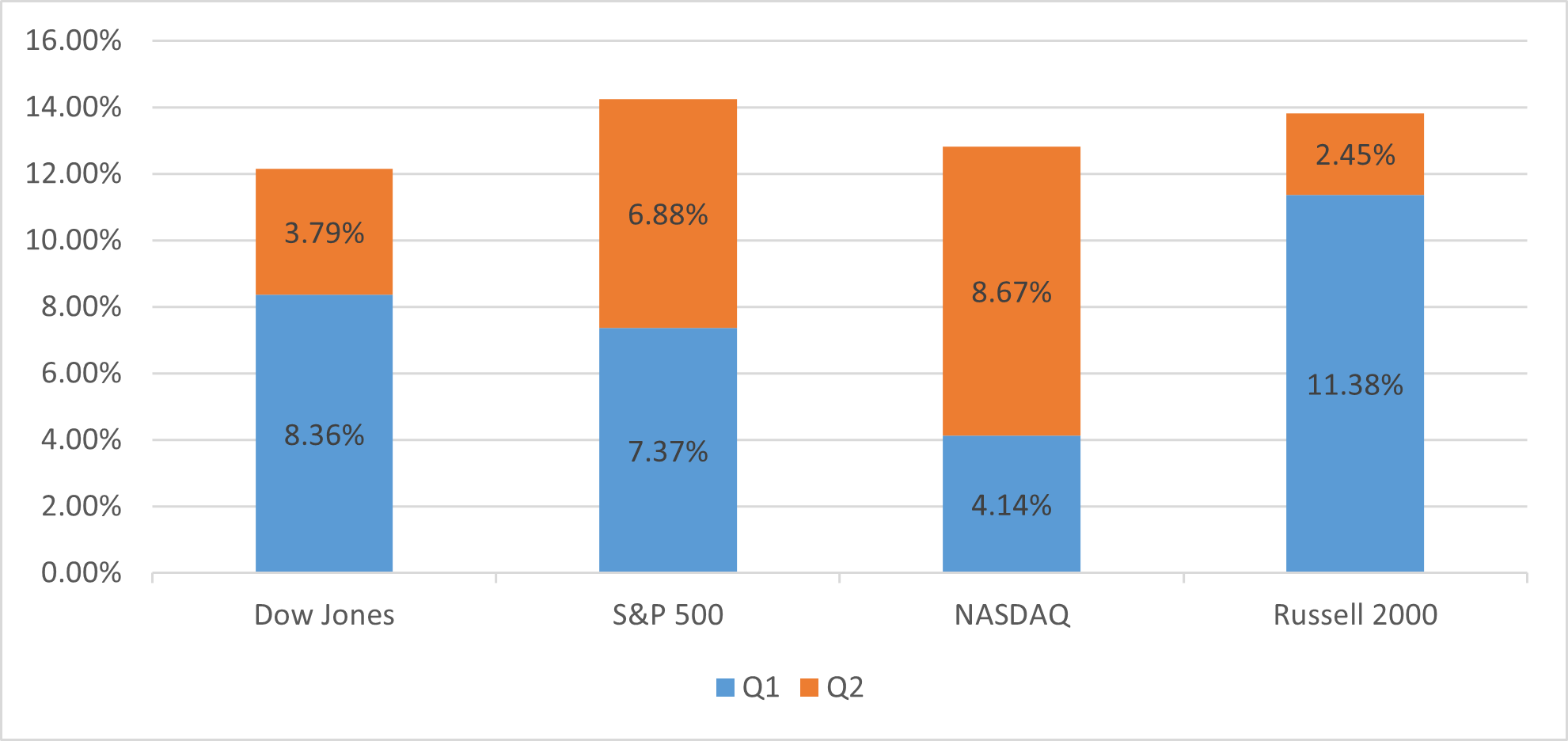
If you were looking at only the markets, the second quarter of 2021 was a stable, positive quarter. Eleven of the twelve major sectors of the U.S. stock market were up, with utilities being the only exception. However, the quarter was eventful in many ways, not the least of which was politically. The radical changes, both socially and economically, in federal policy rattled the country, but not enough to shake the markets. The four major market indexes performed as follows¹:
Market Performance by Quarter
Oil’s Acceleration
The top performing sector of the market in Q2 was technology followed by energy and healthcare; however, the overall winner so far in 2021 is energy (up 46%)². This is due to multiple factors, not the least of which is the change in presidential administrations.
When the uncertainty of Covid-19 came to America in March of 2020, oil was already on a weakened footing due to overproduction. While energy independence is good for American foreign relations, it hurt the oil market, and companies such as Exxon, Chevron, and Occidental Petroleum were beginning to develop deep financial issues. Brent Crude, which currently sits at $73.29 per barrel³, went from $51.86 per barrel to $9.12 by April 21. For one day, oil futures actually went negative. This crash in oil, combined with the pandemic, led to a very difficult time for oil companies in 2020. It has been estimated that over 100,000 oil field workers lost their jobs4. All of these indicators were leading to a slow, painful, permanent decline.
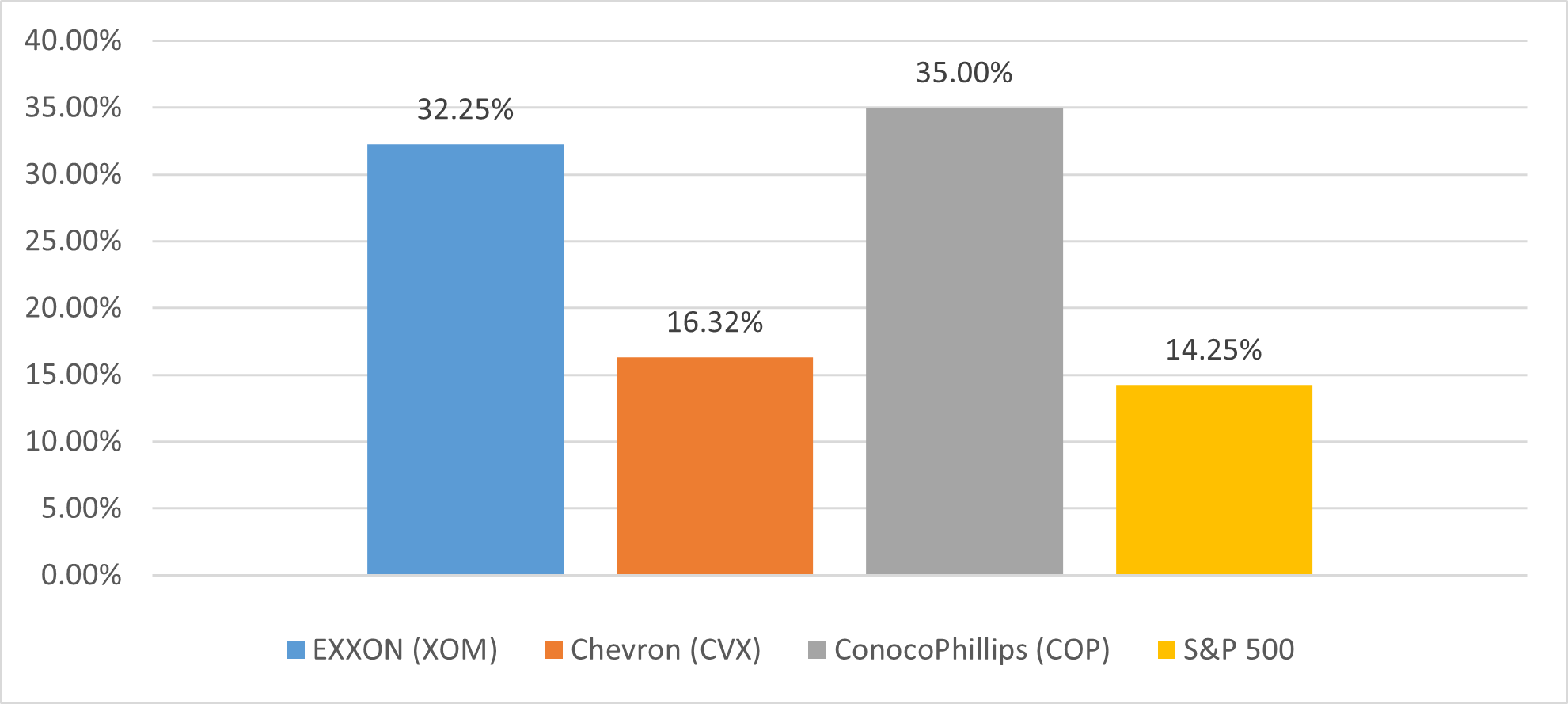
However, the new Biden administration’s anti-oil position unintentionally brought a needed change to this dire equation: decreased production. Without meaning to, President Biden’s policies of stopping the Keystone Pipeline and new drilling on government land significantly decreased the potential oil supply and fixed the supply/demand equation. With more demand brought about by increased post-pandemic openings and the stoppage of significant, additional drilling by the federal government, the oil industry’s strength is now temporarily supported. This is good news for oil investors all over the United States. Here is a chart of the performance of some of the top oil industry leaders compared to the S&P 5005:
Oil Stocks vs. S&P 500
Foreign Cyber Threats
The emergence of foreign cyber security threats against several industries has led to increased uncertainty about the security of vital industries that effect both national security and the overall economy. Foreign hackers demanding ransom attacked both the oil and meat industries. One of these ransomware attacks resulted in an almost disastrous shortage in oil on the east coast, which spiked gas prices all over the country.
Any attack in the future against critical infrastructure, could be a major blow to the economy in general and the stock market in particular. This is one of the major uncertainties facing the market for the rest of the year and the near future.
Covid-19 and Vaccinations
The Covid-19 pandemic lockdowns are almost over in the United States. With 56% of American’s partially vaccinated with one shot and 48% fully vaccinated with either two shots or the Johnson & Johnson single shot, lockdowns and restrictions are being lifted all over6. While this opening posture is not reflected in the rest of the world, the U.S. consumer has more than enough economic strength to help the U.S. economy start to recover.
Whether it is the vaccines themselves or herd immunity or that Covid-19 has simply mutated itself into a less dangerous virus, the pent up demand in the United States is enough to drive the economy into a forward motion. This momentum should continue.
Inflation
Of all of the different factors effecting today’s market and economy, the one with the most impact is inflation. Real GDP is expected by the Federal Reserve to grow 6.5% in 2021 and 3.3% in 20227. The main problem with this projection is that the Federal Reserve does not see any lasting inflation. They look at inflation in a theoretical way. To them it is just another ratio in the economic engine; they see current inflation at around 3% in 2021.
However, the CPI (Consumer Price Index) is up over 5%. This differential, “hidden inflation,” is not being looked at by governmental agencies, even though the average American consumer is feeling the rising prices immensely. Here is a sample of rising prices so far this year:
Rising Prices for 2021

While the increases in each of these categories is concerning, the increase in gas prices is the most dangerous. The projections the Federal Reserve have made for 2021 and 2022 rely on a smooth and steady increase in consumer strength and spending, but increasing gas prices effect almost every part of the economy, and while they help the oil companies, they hurt the lower and middle classes in a big way. The majority of spending in America comes from the middle class, and increasing gas prices not only reduces travel, but make every purchase more expensive. Grocery stores have to charge more for their products, airlines charge more per flight, Amazon has to charge more for each box delivered, and the list continues.
This inflation was created by the massive printing of money that no one was able to spend in 2020, and if the Biden administration continues to increase the money supply, constrict the supply of oil, and raise prices through increased regulation, then this inflation is only destined to go higher. While hyperinflation, which is usually defined as a month over month 50% or higher increase in inflation8, or higher, is not likely, inflation reaching the mid teens by next year is not unlikely.
The Markets Going Forward
So, taking all of these factors into account, what is the outlook for the stock market in 2021? Well, all of the factors mentioned above tell an interesting story that is actually good for the markets overall. While a pullback in July and October are to be expected, the market trends should continue upward, in general, by the fact that stocks are an anti-inflationary asset. When inflation begins to build, people rightfully take more cash and invest it in the stock market.
One hypothetical example would be if inflation ends 2021 at 7%. That means that $100,000 in the bank would still be $100,000, but the value of that money would only be $93,000. To counteract this, investing that same $100,000 in the stock market at a 6% rate of return would mean that the money would be $106,000 and the value would be $99,000.
In inflationary times, cash is guaranteed to go down in value while investments have a chance to counteract this decrease. This paints a questionable but hopeful picture for the stock market for the rest of 2021.
1 https://www.marketwatch.com/investing/index/SPX/charts
2 https://csimarket.com/markets/markets_glance.php?days=ytd#tablecomp
3 https://markets.businessinsider.com/commodities?op=1
4 https://nypost.com/2020/10/05/us-energy-industry-axed-107000-jobs-amid-coronavirus-crisis/
5 https://www.marketwatch.com/investing/stock/XOM
6 https://usafacts.org/visualizations/covid-vaccine-tracker-states/
7 https://www.federalreserve.gov/monetarypolicy/fomcprojtabl20210317.htm
8 https://www-proquest-com.ezproxy.liberty.edu/docview/213159292?pq-origsite=summon
Securities and advisory services offered through Sunbelt Securities, Inc. Member FINRA/SIPC. CPA and related accounting services offered through Chamberlain Financial Services are not associated with the services of Sunbelt Securities, Chamberlain Financial Services and Sunbelt Securities, Inc. are unaffiliated companies. Sunbelt Securities, Inc. does not provide tax or legal advice. Tax advice and preparation services are strictly offered by Neil Chamberlain, CPA.