

Items of Interest
- Economic Overview
- Tariff Trade War
- Government Spending and the Deficit
- The Fed’s Difficult Decision
- Immigration Update
- The Markets Going Forward
Market Overview
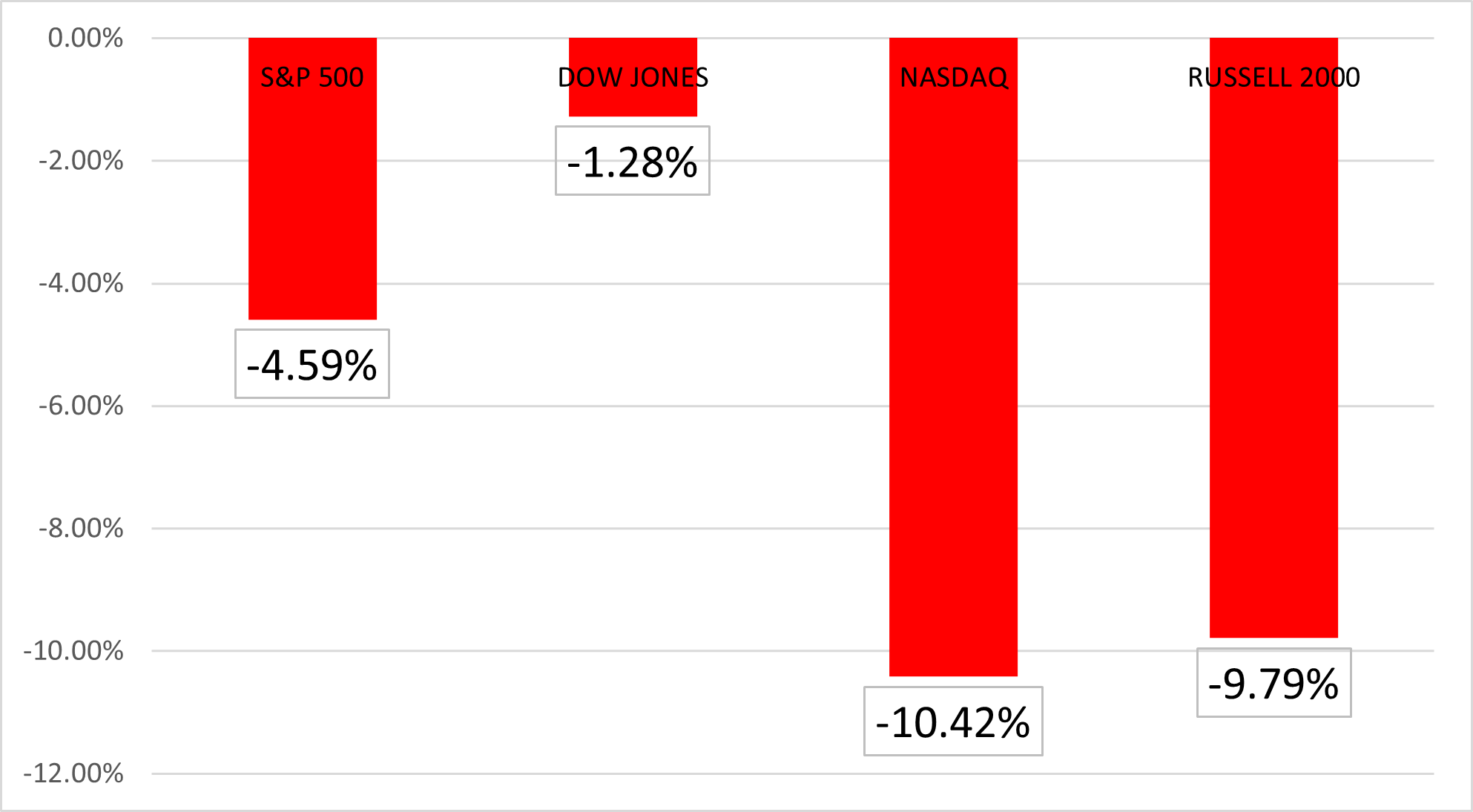
The first quarter of 2025 ended down, with all four market indices declining. The S&P 500 ended down -4.59%. Out of the twelve market sectors, eleven ended down. Consumer Staples was the only positive sector, and it was up less than 0.5%. Information Technology was the worst performing sector (-22.51%).1 The market indexes (Dow Jones, S&P 500, NASDAQ, & Russell 2000) ended as follows:2
Economic Overview
The economy in the first quarter of 2025 looked a lot like it did at the end of 2024. Inflation stayed around 3%, global tensions kept rising, and political issues continued to dominate the news.
Q4’s massive market rally was being undone quite rapidly as of March 31st. Actually, the first few days of April brought a reversal of almost all the gains of the market for the entirety of 2024. Even though the greatest market instability happened in the first part of April (the beginning of Q2) instead of Q1, the instability of the period will lead to most of this update looking at the first part of April.
The economy was fairly stable throughout Q1, with stable projected growth and a slight increase in the job market. The change in Presidential administrations didn’t really affect the economy in a measurable way. The Federal Reserve remained ambiguous, bidding its time until more information came in on prices and jobs.
Oil prices rose and then fell, leading to a fairly flat energy market for Q1. Positive forces in the economy still prevailed with the gradual decline from Q4 2024 still in effect. Consumer spending and confidence lowered slightly, but overall, the US economy and markets were alright.
That is until the end of March/beginning of April. On April 2nd, President Trump announced a massive increase in tariffs globally, a day which he referred to as “Liberation Day.” I will do a much deeper dive on the tariff debate in a bit.
Regardless of opinion and who is actually right, this announcement and further clarification has sent markets and consumers into a panic. With the stock markets entering bear market territory. This has made the economic outlook for the US in 2025 go from ok/uncertain to uncertain/negative.
But, before we move on to the outlook for the year, here is the Q1 2025 economic synopsis:
- GDP came in at 2.8% for 2024 and Q1 is forecasted to come in at 2.5%-2.8% growth.3 These numbers are annualized of course.
- Inflation, as of February 28th, stood at 2.8% year over year.4
- The Industrial Production Index increased from 102.02 in November 2024 to 104.21 in February 2025. 5
- The Unemployment Rate has remained flat at 4.2% since November 2024.6
- 456,000 full time equivalent jobs were created from January – March according to projections. This is a decrease from the same time frame in 2024, which produced 587,000 jobs.7
Tariff Trade War
Because the economic and market outlooks for 2025 and beyond have been reshaped since April 2nd, I will spend a majority of this update breaking down the tariff issue, putting aside political talking points from both sides.
The import tariffs, which are taxes applied to goods entering the country, applied on April 2nd 2025, were broad, with no country being granted an exception. More specifically, a 10% import tariff was levied against imports from all countries, with country-specific tariffs for certain nations (for example, a 34% tariff on Chinese products and around 20% on goods from the European Union). A special 25% tariff on imported automobiles and parts also took effect. On April 9th, President Trump moved all countries, except for China to a flat 10% tariff. The Chinese tariffs were raised to 125%.
But before April 9th, both sides of the tariff issue began howling their points of view. Instead of opining on all the points each side is making, let’s look at them in bullet points first:
The administration holds that the new tariff policy will:
- Reshape trade policy in favor of American interests promoting a level playing field
- Decrease the large trade deficits the United States has with many countries
- Bring leverage to the United States in geopolitical negotiations
- Boost domestic industries and job creation
- Make the United States less reliant on other countries
- Increase investment in the United States over the long term
Those in opposition hold that the new tariff policy will:
- Significantly increase prices for American consumers, including everyday items
- Put strains on business supply chains due to tariff policy uncertainty
- Result in a trade war that will weaken the United States standing in the world and hurt the entire global economy
- Dampen household spending
- Cause a pullback in investment and hiring in the United States
- Significantly increased inflation
- Cause market downturns and uncertainty
- Result in stagflation or a recession
Before looking at any of these points in detail, let’s back up and look at the big picture.
A tariff is a tax imposed by a government on goods imported into that country. They can be used for the purpose of protecting domestic industries, raising government revenue, or influencing trade policy. They are mainly used in a noncontroversial manner to prevent things like dumping (which is a company exporting a large amount of a product at a low price to undercut domestic markets). For example, this is commonly done with steel when China or Japan have exported a large amount to the United Sates at once.
The truth is no one knows what effect these tariffs will have for sure. But we can look at past examples, couple that information with the current economic and geopolitical conditions, and arrive at the most likely result.
Tariffs have been tried, to a large extent, five times in US history: The late 1800s under President McKinley, the 1930’s Smoot- Hawley Act, the 1980s Japan steel tariffs, the Trump tariffs 2018-2020, and the tariffs the administration just imposed. Of that list, only two of those times did the tariffs have any benefit. The first was in the late 1800s. This is the time President Trump cites most often. These tariffs protected small, growing industries in the United States from larger international companies. The reason not much inflation resulted from these tariffs is that in the late 1800s most people didn’t use that many imported products. The United Sates was still an agrarian society, not a commercial one. So, those tariffs and the 2025 tariffs are completely different.
Without going into detail on the other times tariffs were used, let’s simply summarize the effects tariffs typically have and the most likely outcome of the new tariffs in question now.
When a tariff is imposed, those importing the goods pay the tariff before the good is allowed into the country. The importer then (with some rare exceptions) takes the cost of the tariff and adds most of it to the end price of the good to the consumer. So, for example, if a company brings in a good from Asia or Europe that previously sold for $100, a 10% tariff would mean that the company would pay the US government $10. Then the company will sell the product for $108-$110. This shows that even though the American people aren’t directly taxed, they end up paying the cost.
When two countries get into a trade war, they keep raising the prices back and forth, going higher and higher. This is like raising taxes on their own citizens in an attempt to punish the rival nation. The result of a trade war in the long term may be a better trade deal, but in the short term, it is like an old fashioned western duel at point blank range. There are no true winners. Bringing in investment and better trade deals does little good when the economy has been severely damaged in the meantime.
Unfortunately, this is the most likely outcome of the recent tariffs. Even if the administration was able to get concessions from other countries, the damage will have been done, and it could take years to repair. The current tariffs, without a prolonged trade war, are already estimated to cost the average American household between $2,700-$5,000 per year. This will only grow as the trade war escalates.
However, while the likelihood is that the tariffs cause economic and geopolitical harm, there is one possibility where they end up being a net benefit to the United States. If the tariffs are actually a negotiating tool the President plans on using, and not keeping long term, then it is possible that the resulting trade deals will bring the world closer to a zero tariff world which would benefit everyone. With the April 9th move, this strategy is becoming more likely. But we will have to wait and see. The 90 day pause is still just a pause, however. If it doesn’t hold, massive economic trouble is back on the table.
Government Spending and the Deficit
Government spending in the United States has been a hot topic for months now, and rightfully so. Over recent decades, expenditures have consistently outpaced revenues, leading to persistent budget deficits and an escalating national debt. As of 2024, the annual federal deficit surpassed $2 trillion, which is the entire discretionary budget. To clarify, discretionary spending is everything Congress actually votes on each year, like defense, education, infrastructure, etc. Items like Medicaid, Medicare, Social Security, etc., are items that are required to be spent by law and are considered automatic.
A good example of the difference between nondiscretionary and discretionary spending is in a monthly budget. Things like mortgage/rent payments, car notes, or health insurance are expenses that are paid every month automatically, and don’t change unless you change the underlying item (i.e. sell your home or change insurance providers). These are examples of nondiscretionary spending. Discretionary spending is more like eating at restaurants or giving. These items are variable and can be cut completely when times get tough. So, the US annual deficit is equal to the entire amount of discretionary spending.
So, with this in mind, it is clear to see why cutting our annual deficit will be so difficult. Here is a chart of the $6.8 trillion annual budget for 2024. ND means nondiscretionary and D means discretionary.8
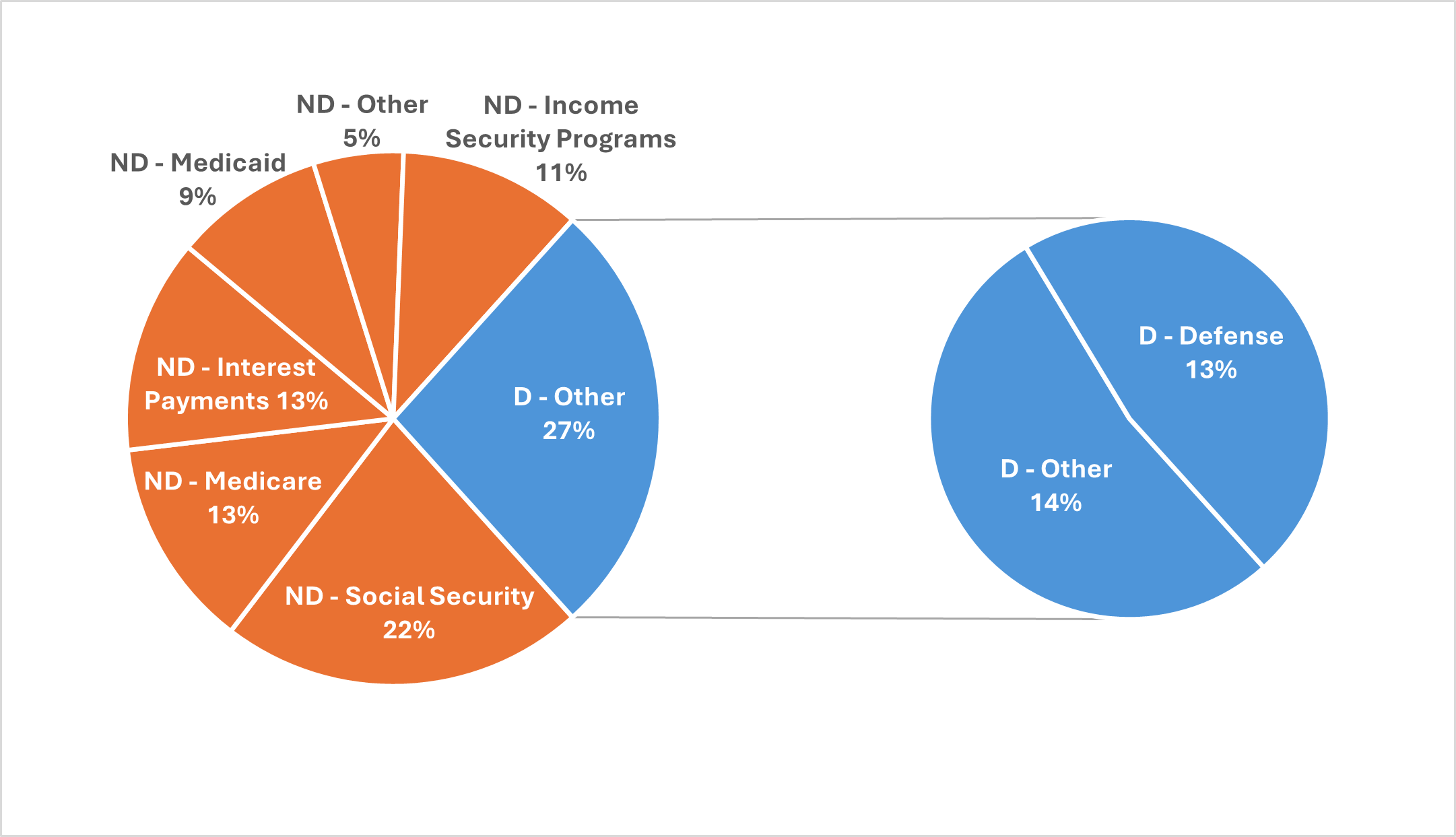
So, if politicians aren’t willing to cut the nondiscretionary budget then they will have to cut a vast majority of the discretionary budget or increase taxes. Even the now famous DOGE (Department of Government Efficiency) can’t cut enough of the budget to balance. There will have to be increases in taxes and decreases in spending to make it balance. Remember, this isn’t paying off the debt, just not incurring more. Cost cutting and tax hikes could greatly impact the economy, so this is another area that requires observation. We will watch and see what direction these efforts take us.
The Fed’s Difficult Decision
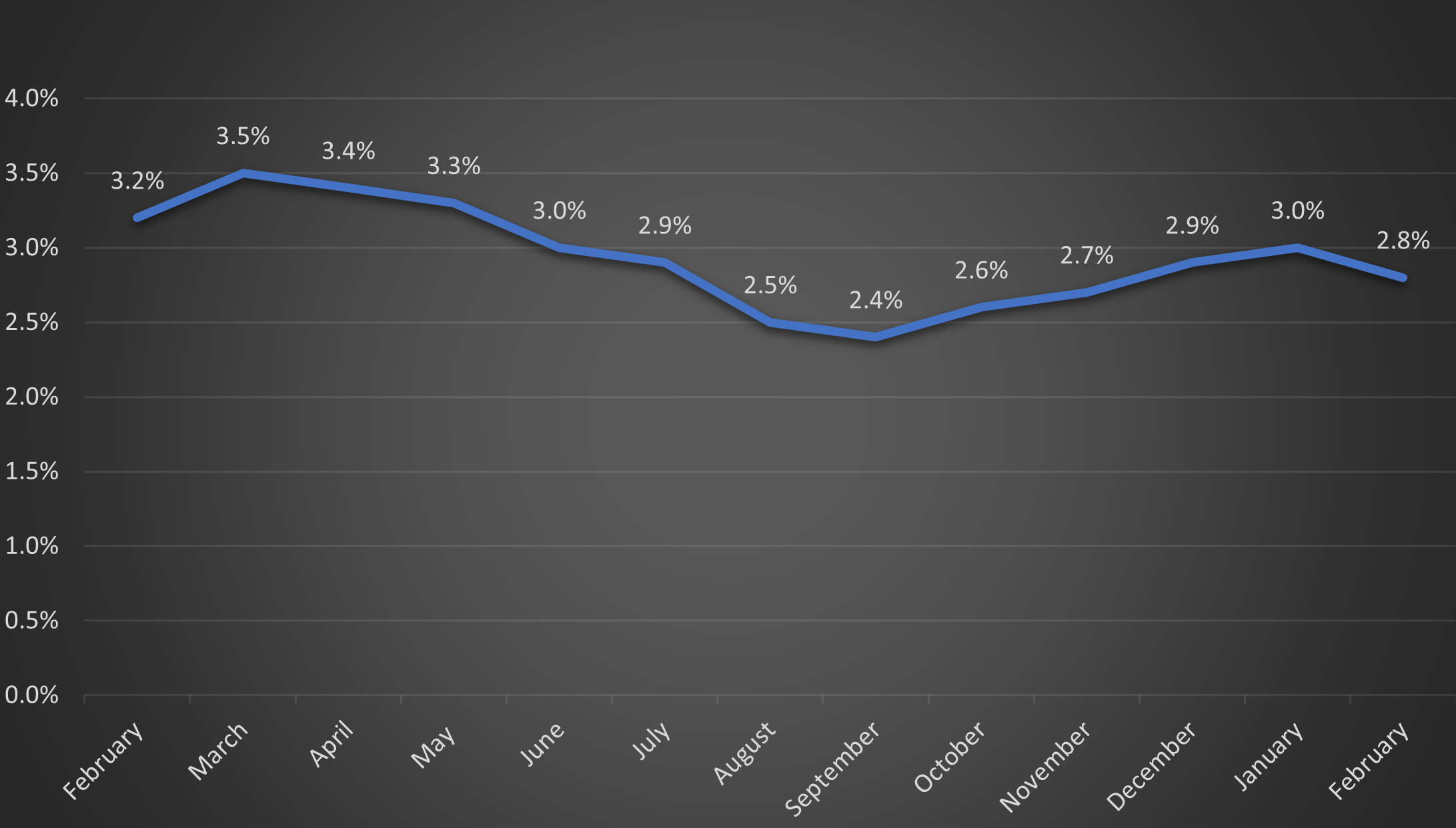
As I mentioned in the last update, Inflation decreased from its major highs a couple of years ago, but it still is stuck in the high 2% range (2.8% as of February). This is still above the Fed’s 2% target and remained problematically sticky, even before the tariffs were imposed. The computation for the Fed has taken a strange and difficult turn in the last few weeks, however. On one hand, the strong job market and higher inflation would lead to rate hikes being appropriate. On the other hand, the economy is slowing, and the new tariffs could have a majorly negative impact, even beyond time after they are lifted, if they ever are. This would lead to the need for rate cuts to spur economic activity.
Therein lies the problem the Federal Reserve has. Part of the data says they should raise and part says they should cut. Most likely this will lead to stable rates until we know whether jobs, inflation, or growth will be more negatively impacted. As of 3/31/2025 the Federal Reserve Rate remains at 4.25% – 4.5%. The future of the Fed rate for 2025 is unknown. We will have to wait and see. Remember that the Fed has the responsibility to maximize employment and bring stability to pricing in the United States. This is an extremely difficult needle to thread for the Federal Reserve, and we will see how they handle the task in the months to come. Here is a chart of inflation over the last 12 months:
Immigration Update
The Trump administration’s approach to immigration has turned out to be a dual approach: attracting affluent investors through the proposed Gold Card visa program while intensifying efforts to deport individuals with criminal backgrounds.
The Gold Card visa proposal aims to replace the existing EB-5 Immigrant Investor Program. Under this updated initiative, foreign nationals can obtain U.S. residency, and potentially citizenship, by investing $5 million directly into the U.S. government. This approach eliminates the EB-5’s job creation requirement, focusing solely on the financial contribution. President Trump has suggested that this program could generate substantial revenue, potentially aiding in reducing the national debt.9
Simultaneously, the administration has escalated deportation efforts targeting individuals with criminal records or suspected gang affiliations. Leveraging the Alien Enemies Act of 1798, the administration has deported hundreds of migrants, including alleged members of gangs like Tren de Aragua and MS-13, to El Salvador. These deportees are often detained in high-security facilities such as the Terrorism Confinement Center (CECOT).
While the deportation strategy has led to legal challenges, the administration has been largely successful in their targeted deportations. Mass deportations haven’t been attempted, so the administration’s approach to immigration has been much more nuanced and measured than many expected, seeking to balance economic incentive and national security. This balance of new immigration and deportation will be closely watched going forward.
The Markets Going Forward
Before continuing on to the items to watch going forward, let me just say that even though chaos may seem to be at an all-time high and it appears the United States is headed for an economic downturn, take a moment to remember that even though what happens in Washington or on Wallstreet may affect you, there is wisdom and strategy to help navigate through these times. Take a breath and remember that this time will pass and even a bad economy will pass. Look through the lens of history. Let’s be grateful we live in the most affluent, prosperous country in the world.
So, with all the dynamics mentioned above, the next question is: what does it look like for the markets and economy going forward? Looking at all the elements above plus the continued wars and geopolitical tensions with China and Iran, patience will be the best strategy going forward. Despite many issues, the economy is still in ok shape overall, and even if an issue comes, it will be temporary.
All these items considered, here are the factors to watch for in 2025:
- Escalating Trade War
- Continued War in Ukraine & War in Israel
- Inflation Higher Than Expected
- The Fed’s Interest Rate Path
- Rising Tensions Between China and the United States
- Uncertain Tax policy
- Geopolitical Shakeups
All these factors still paint a picture of both issues and opportunities as I have said for years. Once again, no one knows what the future holds. The theme of uncertainty from 2023 remained through 2024, but the theme for 2025 should be caution. Opportunities are still available, but they are less obvious than they were even a few months ago. Discipline, caution, and sticking to core investing principles is still the best strategy. We will see what is in store for the rest of 2025. Whatever happens, I guarantee it will be interesting.
2 https://www.marketwatch.com/market-data
3 https://fred.stlouisfed.org/
4 https://data.bls.gov/pdq/SurveyOutputServlet
5 https://fred.stlouisfed.org/
6 https://fred.stlouisfed.org/
7 https://data.bls.gov/timeseries/CES0000000001&output_view=net_1mth
8 https://www.cbo.gov/publication/61181
9 https://natlawreview.com/article/paying-green-card-gold-card-huh?utm_source=chatgpt.com
Article written by Jonathan Chamberlain of Chamberlain Financial Services an Investment Advisor Representative, holding a Series 7 and Series 66 securities license.
Securities and advisory services offered through Sunbelt Securities, Inc. Member FINRA/SIPC. CPA and related accounting services offered through Chamberlain Financial Services are not associated with the services of Sunbelt Securities, Chamberlain Financial Services and Sunbelt Securities, Inc. are unaffiliated companies. Sunbelt Securities, Inc. does not provide tax or legal advice. Tax advice and preparation services are strictly offered by Neil Chamberlain, CPA.