

Items of Interest
- Update on Oil
- Covid-19 Variants, Treatments, & Vaccinations
- Supply Chains & an Expensive Christmas
- Inflation Uncertainty
- Government Spending & Debt Default
Market Overview
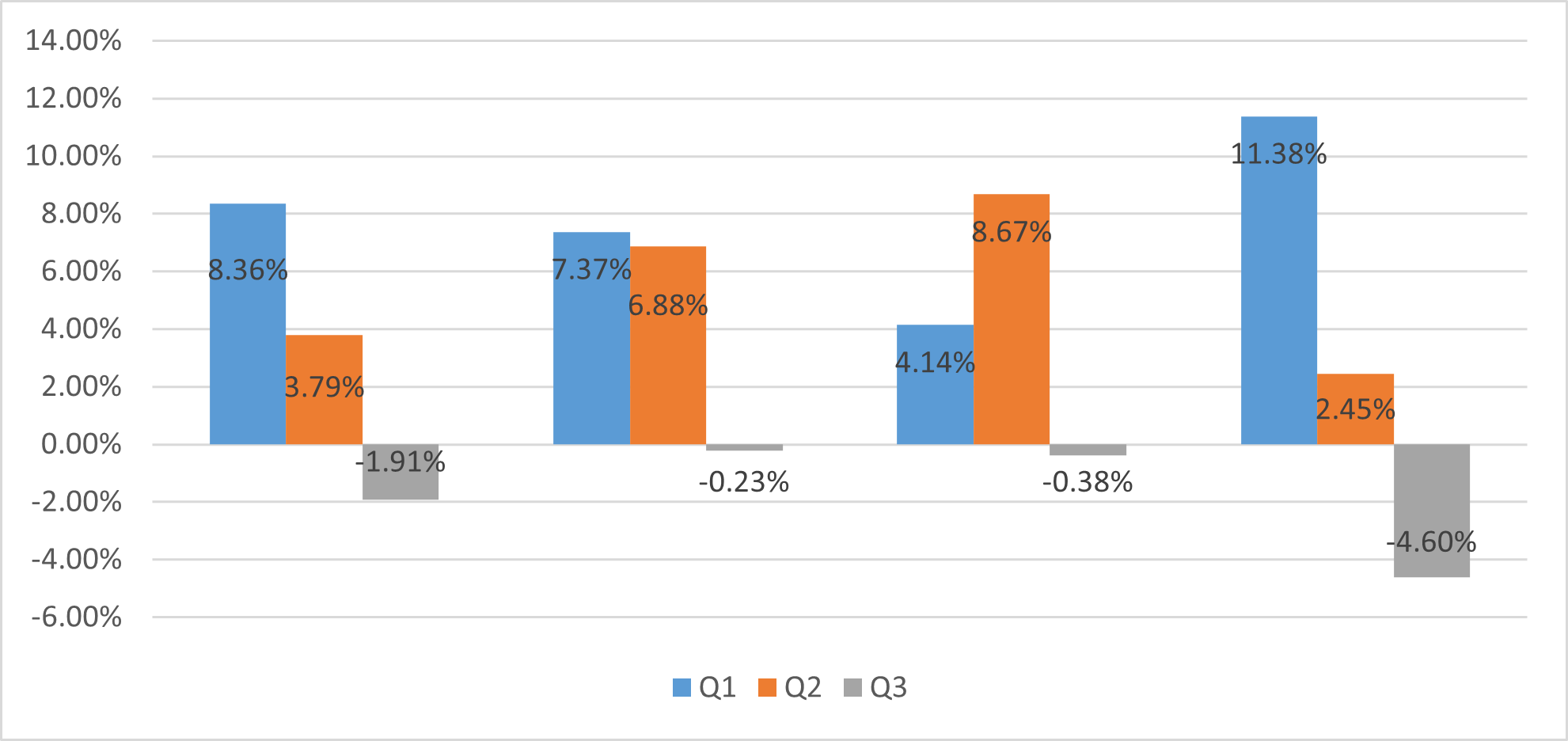
The third quarter of 2021 ended in loss for the financial markets. Only three of the eleven market sectors ended down however, with industrials being down the most. All four major indexes in the US stock market were up until September, at which time, they lost all of their gains. The Russell 2000 performed the worst. The term eventful pales to describe the turmoil of the quarter. Almost every front of politics and finance turned upside down, with the retreat from Afghanistan starting the shift. The radical changes, both socially and economically, in US federal policy continued and further escalated, but these changes still were not enough to significantly shake the markets. The market indexes (Dow Jones, S&P 500, NASDAQ, & Russell 2000) performed as follows1:
Market Indexes Q3
Update on Oil
The energy sector, and oil in particular, started to correct from its sharp run in the first half of 2021; however, toward the middle of September, political miscalculations and pressure turned the already constrained fuel supply into a fuel shortage in different countries. The largest country to feel this shortage was Great Britain. The sector is still the highest performer of 2021 thus far, and all indicators point to this trend lasting for the rest of the year.
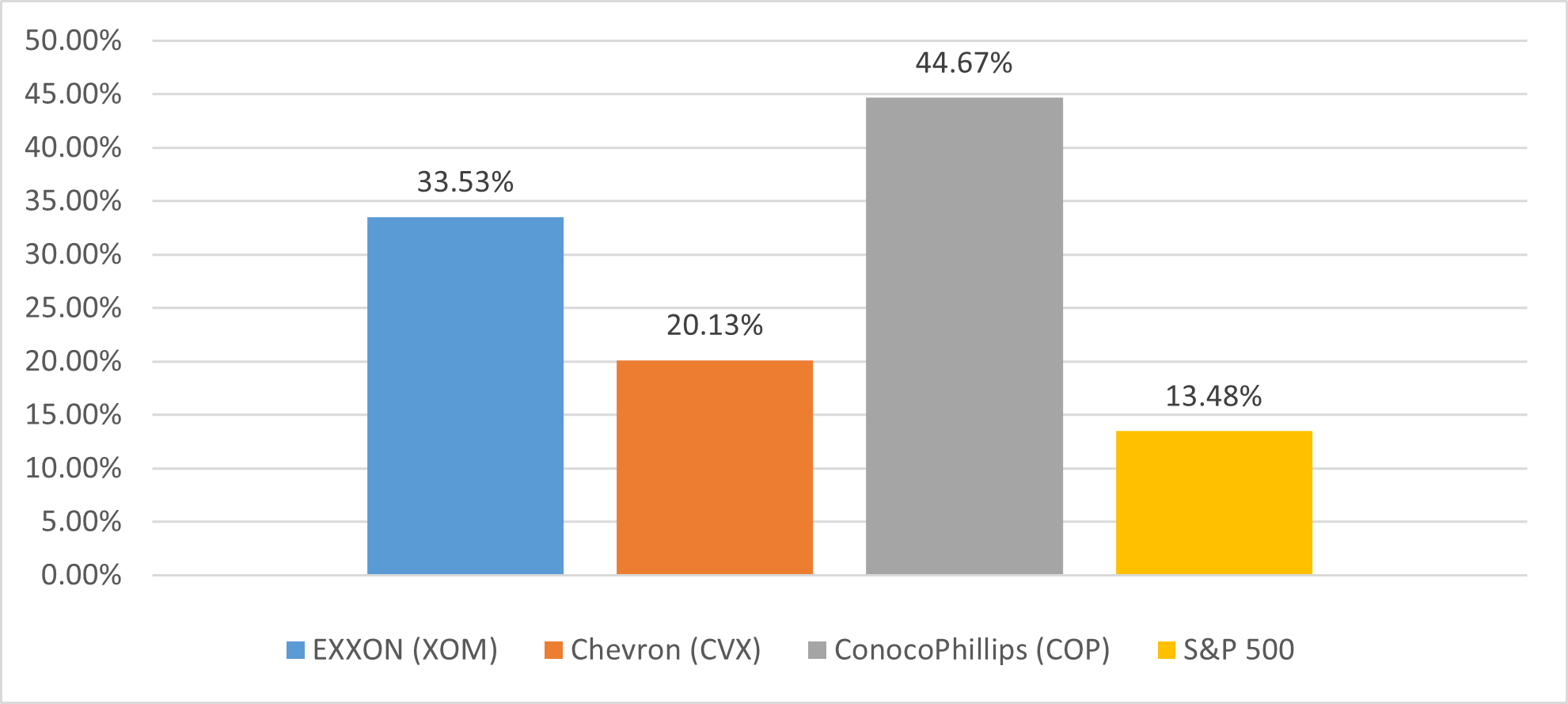
The primary reason for this is the stance of the Biden administration. The anti-oil policies of President Biden have so far been extremely consistent: return the United States to a foreign energy dependent country. This position is evidenced by the fact that he has made every attempt to limit US domestic oil production while imploring Russia and the OPEC, middle eastern countries to increase production. Even without any conflict overseas, the supply demand ratio only points to further increases in oil and gas prices. As of the beginning of October, the price of Brent Crude was around $80 per barrel. The decreased production that practically saved the oil industry at the beginning of the year is now starting to hurt the pocketbooks of citizens around the world. Here is a chart of the performance of some of the top oil industry leaders compared to the S&P 5002:
Oil Stocks vs. S&P 500
Covid-19 Variants, Treatments, and Vaccinations
Covid-19’s significant reduction in June/July was short lived. As vaccination rates continued to rise as Q3 began, the Delta variant began to emerge. Unfortunately, the vaccines developed for the Alpha variant were not very effective against Delta. Vaccination rose by the following:
- Partially Vaccinated: 56% to 64% (One Shot of Moderna or Pfizer)
- Fully Vaccinated: 48% to 56% (Two Shots of Moderna or Pfizer/One shot of JNJ)3
Sadly, the increased vaccinations did not stop Delta from spreading, and many breakthrough cases were reported. In fact, overlaying the charts of vaccination numbers and daily case numbers shows that they mirror rather than have an inverse relationship, at least through Q3.
Looking forward to Q4 and beyond, Delta is now coming under control and no other deadly variant has emerged as of the beginning of October. Basic virology teaches us that a virus becomes less deadly the longer it is around. Delta, being less deadly than Alpha from a percentage perspective, followed this pattern. So far, a variant as strong as Delta has not materialized.
The biggest threat that Covid-19 now poses to the economy and financial markets is now not a medical one; it is political. The rise of the vaccine mandate from the federal and state government level has now brought the US consumer to the edge of an economic cliff. With 30%-35% of workers unvaccinated, and 25% of healthcare workers unvaccinated4, a vaccine mandate could cause a catastrophic employment crisis. The reason for this is that a mass termination wave would cause the remaining 75% of workers to work harder. This potential burnout, along with the financial hardship being unemployed would cause on the unvaccinated, would cause a massive wave of unemployment that could reach a temporary high of 30%. This burnout is already becoming apparent in the momentous switching of jobs already occurring. It is estimated that, vaccine mandates aside, over 25% off all US workers will resign and switch jobs in 2021. This is already being called the Great Resignation.5
These mandates, however, are already being challenged by some state governments, and the issue will likely end up in front of the US Supreme Court. The Court has, thus far, rejected all of the Covid restrictions that have been brought forward. Many believe that vaccine mandates will also be struck down.
The last potential item in the Covid-19 story is that of the booster shot. The shots have only been authorized for those 65 and older and those in high risk situations.6 Hopefully the booster shot that will be administered will be effective against Delta and any subsequent variant. However, a massive rollout of said booster is not expected. It appears as though they will need to be sought out more than broadly advertised.
So, in conclusion to the Covid-19 section, if Delta continues to diminish, no new deadly variants emerge, vaccine mandates do not materialize past government rhetoric, and the booster shots do not have an adverse reaction, then the markets will be able to navigate the rest of the Covid-19 pandemic without major issues. Caution is warranted, however, if even one of these issues manifests.
Supply Chains and an Expensive Christmas
As we begin Q4, the Christmas shopping season begins. The early shoppers, that begin their shopping in October, may be the smart ones after all; everyone from company CEOs to Vice President Kamala Harris have said that if you want to be able to buy Christmas gifts, you should do it now.7 This shortage has now become such a big deal that Vice President Harris mentioned it in one of her speeches. She said, “If you want to have Christmas toys for your children it might be the time to start buying them because the delay may be many, many months.”8 This shortage is a result of the Covid caused factory shutdowns last year and a lack of factory workers globally. Also, semiconductor parts, essential elements in technology manufacturing, are in extreme shortage that is slated to last at least two more years.9 These shortages will directly impact both physical as well as online retailers. This could have a negative effect on the markets big names like Walmart, Amazon, and others. Only time will tell if these issues will be deep enough to cause these stocks to drop.
Inflation Uncertainty
Out of all of the different stories effecting the markets, one that has been less harmful than expected is inflation. Inflation is caused by too much money chasing too few goods. To break this down practically, there are three groups that are holding money right now: US consumers, financial institutions, and foreign entities. With all of the money the government has been printing, over $6 trillion in 2020 alone, if any one of these groups decides to spend their portion of the money in a significant way, the result will be skyrocketing inflation of potentially more than 10% annually. The good news for inflation is that a pessimistic feel towards the economy and the current presidential administration has stopped the US consumer from significant spending. That fact, coupled with the lack of financial institution and foreign spending, has led to a goldilocks scenario in which the government has been able to print money at an unbelievably fast rate. Inflation, according to the consumer price index (CPI), is only up 5.3% percent over the last 12 months. This is much better than anticipated.
However, if Congress continues to increase the money supply at such an alarming rate, then it is only a matter of time before inflation will go higher. While hyperinflation, which is usually defined as a month over month 50% or higher increase in inflation,10 or higher, is not likely, inflation reaching or exceeding 10% next year is not unlikely.
Government Spending and Debt Default
The last issue at hand is the one with the largest impact: government. The Congress has so far followed President Biden’s economic agenda, the main feature of which is extreme spending. In fact, if the government stays on pace, the total amount spent by the government for 2021 will reach $9 trillion.11 For a little perspective, imagine that the average family making $50,000 per year decided that they wanted to pay off the $9 trillion. If they decided to put all $50,000 of their annual income into paying for the spending it would take them 180 million years. This is just the spending for 2021, let alone all of the debt accumulated in previous years and future spending. Backing up to see a more reasonable example, what if every man, woman, and child in the US were to come together equally to pay off the $9 trillion. The resulting bill would come to $28,755 dollars per person.12 Once again these numbers are just for this year’s spending alone.
But the more immediate government threat to the financial markets is that of the impending debt default. The way the government has borrowed money for decades is to go through a process that has become known as raising the debt ceiling. According to the Government Accountability Office, “Congress and the President set a single limit on the amount of debt the Department of the Treasury (Treasury) can issue, creating the debt ceiling. This provides the Treasury with the flexibility that it needs to manage federal debt on a day-to-day basis within this overall limit. However, the debt ceiling does not control the amount of debt. Instead, it is an after-the-fact measure that restricts the Treasury’s ability to borrow to finance the decisions already enacted by Congress and the President. Delays in raising the debt ceiling can disrupt financial markets, increase U.S. borrowing costs, and threaten the full faith and credit of the United States.”13 The average citizen doing this would be like them buying items on their credit card and then being allowed to raise their own spending limit on that card indefinitely. The government has raised the limit and spent the limit so many times, that taxpayer dollars are now only a section of the monetary intake. Borrowing and printing money together have now become the biggest monetary intake as of late.
Every few years the Congress has to officially vote to raise the debt ceiling, and now (October of 2021) that time has come again. However, the US Senate is now divided 50-50 Republican and Democrats. The Republicans have said they will not raise the ceiling in an attempt to stop the runaway train of government spending. And, if the Democrats do not use the budgetary reconciliation process, then the debt limit will be reached by approximately October 18 and the treasury will be forced to begin to default on some of the treasury bonds that mature on that date.14 Analysist and investors alike are unclear if the default will happen; and if the default does actually occur, a worldwide recession could follow since US bonds are the base of international financial transactions. Will this default happen? The answer is truly: I don’t know.
The Markets Going Forward
So, taking all of these factors into account, what is the outlook for the stock market for the last quarter of 2021 and the start of 2022? Well, here are the factors to be watched:
- The Delta Covid-19 variant
- The Emergence of Any New Deadly Covid-19 Variants
- Vaccine Mandates
- Covid-19 Booster Shots
- Supply Chain Constraints
- Increased Inflation
- Continued Exponential Government Spending
- Potential US Debt Default
This list is very long, and to be honest, does not paint a good picture for the stock market in the coming months, with the exception of the semiconductor segment. If all of the eight points above go in a favorable direction, then the economy, as well as the markets, can grow. But this will be a tall order.
One example of the pressures these issues place on the market is that of a football player. Imagine you are a player running with the ball down the field toward the end zone. But, while you are running, an opposing player comes behind you and tries to push you to the ground. You, like the U.S. stock market, are very strong, so you can resist the onslaught. The question is how many of the eight opposing players can you handle before you get pushed to the ground? The answer to that question is the answer to the question of how much can the market handle and still grow.
The major item that is the markets favor at this time is stocks are an anti-inflationary asset. This means that when inflation begins to build, people rightfully take more cash and invest it in the stock market. If economic times get difficult and inflation abounds, cash is guaranteed to go down in value while stocks have a chance to counteract this decrease. These problems and opportunities together paint a questionable picture for the stock market for the rest of 2021. We simply hope the problems looming over the economy do not materialize.
1 https://www.marketwatch.com/investing/index/SPX/charts
2 https://www.marketwatch.com/investing/stock/XOM
3 https://covid19.healthdata.org/united-states-of-america?view=vaccinations&tab=trend
4 https://www.webmd.com/vaccines/covid-19-vaccine/news/20210628/huge-number-of-hospital-workers
5 https://www.forbes.com/sites/glennllopis/2021/09/22/the-great-resignation-is-not-new-but-your-response-to-it-must-be/?sh=ddddd03897de
6 https://www.cdc.gov/coronavirus/2019-ncov/vaccines/booster-shot.html
7 https://www.cbsnews.com/news/holiday-shopping-shipping-delays-supply-chain-ups/
8 https://www.realclearpolitics.com/
9 https://www.washingtonpost.com/technology/2021/04/13/intel-ceo-semiconductor-chip-shortage/
10 https://www-proquest-com.ezproxy.liberty.edu/docview/213159292?pq-origsite=summon
11 https://nationalinterest.org/blog/reboot/us-government-spending-track-top-9-trillion-2021-177344
12 https://www.cnbc.com/id/46372422
13 https://www.gao.gov/blog/federal-debt-has-reached-its-ceiling.-what-does-mean
14 https://www.bloomberg.com/news/articles/2021-10-04/doomsday-clock-for-u-s-debt-ticks-with-no-congressional-plan
Securities and advisory services offered through Sunbelt Securities, Inc. Member FINRA/SIPC. CPA and related accounting services offered through Chamberlain Financial Services are not associated with the services of Sunbelt Securities, Chamberlain Financial Services and Sunbelt Securities, Inc. are unaffiliated companies. Sunbelt Securities, Inc. does not provide tax or legal advice. Tax advice and preparation services are strictly offered by Neil Chamberlain, CPA.