
Items of Interest
- Energy Takes the Top Spot
- Covid-19 Deceleration & Vaccination Changes
- The Change in Employment Standards
- Inflation and the Federal Reserve
- Government Spending Curbed
- Nvidia and the Omniverse
Market Overview
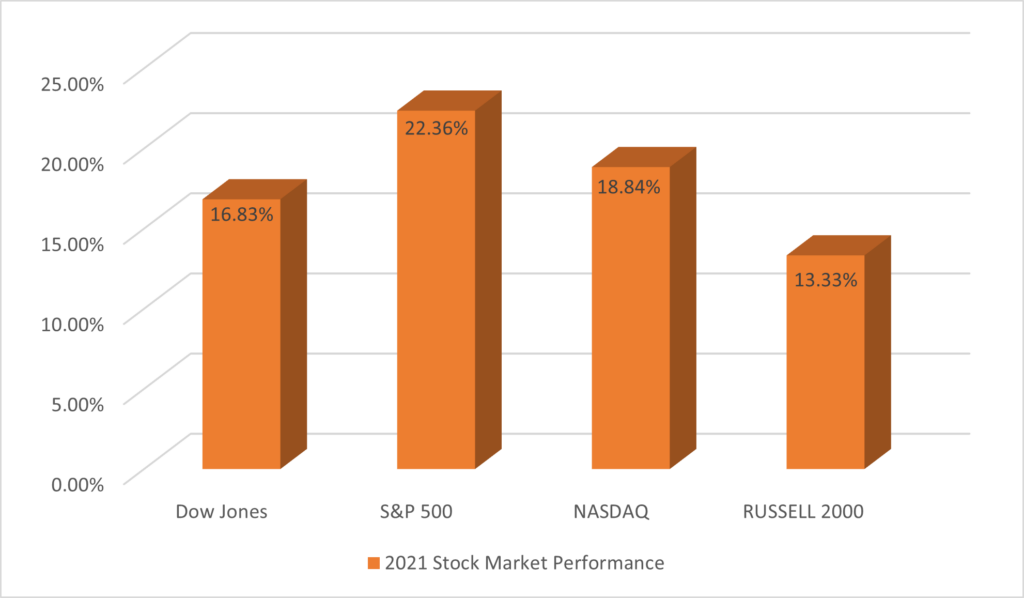
The fourth quarter of 2021 ended in gains for the financial markets. All eleven market sectors ended up, which is a rare occurrence. All four major indexes in the US stock market were up as well; however, the Russell 2000 small cap index was the worst performer for the quarter, only gaining 0.16%. In a strange turn of events, the S&P 500 outperformed both the Dow Jones and the NASDAQ. This has not happened in some time and can be attributed to the major gains in a few of the S&P 500’s names (i.e. Moderna, Nvidia, Ford Motor Co., Devon Energy Corp., etc.) The radical changes, both socially and economically, in US federal policy continued but were starting to be mitigated by December. This is especially due to the split US Senate. The market indexes (Dow Jones, S&P 500, NASDAQ, & Russell 2000) ended 2021 as follows¹:
Market Performance by Quarter
Energy Takes the Top Spot
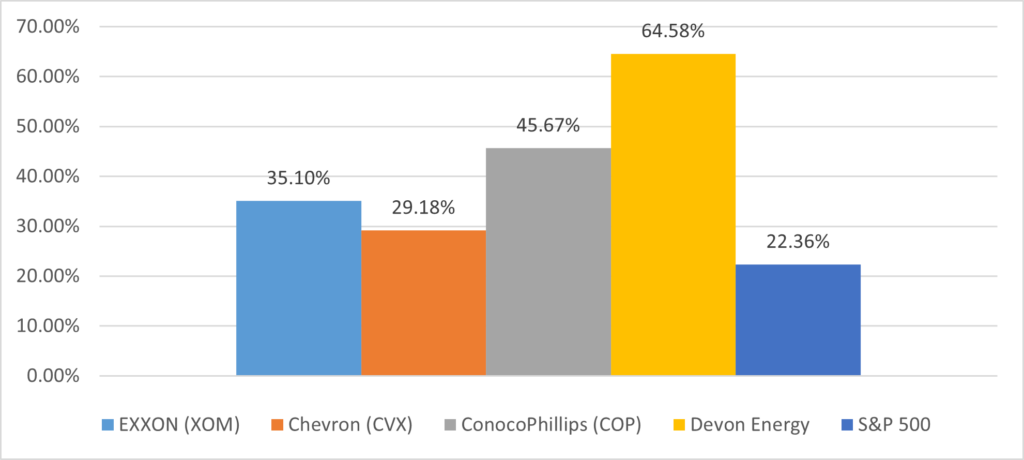
The energy sector ended 2021 as the top performing market sector, up over 55%. The second and third quarter slumps in oil stocks did not deter fourth quarter traders since the political games and international pressures created an environment where it will be difficult for the price of oil to maintain any significant drop. This is largely due to the fact that the Biden Administration has maintained its anti-oil stance, even in the face of economic and political pressures. The President has continued to limit US oil production while still petitioning Russia, OPEC, and other middle eastern countries to increase production. Even without any conflict overseas, the supply demand ratio still only points to further increases in oil and gas prices as was the case at the end of the third quarter. As of December 31st, the price of Brent Crude was still hovering around $80 per barrel. The decreased production that drastically helped the largest oil companies has now fully trickled down to American citizens, with gas prices around the nation up over 58% since December of 2020. This works out to an average price per gallon of $3.50 across the country. Here is the performance of 5 top oil industry leaders compared to the S&P 500 in 2021:
Oil Stocks vs. S&P 500
Covid-19 Deceleration & Vaccination Changes
The Covid-19 Delta variant kicked off a fourth quarter of higher infection rates that surged a second time with the Omicron variant. Vaccination rates began to slow as Q3 ended but swiftly picked up when the boosters became available, and Omicron started to impact the US. Unfortunately, the vaccines developed for the Alpha variant in 2020 have almost no efficacy in their battle against Omicron’s transmissibility. The good news for the country, and world in general, is that Omicron seems to be signaling the degrading of Covid-19 back to its roots as the common, summer cold. This drastic mutation is most likely the reason for the vaccines lack of efficacy. This change did not pause vaccination efforts; however, since vaccinations rose by the following by the end of 2021:
Partially Vaccinated: 64% to 74% (One Shot of Moderna or Pfizer)
Fully Vaccinated: 56% to 63% (Two Shots of Moderna or Pfizer/One shot of JNJ)
Hopefully this is the last quarterly update in which Covid-19 will hold a significant place but, no one can say for sure.
Before moving on from Covid-19 and Omicron, it is important to stop and take note of what the future of the Covid-19 vaccines looks like, as well as their origin. The near 0% efficacy of all of the vaccines against the transmission of Omicron has started to turn the conversation away from the term vaccine and more toward a simple shot, like the flu shot. Many doctors believe that by next year, a Covid-19 shot will be offered at the same time as a flu shot with around the same effectiveness. Hopefully the lessons, both social and medical, learned from the Covid-19 pandemic will be remembered in the years to come.
We must keep in mind that the scientific discoveries and technologies of today, may be used as the medical treatments of tomorrow. The Covid vaccines were begun to be researched in 2016 but the funding dried up until the emergence of Covid-19 in 2019. Every investor should now be looking to future medical technology through the lens of Covid-19. Hopefully the next time these technologies are needed they will be given more time for research and will not be brought into the political arena. The good news as far as Covid-19 is concerned is that Omicron can only spin off an even less deadly variant than itself. This is very encouraging.
The Change in Employment Standards
The stay-at-home orders that began in 2020 are still causing disruptions at the beginning of 2022; however, this is not reflected in the unemployment numbers. When workers deemed nonessential were let go from their jobs or quit, the unemployment rate went from 3.5% in January 2020 to 14.8% by the end of April with over 23,000,000 filing for unemployment according to the Bureau of Labor Statistics. This is what you would expect to see result from the largest economy in the world being shut down. The issue with the unemployment numbers is not in the spike, but with the equally drastic recovery.
According to the data, the unemployment rate is now back down to 4.2% with only 6,900,000 people in the unemployment system. At the same time, over 11,000,000 jobs are available across all industries. This means that if every person on the unemployment roles got a job, there would still be 4,100,000 job positions unfilled. So, how did the unemployment rate drop so fast? And how are there so many more jobs available than people willing to take them? The answer is found in the labor participation rate. 25 years ago, 67% of people in the United States eligible to work were working. Once Covid-19 hit in March 2020, that number, which had already been on a decline, fell to 60%.
Labor Participation Rate (25 Years)
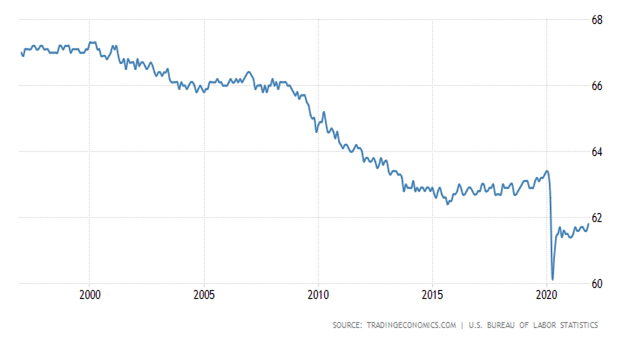
The issue is that across all working demographics, the participation rate went down but has only made-up half of its losses as evidenced by the chart above. This is partially due to Covid-19 uncertainty, but the biggest factor is not statistical. It is social. The social environment of 2020 can only be described as toxic in every way. This toxic environment gave people the excuse they needed to stop work for a myriad of reasons. In today’s society, living your best life, retiring as early as possible, and experiencing everything possible, are the slogans and attitudes our culture lives by. Who hasn’t heard of YOLO (You Only Live Once) when a friend or coworker wants to make a poor financial decision? This has led to a dangerously low labor participation rate that is not reflected in unemployment. The reason for this is that if someone stops looking for work, they are taken out of the unemployment statistics since they have “dropped out” of the work force. People, especially those in the 55+ age bracket, have decided, not to retire early, but to live on their savings until they run out and are forced to return to work. This is a category of people that are not working, but do not fall into the unemployment statistics. This shows the issue in our culture that must be addressed before our economy can ever truly grow.
The United States operated on a Christian economic ethic for over 200 years. This ethic could be characterized as pro-saving, pro-growth, and pro work. Sadly, the US has now begun to work under the european economic model. This model only focuses on growth, but rarely gets it since the underlying economy is not focused on work or saving. This is indicative of a long-term economic change that will only be righted by a cultural shift that once again focuses on helpful innovation (not just the latest streaming service) and technology with an emphasis on entrepreneurship. I believe that this shift will only happen at the cultural and spiritual level, and I hope this shift will come about. If not, growth will only come at the expense of soaring debt and long-term inflation. This is something to watch out for in 2022.
Inflation and the Federal Reserve
One of the top economic stories followed in 2021 was inflation. By the time December’s numbers are added to 2021’s numbers, the inflation rate for the year will most likely end at somewhere between 7.2-7.5%. This is over a 40 year high, and really hurt consumers in 2021. Every product and service seemed to go up in price, especially gasoline. The good news in the short term is that this rate should be lower in 2022, closer to 5.5%. The long-term issue is that many predict inflation of over 4.8% for the next ten years. This could be a major issue if not addressed.
The Federal Reserve saw the weakness in the economy last year caused by the Covid-19 shutdowns, and its response was to leave interest rates pegged between 0.0 – 0.25%. This allowed companies to continue borrowing money inexpensively, which kept the economy artificially inflated. Now that the vaccine mandates appear to be close to being struck down by the courts and inflation is about to get out of hand, the Fed has signaled that they will begin aggressively raising rates in 2022. This is good news for the economy since long term inexpensive debt is partially what has brought the economy to the shape it is in now. Hopefully the Fed will hold to this policy, and this will tame both wild borrowing and inflation at the same time.
Government Spending
The severe increase in government spending has not changed since my last quarterly update; however, one positive shift has emerged: the defeat of the Build Back Better Bill. This is good news for the economy in several ways from lowering 2022’s inflation possibilities to not increasing government’s size, and many more reasons. The inevitable political shift in both the US House and Senate should also keep largescale spending down since 2022 will be filled with nonstop campaigning from both sides. 2022 Should be much less expensive than 2021 in this regard.
Nvidia and the Omniverse
One of the most interesting stories in the market is not politics, not the federal reserve, not supply chain issues, it is the Omniverse. The Omniverse is a digital replication of the world. Let me explain it this way: imagine you are playing a computer game. Your character is exploring and interacting with objects in this virtual world, and you control that character. This is the traditional, virtual environment. The Omniverse is essentially the same except that you are now that character. Through virtual reality devices, you can be meeting someone in a coffee shop in London or walking on the beaches of Bora Bora. While the technology does not yet exist to make the experience touch enabled, you will be able to see everything like you were actual in these places. This is different from the metaverse, which is an attempt to create a different realty. The metaverse is a consumer experience mainly promoted by Facebook (whose name is now META non coincidentally) while the Omniverse is a duplication of the real world. The Omniverse technology is mainly led by the tech company Nvidia, and the technology has many amazing benefits in real life. Picture a car manufacturer that is about to build a factory. What if this company could duplicate this factory in the Omniverse to minimize waste and create the perfect assembly line? I believe this technology is going to dominate the business world’s tech discussion for many years to come, and Nvidia is at the forefront of the technology in 2022. This subsector of the technology market sector should be watched carefully with much expected growth.
The Markets Going Forward
So, taking all of these factors into account from 2021, what is the outlook for the stock market for the first quarter of 2022 and beyond? Well, here are the factors to be watched:
- Covid-19’s deceleration
- Vaccine Mandates
- Inflation
- Mid Term Elections
- Employment Numbers
- Rising Interest Rates
- The Federal Reserve
The list has significantly changed since the end of Q3, but this is a good sign. The vaccine mandates that loomed ominously over the economy appear to be on their way out the door, courtesy of the Supreme Court. This is not guaranteed but is extremely likely. Even if the Supreme Court does allow the mandates, political mid term election pressure will most likely cause their demise.
Covid-19 in general, is being considered in decline all over the country. The good news is that even if another contagious variant comes along after Omicron, the death rate should not meet 2021’s level. My view on Covid for the markets and the economy is that most of the damage should be in the rearview mirror.
Inflation, which should end the year north of 7.2%, is still a problem for the economy, but looks to be digested from the equity market’s perspective. Inflation has been and will continue to cause harm to the broader economy, but a change in government and the Fed tightening monetary policy should really help by the time 2022 ends. Now, as far as the mid term elections go, the question at this time appears to be, not whether Republicans will take back the House and Senate, but by what margin. A conservative estimate is 40-50 seats in the House and 2-3 Senate seats. This estimate, which most likely will end up being exceeded, will cause the government to go into a 2-year gridlock. Gridlock is investors’ favorite type of government since laws and regulations will be relatively stable until 2025.
The employment numbers mentioned earlier need to improve; however, for the economy to regain long term strength. This is one of the shifts that needs to happen and is frankly the most needed. On the short term, rising interest rates will help inflation and stabilize an economy that is beginning to run hot on debt fueled growth. This will most likely cause a slowing of GDP growth in 2022, but it will be real growth, not unsustainable spending.
The major item in the market’s favor at this time is still that stocks are an anti-inflationary asset. As inflation continues to build, investors rightfully take more cash and invest it in the stock market. If inflation continues at elevated levels, cash is guaranteed to go down in value while stocks have a chance to counteract this decrease. These changes in the economy, politics, and stock market paint a surprisingly improved picture for the stock market for 2022 as opposed to the end of 2021. More specifically, look for companies with lower debt loads, high sales growth, and new opportunities to do very well this year. Some key sectors to watch still include energy and semiconductors while bonds will not thrive in an environment of raising rates. We must see what the year holds, but prospects are bright for the stock market.
1 https://www.marketwatch.com/investing/index/SPX/charts
2 https://www.marketwatch.com/investing/stock/XOM
3 https://covid19.healthdata.org/united-states-of-america?view=vaccinations&tab=trend
4 https://www.nbcnews.com/health/health-care/scientists-were-close-coronavirus-vaccine-years-ago-then-money-dried-n1150091
5 https://www.google.com/search?unemployment+rate
6 https://tradingeconomics.com/united-states/labor-force-participation-rate
Securities and advisory services offered through Sunbelt Securities, Inc. Member FINRA/SIPC. CPA and related accounting services offered through Chamberlain Financial Services are not associated with the services of Sunbelt Securities, Chamberlain Financial Services and Sunbelt Securities, Inc. are unaffiliated companies. Sunbelt Securities, Inc. does not provide tax or legal advice. Tax advice and preparation services are strictly offered by Neil Chamberlain, CPA.