

Items of Interest
- Internal Crash
- Energy Takes the Top Spot Once Again
- Growth VS. Value
- The War in Ukraine
- Reopening After Covid
- Inflation and the Federal Reserve
- Midterm Elections
- Economic Uncertainty
Market Overview
The first quarter of 2022 was extremely volatile and ended in losses for the financial markets. Nine out of the eleven market sectors ended down, with energy and utilities being the only exceptions. All four major indexes in the US stock market were also down, with the NASDAQ index being the worst performer for the quarter, ending -9.08%. The market indexes (Dow Jones, S&P 500, NASDAQ, & Russell 2000) ended as follows[1]:
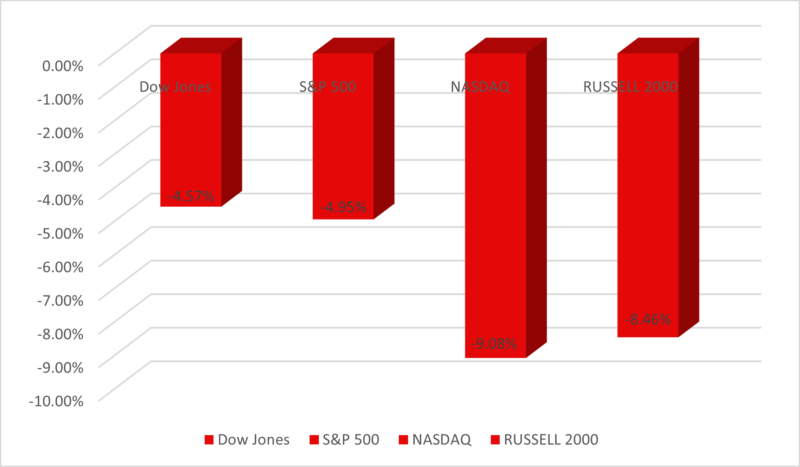
However, these numbers are a significant improvement in comparison to losses experienced by March 14th. At that time the S&P 500 was down 13% and the NASDAQ was down over 20%. This coincided with the spike in oil and commodity prices as well as the beginning of the invasion of Russia into Ukraine. All four indexes did rally significantly, retracing their losses by over 60%.
Internal Crash
Before moving on to investment news and sector analysis, it is important to note the strange nature of the market sell off this year. While the Indexes struggled, many stocks inside actually crashed. For instance, high priced technology stocks like Zoom, Snowflake, DocuSign, and PayPal were down over 50% by March 14th. This is a strange divergence lower than the rest of the NASDAQ and has indicated a shift in investor sentiment. The reason that the indexes did not show these losses is that the bigger, more profitable, financially stable companies did not sell off because the fundamentals of companies were more important than the promises of future growth.
Energy Takes the Top Spot Once Again
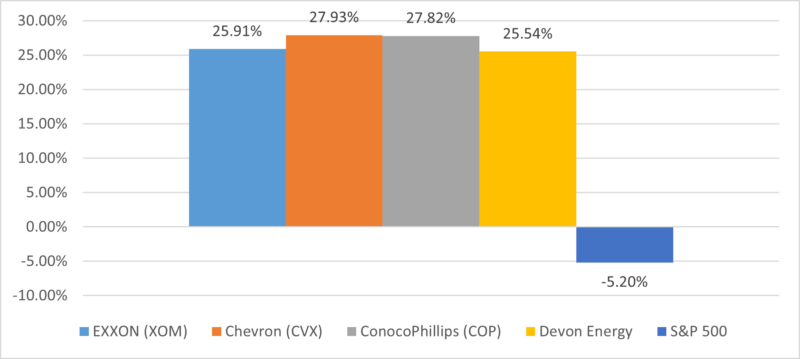
Once again, energy was, by far, the best performing market sector in Q1, up over 25%. These gains came on the back of an outstanding year for energy and was only accelerated by the war in Ukraine. Last year the theme for energy was all about domestic politics and the deemphasizing of oil by the Biden administration. However, after Russia invaded Ukraine, the price of oil momentarily rose to $130 per barrel after the United States stopped buying 500,000 barrels of crude oil per day from Russia that supplied the Boston area and some of the northeast. Once the price of oil maintained above $120 per barrel for a couple of weeks the administration first went to Saudi Arabia and requested them to increase their oil production to fill in the gap. After the Saudi’s refused, the Biden Administration released oil from the strategic reserve, which caused a reduction in oil and gas prices for a couple of days. After the effects of the release wore off, the Administration then went, quietly, to the American oil companies and requested that they drill more oil on the leases they were already granted. The oil companies, who have been enjoying high profits over the past year, declined. The reason for this is that once a company starts the drilling process, it is at least a year before the well in question is producing oil at a commercial level. The companies believe that if they begin drilling now, they will be producing oil when the prices are reduced from where they are now. Also, the oil companies are relishing the opportunity to put so much pressure on the Administration that they change their anti-oil stance.
After running out of options, the Biden Administration has announced it will release a million barrels of oil per day into the American supply for 6 months[1]. The United States consumes approximately 19.75 million barrels per day, so this release will bring down the price of gas in the short term. This move is somewhat desperate and is most likely a response to critics before the midterm elections in November. This news did bring down the price of oil to end March at $105 per barrel. The problem is that only so much oil can be released from the reserves before needing to be bought back. So, the outlook for oil is a few months of reduced prices, assuming no new developments in the Ukraine conflict or trouble with China, followed by another spike in prices once the reserves start to be refilled. It will be interesting to see how President Biden will handle this second round of price increases after the price of gas has already risen 79% since he took office. This works out to an average price per gallon of $4.25 across the country. Here is the performance of 5 top oil industry leaders compared to the S&P 500 thus far[2]:
One final note on energy is that even if the Keystone Pipeline were started back and the oil companies decided to begin drilling increases, no new oil would be on the market for a year. This means that gas energy prices, across the board, will remain elevated for at least the rest of 2022.
Growth Vs. Value
Even with the markets in turmoil, one theme has stood out above the rest. It is not the Federal Reserve’s change in policy or the end of the pandemic, it is the change in market sentiment from growth to value. For the last decade, growth stocks (stocks that grow based on future projections and not current valuations) have significantly over performed value stocks (stocks that are less risky due to their higher relative profits and lower price to earnings multiples[1]. This has led to arguably over valuated companies, and when companies remain overvalued for too long, they will eventually correct downward. This is what happened in Q1, with overvalued tech stocks crashing, some over 60%. The higher quality, income producing companies did not take these drops, however. This is a significant change and is a good sign for the market going forward. When the stock market only values the future at the expense of earnings, it is unsustainable. Hopefully this change will bring a much needed balance in the stock market that will reduce volatility and bring expectations to a reasonable level for the foreseeable future.
The War in Ukraine
The most important event in the entire quarter was hands down Russia’s invasion into Ukraine. Although the slow buildup of Russian forces on the Ukraine boarder was a telling sign, no one expected President Putin to order a massive invasion into the second largest country in Europe. While the attack is atrocious and world changing, let’s focus on the global economic impacts. The first and largest problem created is not that of the spike in oil prices, it is that Ukraine produces nearly 12% of the worlds food, with wheat being the main export[2]. This means that food prices, especially products made with wheat and other produce will skyrocket in price this year since the invasion has stopped Ukrainian farmers from planting their crops. This will affect every country, but the biggest pain will be felt by the poorest nations, especially those on the African continent. Sadly, what Americans will feel as a shortage will be a famine in other countries. This alone will increase inflation worldwide, causing economic slowdown.
Without taking the time to go through all of the issues caused by the Ukraine conflict, let it suffice to say that the conflict will cause an economic downturn for the entire world regardless of the outcome of the conflict. However, if the Ukrainians either win the war outright or Russia pulls out of the country, the economic and food problems will be less severe. Every day that goes by with the conflict still raging is one step closer to an economic slowdown in the US and a recession in many other less stable countries. This war will dominate both the political and economic story for many months to come. I pray that the Ukrainians win quickly for the sake of the entire world.
Reopening After Opening
One bright spot that stuck out in a very negative quarter is that of the ending of the Covid19 Pandemic. Covid finally appears to be returning to the summer cold that it was before 2019. This is evidenced by the reduced death and hospitalization numbers being reported. However, more importantly, the extreme politics that surrounded the pandemic are starting to wane. Restrictions are being lifted all over the world and the United States, and this is a great change for business and the economy in general. However, since some states lifted restrictions before others, this opening may not result in the economic boom hoped for since it was a slower state by state process instead of a unified opening. Hopefully Covid19 will not be significant enough to be worth mentioning in the future as it appears a yearly shot will be available, like the flu shot, for those that want it without political pressure. Hopefully the social and medical lessons, learned from the pandemic will be remembered and taken to heart.
Inflation and the Federal Reserve
Inflation was one of the top economic stories of 2021, and 2022 has not brought an end to the issue. While inflation numbers for 2021 ended at around 7.5%, the number in 2022 has already increased to 8% on a 12 month basis[3]. These are the official numbers, but unfortunately, since the average US citizen has a higher exposure to sectors like energy, meat, and automobiles and less to travel, the real amount of inflation that is affecting the average household of 4 is +10%. Those on Wall Street and in the government used to say that inflation was transitory and temporary; however, once this inflation proved that it was here to stay, the Federal Reserve sprang into action and has begun an aggressive path toward higher interest rates and quantitative tightening (QT). Quantitive tightening simply means that the Federal Reserve will reduce the speed of reinvestment in order to decrease the money supply.
Inherently, the Federal Reserve realizes that there is too much money in the system, and they will do all they can to take excess Federal Funds out to decrease the supply. The problem with this strategy is that when you take every time in history that the Fed has tried to do this, it has only been successful 25% of the time. Every other time it has caused a recession. Hopefully the Fed will get the balance of slowing the economy, increasing interest rates, not allowing the housing market to drastically decline, and decreasing the money supply correct this time. It will be difficult, but not impossible. The key will be to remain data dependent and flexible to changing domestic and international events.
Midterm Elections
One of the major events slated for this year is the midterm elections. Normally this would not affect the market in a dramatic fashion; however, with the polling data showing a significant Republican victory as the most likely outcome, this will change the dynamic in Washington DC. Spending, the conflict with Russia, tax law, and energy policy are ways in which the new Congress will bring either balance to the current policies or gridlock if there is more partisanship. All in all, the markets tend to like when Congress is controlled by a different party than the White House, and a gridlock in massive spending could help the inflation story over the long term. Estimates are that the Republicans will gain 35-60 seat in the House and 2-3 seats in the Senate.
Economic Uncertainty
With all of the variables in the economy right now, the economic outlook appears to be very grim. The best analogy for this time is that of a tightrope walker. Earlier last year, the analogy was of a football player, which means that the default mode for the market and economy was upward. Now, most of the possible outcomes for the economy, both foreign and domestic, are negative. A good outcome is possible, however, if the war in Ukraine ends quickly in a Ukrainian victory, energy prices do not soar as predicted, and the Federal Reserve is able to tame inflation without causing a recession. This combination is the rope the tight rope walker must balance on in order to move forward. The American business community must focus on deglobalization and more reliance on in country manufacturing and production to prevent a future international conflict from causing havoc in the US economy.
The Markets Going Forward
So, taking all of these factors into account from the first quarter of 2022, what is the outlook for the stock market for the rest of the year? Well, here are the factors to be watched:
- Energy Prices
- The Ukrainian Conflict
- The Shift to Value Stocks
- Inflation
- Probable Housing Market Decline
- Mid Term Elections
- Rising Interest Rates
- Quantitative Tightening
All of these factors together do not paint a good picture for the markets this year; however, a year of positive returns is still possible. If inflation decreases to less than 4% annualized and energy prices do not surge again, gains will probably continue. This does not mean that the market will not be volatile. To the contrary, the market will most likely exhibit extremely high volatility for the remainder of the year. Remember that one major element in the market’s favor at this time is still that stocks are an anti-inflationary asset. As inflation continues to increase, investors take more cash and invest it in the stock market. If inflation continues at elevated levels, cash is still guaranteed to go down in relative value while stocks have a chance to counteract this decrease.
The overall picture for 2022 on a scale of extremely negative to extremely positive would fall in the range of fairly negative. Companies with lower debt loads, high sales growth, and new opportunities should do the very best, however. We will see what the year holds, but the theme of the year can be summed up in one word: uncertainty.
1 https://www.marketwatch.com/investing/index/SPX/charts
2 https://www.nytimes.com/2022/03/30/us/politics/oil-release-biden.html
3 https://www.marketwatch.com/investing/stock/XOM
4 https://www.fidelity.com/learning-center/investment-products/mutual-funds/2-schools-growth-vs-value
Securities and advisory services offered through Sunbelt Securities, Inc. Member FINRA/SIPC. CPA and related accounting services offered through Chamberlain Financial Services are not associated with the services of Sunbelt Securities, Chamberlain Financial Services and Sunbelt Securities, Inc. are unaffiliated companies. Sunbelt Securities, Inc. does not provide tax or legal advice. Tax advice and preparation services are strictly offered by Neil Chamberlain, CPA.