
Items of Interest
- Energy is Still on Top
- Crypto (Unable to Rise)
- Update on Ukraine
- Inflation is Sticky
- Federal Reserve (Raising Too Late?)
- Recession or Depression
- Midterm Elections
- Consumers vs. Savers
- Housing Market Freeze
Market Overview
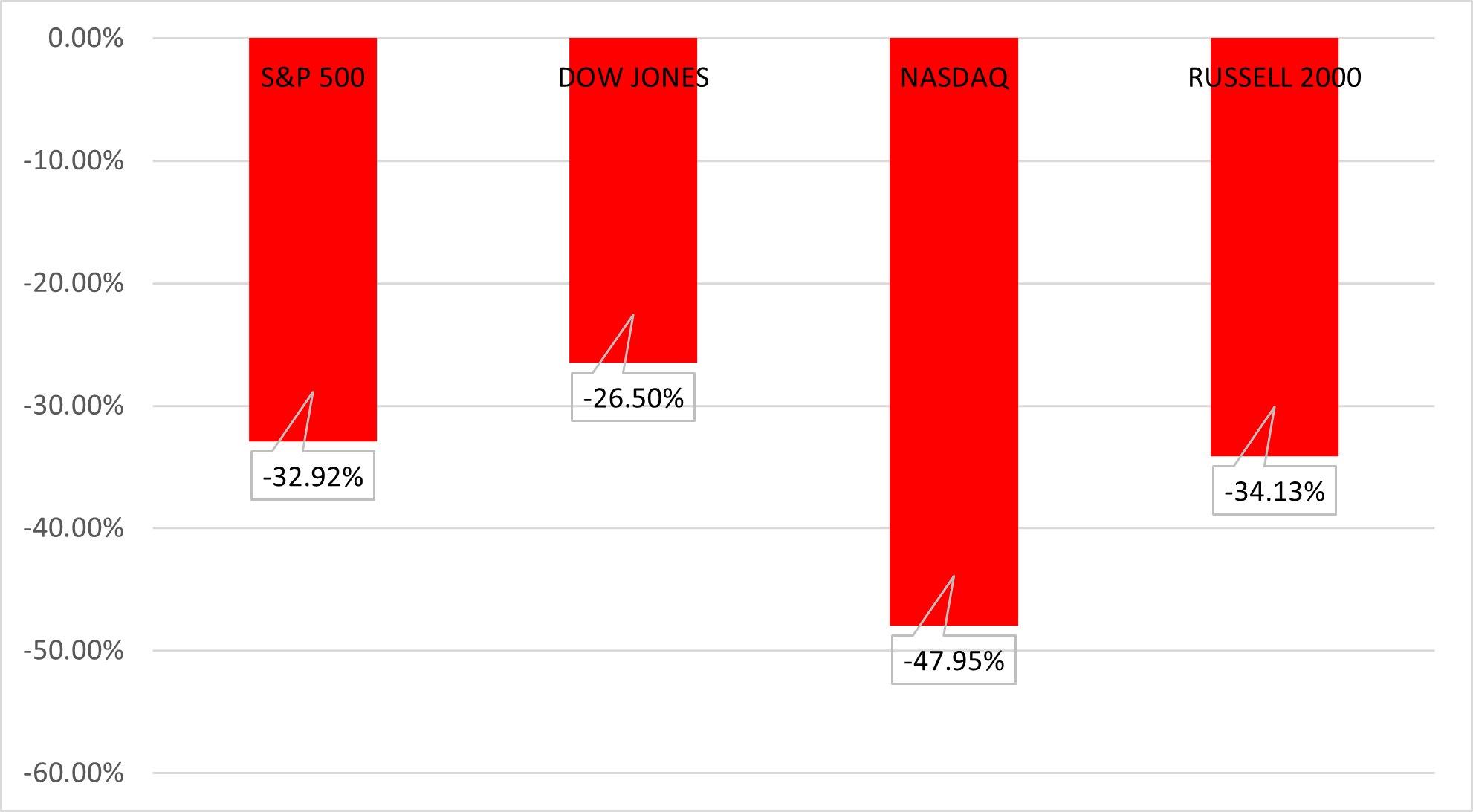
The third quarter of 2022 was a wild ride of a 12% gain followed by a 16.75% decline, ending in another consecutive quarter of losses for the markets. Ten out of the eleven market sectors ended down, some significantly. The Consumer Discretionary sector is the only one up for the quarter, but it is still down 29% year to date.1 It comes as no surprise that Energy is still the only sector up for the year. All four major indexes in the US stock market also continued to go down, with the NASDAQ being the worst performer for the quarter once again, ending -15.5% for the quarter. The market indexes (Dow Jones, S&P 500, NASDAQ, & Russell 2000) ended as follows:2
Market Performance by Quarter
Energy is Still on Top
Energy is still, by far, the best performing market sector for 2022, up 31.90%.3 The sector performed much like the rest of the market with gains in July and August almost all given up by the end of September. Oil has significantly fallen from its highs of over $120 per barrel in June. Brent crude currently trades for $85.30 per barrel. On a similar note, gas prices have also fallen significantly from a high of approximately $5 to just over $3.75 per gallon. This is still much higher than early 2021 levels, but significant progress has been made. This is the result of the continuing recession in the US. Remember that a shrinking economy results from shrinking demand, and gas is not immune to this cycle. These prices are most likely to remain fairly flat with a slight increase over the next few months as winter approaches.
One more note on energy, is that the importance of the sector is moving from oil to natural gas due to Europe’s intense usage during the winter. With Putin beginning to use Europe’s gas supply as an economic weapon, the price will continue to rise. How Europe handles this energy crisis will determine whether 2023 will simply be a rebuilding year for the continent, or a continuous downhill slide. Sadly, the prospects for the European economy in 2023 are not good.
Crypto (Unable to Rise)
Bitcoin remained stuck in a trading range of $19,000 to $22,000 for all of Q3.4 Even with the temporary gains in the market in July and August, crypto has been unable to recover from its tremendous losses of 2022. Bitcoin is still down 70% from its November 2021 high, and this collapse does not appear to be healing just yet. The list of investors that are eternally optimistic on the future of cryptocurrency is shrinking by the day, and with good reason. As the pandemic young investors begin to either start regular market investments or drop out due to the failure of the crypto/reddit/get rich quick crowd, the reasons for cryptocurrency usage have now been reduced to illegal criminal activity or a banking alternative for those in countries run by dictatorships.
Does this mean that cryptocurrency was just a fad like the failed NFT market? Only time will tell, but so far, fad is the best word to describe the shrinking crypto market. One thing is certain, the 2022 crypto crash has permanently discredited Bitcoin as a future, stable currency for everyday use. This may be a bold statement; however, Bitcoin has been put forward as an inflation hedge, gold alternative, tech stock alternative, antigovernment bet, banking system, payment system, and speculative asset. This should illustrate Bitcoin’s incompetence to claim a place in the financial system.
Update on Ukraine
The Russian invasion of Ukraine still continues; however, the Ukrainian Army has made significant progress in taking back stolen land. This sadly does not seem to indicate that the conflict will end anytime soon, but it can be said that Russia is truly losing the war. Ukraine has been able to begin some food exportation, which is extremely needed; however, the amounts are much smaller than required. A reduced food supply will continue into the foreseeable future. Food inflation is one of the hardest types of inflation to kill, and the Russian invasion will make it even more difficult. We should continue to pray for Ukraine’s swift and total victory in the conflict.
Inflation is Sticky
Inflation, which remains elevated at 8.3%, has become the biggest economic story in 2022. This is saying something since this year has included both the Russian invasion of Ukraine and the Feds aggressive rate hike strategy. In fact, inflation is the primary reason that Fed Chair Powell has embarked on his aggressive rate hike strategy. Here is a chart of annualized inflation from January 2021 to August 2022.
Inflation (Month over Month)
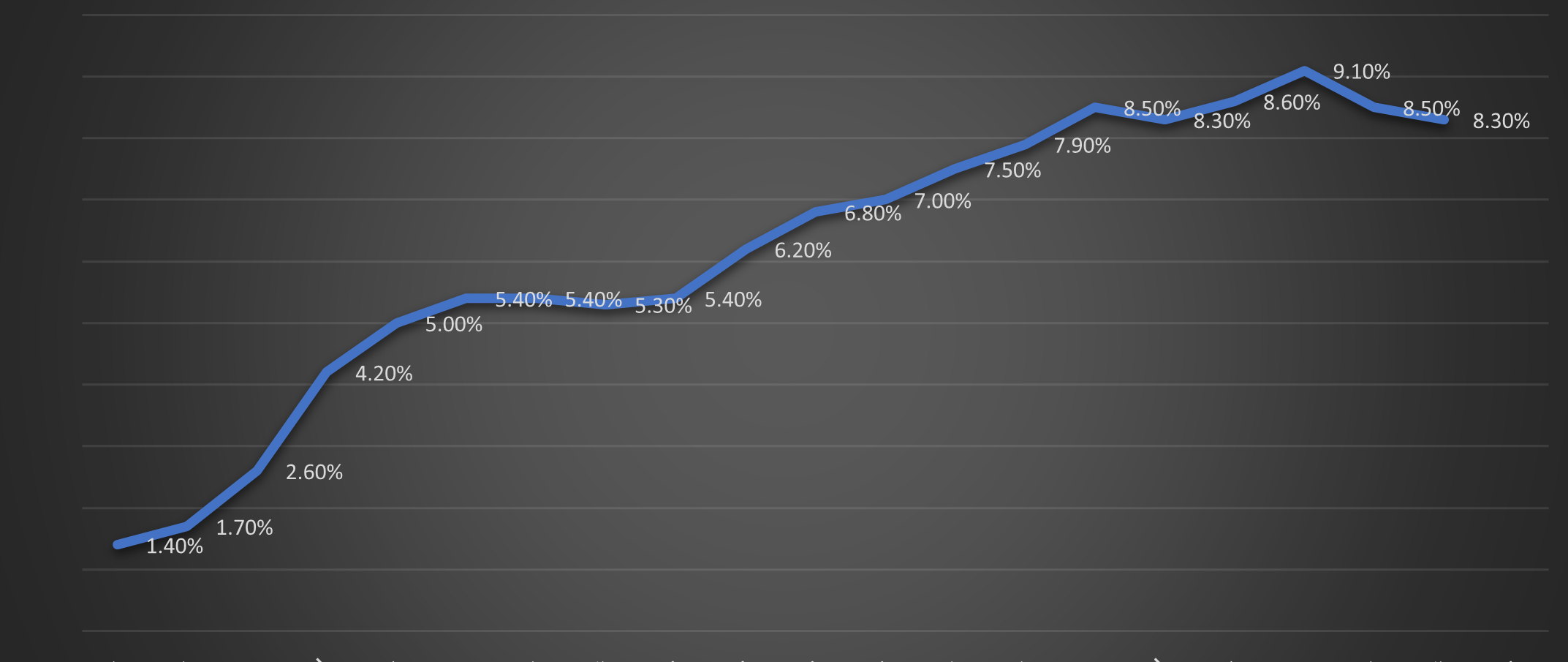
As you can see, inflation has become slow to decrease. Sticky is the term to use with a chart like this. Inflation should remain elevated for some time because of massive consumer categories like food and rent. With food shortages on the horizon and a declining housing market resulting in more renters, these two categories will be difficult to reduce, illustrating that inflation will be slow to reduce to the normal 1-3% range. This will no doubt result in the Feds continuing to raise rates into 2023.
Federal Reserve (Raising Too Late?)
The biggest economic story of 2022 remains and will continue to remain the Federal Reserve’s interest rate policy. In 2021, while the economy was still relatively strong, Fed Chair Powell decided not only to continue with interest rates near zero, the rate at which quantitative easing continued was simply breathtaking. Now, as of the annual Jackson Hole Wyoming meeting, Fed Chair Powell has suddenly turned from the easy money policies of Janet Yellen to insisting that Fed Chair Volcker is his true inspiration. In October 1979, Fed Chair Volcker, appointed by President Carter, raised the prime interest rate by 4% in one month. This rate hike was just one of many that resulted in the interest rate being over 20% by the end of 1980.5 Fed Chair Volcker’s rate hikes, while they caused much economic pain in the short term, are now regarded as the greatest factor in the post Carter economic boom.
Since many compare President Biden to President Carter and both Presidents presided over periods of record high inflation, Fed Chair Powell is looking to the past now to solve today’s problems. The trouble with this approach is that Volcker was not beginning rate hikes from near zero and was not preceded by ten years of flawed interest rate and monetary policy. Because of the situation Fed Chair Powell now finds himself in, he has two choices: 1. Leave rates and monetary supply where they are (which would allow inflation to continue hurting American’s unchecked) or 2. Increase the rate like Fed Chair Volcker and cause a severe economic deterioration that will be the cure for inflation. The scenario under which the Fed could “softly land the plane” is no longer possible.
It appears that out of the two bad choices, he has decided on option 2. This means an economic decline in the short 1-2 year term but decreased inflation over the longer term. From the consumer’s perspective, this is very difficult, but for savers with low debt loads, the increased rates will mean higher bond and savings yields. This is the silver lining in the dark economic clouds overhead. So, what is the best way to take advantage of the Fed’s drastic policies? The answer is to carry very little debt and save more. The new rates will reward these efforts.
Recession or Depression
Since we have been in a recession since the end of June, the question now is: will this recession turn into a depression? We must not look at this term through the lens of fear but the lens of fact. A depression is just like a recession, the only difference is that a recession is 2 consecutive quarters of negative economic growth while a depression is 4 quarters. Remember that the GDP (Gross Domestic Product) of the United States is made up of Consumption, Investment, Government, and Net Exports, which are imports minus exports.6 From all appearances, Q3 was another negative quarter; so, the case for a depression into 2023 is still growing. Consumption makes up 50-70% of the economy and the data is now showing that the American consumer is exhibiting fragility, struggling to pay bills, and slowing purchases of things like cars, household goods, and even sneakers. 7 Travel is also beginning to slow as well. I would say that a depression is highly likely at this point. In fact, a downturn of 6-7 quarters through the middle of next year is highly likely.
Midterm Elections
At the time of this writing, the midterm election are only a little over 5 weeks away. There is a wide variety of guesses as to the results of the elections, but the most likely seems to be that the Republicans will gain 25 – 40 seats in the House and 1 or 2 seats in the Senate. While the newly elected Congress will not be able to solve many problems due to the President still having 2 years remaining in his term, a split government is typically a good sign for investors. Also, a Republican legislature could stop rampant spending. This is not a given, but if this prediction comes true, Fed Chair Powell’s job just got a lot easier. Hopefully for the entire country, this will come to pass.
Consumers vs. Savers
Before we leave the topic of interest rates and recessions, a part of the economic discussion that never gets mentioned is the change in focus over the last 15 years from the whole financial condition of the United States citizen to that of looking at everyone simply as a consumer. The socialist swing in the United States since President Obama became President have continued unabated, and one of the core tenants of socialism has become rooted in American society: disincentivizing saving and subsidizing spending. The low interest rate environment of the last 15 years has led to more spending and thus higher economic growth; however, these low interest rates have made savings and investing in bonds almost not worth the time or effort. Rising rates may not be helpful for spending but will make long term saving finally vie for the attention of both older and younger Americans alike.
Housing Market Freeze
The housing market slowdown that began to materialize by the end of Q2 then turned into a freeze for the first three weeks of September. Not much buying or selling occurred. However as of the last week of September, the housing market has actually begun to decrease. This is not a good sign, as mortgage rates continue to increase and the average home buyer is losing money to inflation. Real estate is a massive part of the US economy, and a downturn in housing will cause problems over the next year.
The Markets Going Forward
So, taking all of these factors into account from the 3 quarters of 2022 thus far, what is the outlook for the stock market for the rest of the year? Well, here are the factors to be watched:
- Natural Gas Prices
- Cryptocurrency’s Demise
- Food Shortages from the Russian Invasion of Ukraine
- Inflation’s, Sticky Slow Decline
- Housing Market Freeze and Decline
- The Federal Reserve’s Path of Economic Damage
- Rising Interest Rates
- A Potential Recession Starting in Q4
- The Midterm Elections
All of these factors together paint a very negative picture for the markets the rest of this year and for the first half of 2023. Rising interest rates also spell out a bad environment for stocks going forward, but rest assured, as the Apostle Paul said, “This too shall pass.” So, what is to be done over the next few months? Well, savings accounts, CDs, and treasure bonds, should provide better returns than they have in years. However, the very best rate of return of any investment will be found in paying off debt.
One more side note is that the stock market is continuing to mirror its performance from 2000-2002. This is not a good sign, and if this pattern continues to hold, could result in much more pain ahead and a near 2 year recovery. This pattern has held for over a year now, and it will be interesting to see if this persists.
The overall picture for 2022 and the beginning of 2023 for the economy and stock markets is strongly negative. Once again, companies with lower debt loads, high sales growth, and new opportunities should do the best over the next few months. We will see what the last quarter of the year holds, but it is most likely going to be very negative from the stock market and economic perspectives.
1 https://eresearch.fidelity.com/eresearch/markets_sectors/sectors/si_performance.jhtml?tab=siperformance
2 https://www.marketwatch.com/market-data
3 https://eresearch.fidelity.com/eresearch/markets_sectors/sectors/si_performance.jhtml?tab=siperformance
4 https://www.coindesk.com/price/bitcoin/
5 https://www.nytimes.com/interactive/2015/12/11/business/economy/fed-interest-rates-history.html
6 https://www.thebalance.com/components-of-gdp-explanation-formula-and-chart-3306015
7 https://www.reuters.com/markets/us/us-consumers-spurn-cars-couches-cruises-results-show-2022-09-30/
Securities and advisory services offered through Sunbelt Securities, Inc. Member FINRA/SIPC. CPA and related accounting services offered through Chamberlain Financial Services are not associated with the services of Sunbelt Securities, Chamberlain Financial Services and Sunbelt Securities, Inc. are unaffiliated companies. Sunbelt Securities, Inc. does not provide tax or legal advice. Tax advice and preparation services are strictly offered by Neil Chamberlain, CPA.