
Items of Interest
- Energy is Still on Top
- Crypto Collapse
- The Continued Fallout from Ukraine
- Inflation Staying Elevated
- Federal Reserve Inability
- Recession
- Economics of Roe vs. Wade
- Housing Market Trouble
Market Overview
The second quarter of 2022 was even more volatile than the first, ending in significant losses for the markets. All of the eleven market sectors ended down, some significantly. Energy is now the only sector still up for the year. All four major indexes in the US stock market were also down, with the NASDAQ index being the worst performer for the quarter once again, ending -31.71%. The market indexes (Dow Jones, S&P 500, NASDAQ, & Russell 2000) ended as follows¹:
Market Performance by Quarter

Oil’s Acceleration
Energy is still, by far, the best performing market sector for the first half of 2022, up 31.75%. These gains were much higher, with oil stocks hitting all time highs by the beginning of June. However, with the rise in interest rates and recession starting to loom over the economy, many commodities pulled back. Gas prices remain near an all-time high, just shy of $5 per gallon nationally. The Biden Administration’s release of gas from the strategic reserve barely dented the gas prices, but it is important to note that while the Administration has not helped the issue and the war still rages on in Ukraine, the only action that can truly bring down energy prices sustainably is a recession.
Commodity price in general, and oil prices in particular, fall during recessions due to a lack of demand. While things can still be done on a political level, politicians are no longer the ones in control of oil prices. The power now rests primarily with the consumer and secondarily with the investor. The only real change that could affect the price of oil would be a drastic and strong shift in policy by the Administration and an end to the war in Ukraine. Still, these changes would cause much less of a decrease in price then a recession. As mentioned above, the average price of a gallon of gas nationwide is just under $5 per gallon. This is significantly higher than the $4.25 average at the end of March.
Crypto Collapse
While this update rarely mentions it, the crypto currency market is a major investment category now valued at over $1 trillion. That is, until this quarter. The entire crypto currency market, and Bitcoin in particular, crashed. On November 8th of 2021, Bitcoin was trading for just over $67,580 per coin; it now trades for just above $20,000.2 This is a 70% drop. Bitcoin was first introduced as somewhat of a rogue investment idea that was antigovernment and anti Wall-Street. This lasted from 2009 until the end of last year. Now that big name institutional investors have embraced crypto, it has lost some of its appeal, and Bitcoin started trading very closely with the NASDAQ Index. However, after the collapse, Bitcoin seems to be having a hard time rallying with the NASDAQ, leaving some to wonder if its allure to the younger, excited investors has waned. If this is the case, crypto could have a long slow, multiyear slog back to its highs. Some wonder if it will ever see those prices again. Only time will tell, but one thing is for sure, this collapse has forever shutdown the possibility that Bitcoin could evolve into a stable, digital means of exchange.
The Continued Fallout from Ukraine
The Russian invasion of Ukraine continues and so do the global economic impacts. The Ukrainians have pushed back the Russians from their initial positions and the conflict has now evolved into a slow, artillery intense, siege heavy conflict. This means a continuation of reduced food supply and increased oil prices will continue into the foreseeable future. We must remain aware that these shortages will affect every country, but the poorest nations will feel famine, not just shortages. These shortages are one of the biggest factors that will keep inflation elevated. Let’s pray that the Ukrainians win swiftly, both for themselves and the entire world.
Inflation Staying Elevated
While inflation was a top story in the Q1, it has become even bigger. Inflation, on an annual basis, has increased from 7.5% at the end of 2021 to 8% at the end of March 2022 to now 8.6%.3 The top inflation contributor was energy once again, followed by food (meat, eggs, poultry, cereals, and baked goods). Two other major factors were airline tickets and used cars. Thankfully, the used car market has come down significantly in June.
The problem with these numbers isn’t even how high they are, it’s the fact that they still do not reflect actual inflation for the average consumer which is well over 12%. Also, higher than 4% inflation is now expected for the next 5 years barring a major economic situation. While a 4.5-5% inflation rate is much better than the current 8.6%, it is still much higher than the average or the Fed’s 2% goal. Now that it is clear that inflation is not transitory and here to stay for a little while, it is clear that while raising interest rates and beginning quantitative tightening will help, the Fed alone cannot appropriately handle inflation. A deeper problem is causing these inflation numbers.
Federal Reserve Inability
It is pretty clear now that the Fed alone will not be able to “land the plane” of the economy gently. What makes the current economic situation difficult is that we are in a recession at the same time as high inflation. The Fed usually has the tools to fight one or the other (raise interest rates and perform quantitative tightening to bring inflation down / lower interest rates and perform quantitative easing to ease economic conditions and smooth out recessions). The problem is that now both issues exist simultaneously. The Fed has been clear that it will get inflation under control, even if it causes a recession, but the Fed waited to tighten until it was too late. They could fight with one hand tied behind their backs, but not both hands.
Recession
All of the economic circles can only seem to discuss one topic: are we headed into a recession? But, before diving into that question, it is helpful to look at a recession without fear. The word recession has been a word used to induce fear; however, a recession is simply a shrinking of the GDP (Gross Domestic Product) of the United States for 2 consecutive quarters. The components of GDP are Consumption, Investment, Government, and Net Exports, which are imports minus exports.4 A depression is 4 quarters of said declines. The definitions demystify the recession and depression buzzwords.
So, back to the question at hand, are we headed into a recession? The answer appears to be that we are already in one. Here is why. Of the four GDP components, consumption is one. However, in the real world, consumers make up somewhere between 50-70% of the economy. Said another way, the part of the GDP calculation that effects everyday people that is suffering the worst of the four components is not represented effectively. So, the consumer could be in recession, or shrinking, while the other components keep the formula from going negative. So, whether the Q2 GDP numbers show a recession or not, we are in a recession of the consumer.
However, a little soberness needs to descend on the United States about the necessities of a recession. The way capitalism works is with boom and bust cycles. These cycles mean that a period of growth is followed by a period of contraction. Recessions shake out, for lack of a better term, the debt laden, unsustainable areas of the economy that need fiscal discipline if they are to continue to grow. This is not a pleasant process, but it is necessary for the long term health and stability of the economy and consumer.
A new phenomena has taken over in the last 25 years that has changed the stakes of recessions. The Federal Reserve has been trying out a theory that says that the government, businesses, and consumers can borrow their way out of a recession if the loans rates are inexpensive. This method has not caused significant harm until now. If anyone, government or otherwise, spends money they don’t have, they eventually have to pay it back, and if they try to borrow money to pay off borrowed money, that cycle eventually falls apart. That is where we are now. I am not implying that the economy is about to fall apart; I am saying that four times in the last twenty years, the US should have gone into a recession and put it off through borrowing increases. The common conservative phrase “we shouldn’t borrow money that our children and grandchildren will have to pay back” has a good message behind it but is fundamentally flawed. The recessions we put off today will keep compounding, until the effects of a future recession are overpowering. In other words, it isn’t the debt that will sink the ship, it is what the debt is buying. However, there is a glimmer of hope in this bleak circumstance: If we fully embrace the current recessionary environment and curb spending, borrowing, and consumption, we can get through this time, regain solid footing, and proceed to correct the mistakes of the last 25 years.
Economics of Roe vs. Wade
One of the biggest news making events of Q2 was the formal overturning of Roe vs. Wade on June 24th. And while this long anticipated decision was a powerful prolife decision, there are economic consequences that should be considered. The United States population, while not declining, had been seeing a decrease in the population increase rate over the past few decades. With just over 331,000,000 current residing in the country, the 63,000,000 aborted children since 1973 is a drastically high number. With the severe lessening of abortion after the Dobbs case, our population that is beginning to age more than give birth will finally reverse this trend. Having more children will do many amazing things for the economy: increase the talent pool for innovation, increase the domestic workforce (which is currently smaller than the job openings), and fix the problems in social security by increasing those paying into the system without taking for many years). These are just a few benefits. One more, and perhaps the most overlooked is that a lack of children equals a lack of new discoveries. Think of those in history like Benjamin Franklin, Thomas Jefferson, Albert Einstein, Nikola Tesla, and Marie Curie just to scratch the surface. Out of 63,000,000 abortions, how many were of men and woman that God would have given brilliance. It is an extremely sobering thought.
Housing Market Trouble
Existing home prices hit a record of $402,000 in June while home sales were down 3.4% in April alone.5 This really isn’t a surprise since the average 30 year fixed mortgage rates have gone from 3% to 6% in the last 6 months. Here is a chart of the 15 year, 30 year and 5/1 Adjustable Rate Mortgage Rates since 2005.
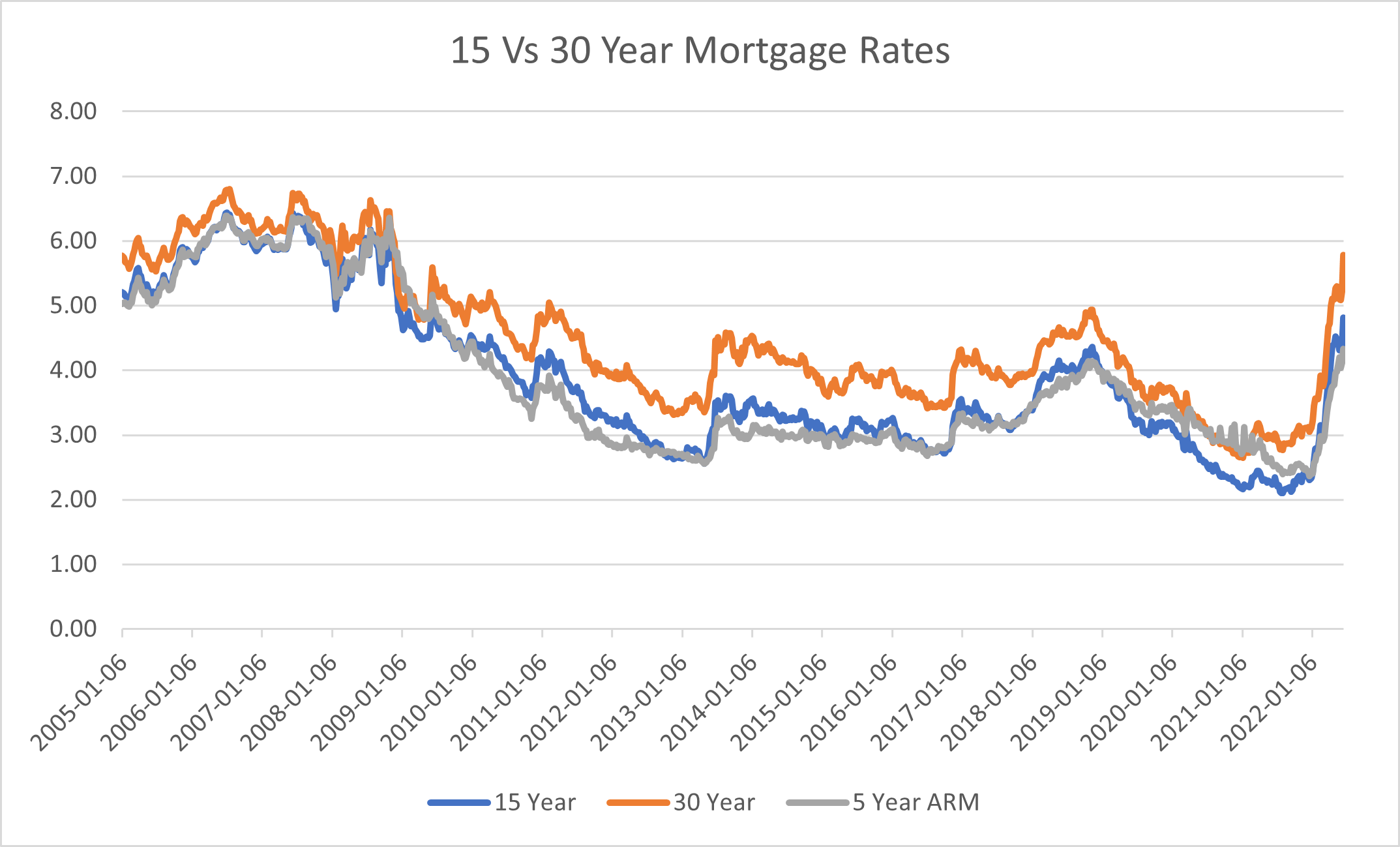
The sudden jump, due to the Fed’s lack of activity and then swift rate hikes, has caused a rapid decrease in refinances and a significant slowdown in home buying. People are already paying significant amounts for their homes, but the last two years of skyrocketing home prices has brought this trend to an extreme. Many people that purchased homes that were a little too expensive for their incomes can still be fine if they got a fixed rate mortgage. However, people that got mortgages 5 years ago are about to see their interest rates double if they secured an adjustable rate mortgage (ARM). This means that the people subject to these rates won’t be able to refinance for a lower rate, causing an increase in home sales in a housing market already declining in volume. This sets up the housing market for a significant downturn, not a crash like in 2007-2009, but a sharp, painful decline. When home prices surge, followed by a sudden increase in supply and decrease in demand, a downturn is what follows. The best advice for anyone looking to avoid this problem is simply to carry the least amount of debt possible. A borrower cannot repossess what you don’t leverage through debt. This impending, significant housing downturn will also hurt the middle class, furthering the pain of the already tight recession, and this is the real danger for the economy.
The Markets Going Forward
So, taking all of these factors into account from the first half of 2022, what is the outlook for the stock market for the rest of the year? Well, here are the factors to be watched:
- Energy Prices
- Cryptocurrency’s failure to bounce back
- Food Shortages from the Russian Invasion of Ukraine
- Inflation’s Continued Elevation
- Housing Market Decline
- The Federal Reserve’s Inability to Stop Both a Recession and Inflation
- Rising Interest Rates
- Recession
All of these factors together do not paint a good picture for the markets this year; in fact, a year of positive returns is extremely unlikely. For the market to turn bullish again, the recession we are currently in would need to abate, the Ukraine War would need to be resolved, inflation would need to go down significantly, and energy prices will need to fall considerably. One other element that is standing in the way of market gains is the raising of interest rates. Stocks have been one of the only classes of investment that has offered good returns over the past 5 years. This could change quickly if the Fed continues to raise rates. This would be good for those wanting to keep more money in the bank, CDs, and the like, but stocks perform less when there are other alternatives.
One more side note is that the stock market is now currently mirroring its performance from 2000-2002. This is not a good sign, and if this pattern holds, could result in a multiyear, slow downward trend for the S&P that will take 2 years to fully recover. This pattern has held for a year, now, and it will be interesting to see if this persists.
The overall picture for 2022 for the economy and stock markets is strongly negative. Companies with lower debt loads, high sales growth, and new opportunities should do the best, however. We will see what the second half of the year holds, but it is most likely not going to be good from the market’s perspective.
1 https://www.marketwatch.com/investing/index/SPX/charts
2 https://www.coindesk.com/price/bitcoin/
4 https://www.thebalance.com/components-of-gdp-explanation-formula-and-chart-3306015
Securities and advisory services offered through Sunbelt Securities, Inc. Member FINRA/SIPC. CPA and related accounting services offered through Chamberlain Financial Services are not associated with the services of Sunbelt Securities, Chamberlain Financial Services and Sunbelt Securities, Inc. are unaffiliated companies. Sunbelt Securities, Inc. does not provide tax or legal advice. Tax advice and preparation services are strictly offered by Neil Chamberlain, CPA.