
Items of Interest
- Energy Came in First
- ESG (Falling Out of Favor)
- The Rise and Fall of Crypto
- Inflation
- Federal Reserve (A Bumpy Landing)
- Another Recession?
- Midterm Election Results
- Housing Market Trouble
- 2022 in Review
- Looking Ahead to 2023
Market Overview
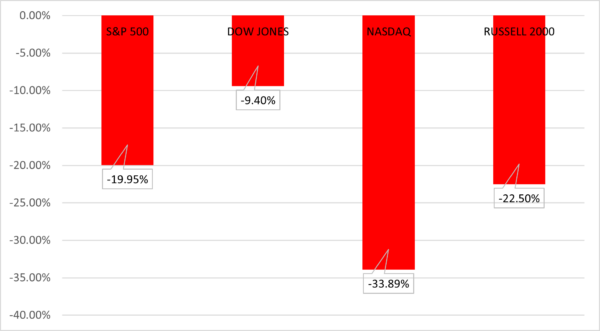
The fourth quarter of 2022 was the only positive quarter of the year ending up 6.61%. Nine out of the eleven market sectors ended up, some significantly. The energy sector was the biggest gainer (20.58%) while the consumer discretionary sector performed the worst (-12.05%).¹ Three of the four major indexes went up, with the NASDAQ being the only exception. The market indexes (Dow Jones, S&P 500, NASDAQ, & Russell 2000) ended 2022 as follows²:
2022 Market Performance
Energy Came in First
It comes as no surprise that energy was, by far, the best performing market sector for 2022, up 58.37%.³ Oil has significantly fallen from its highs of over $120 per barrel in June. Brent crude currently trades for $83.11 per barrel. On a similar note, gas prices have also fallen significantly from a high of approximately $5 to just over $2.60 per gallon. This is still higher than early 2021 levels of $1.99 per gallon4, but significant progress has been made, and gas has finally receded from an economically damaging level. This is the result of the ongoing consumer recession in the US and the massive sale of oil from the US strategic petroleum reserve. The approach of winter and the enormous winter storm that has engulfed much of the US has thankfully not caused much of an increase as a result. Opinions vary widely, but oil prices can be fairly stable in 2023 assuming global tensions do not further erupt.
ESG (Falling Out of Favor)
With the price of oil rising all the way to $120 per barrel only to return to $83 (only a 4-5% rise for 2022), why did energy stocks rise 58% on average? This is partly due to the downturn in ESG investing. ESG stands for environmental and social good. This name has been deceiving however, since it basically means the investments are left leaning politically and must emphasize environmentalism, pro LGBTQ+ lifestyles, and other leftist ideologies. This type of investing gained an extremely high level of popularity from 2016-2021, but in 2022, this all fell apart. Many began to push back against this type of investing as simply a cover for political activity. Since oil stock were ESG’s main target, they were finally able to rise after 6 years in the penalty box. This is a good thing for markets in general. Investing should not be about pushing an agenda; rather, it should be focused on the quality of the companies financials and management team. As of 12-31-2022, energy, after having 2 stellar years, is still undervalued compared to the other sectors in the market. This is good for energy stocks going forward. For more information on the downfall of ESG, see the Harvard Business Review Article linked below:5
The Rise and Fall of Crypto
Bitcoin has fallen from its Q3 trading range of $19,000 to $22,0006 to a new range of $15,000 to $17,000. This was mainly due to the implosion of the cryptocurrency exchange FTX. For the sake of time, I won’t elaborate on entire the collapse, but the 30,000 foot view is that Sam Bankman-Fried (known as SBF), the founder of FTX, is alleged to have committed one of the worst financial frauds in history. He is accused of taking over 8 billion of customer funds to finance his hedge fund and lavish lifestyle.
But, before the bubble burst, Sam accumulated a net worth north of 26 billion dollars, paid for endorsements of FTX by pop culture superstars like Tom Brady and tennis player Naomi Osaka, gave enormous amounts of political donations in 2022, and was frankly the cryptocurrency world’s leading authority.7 While he has not been convicted of the alleged crimes, he has admitted to horrible management of FTX in the least. John J. Ray III, known for his management of the Enron bankruptcy, is heading up the FTX cleanup process. He has made comment that the FTX fraud could even be bigger than that of Enron.
Even so, why is this important to the price of Bitcoin and other cryptocurrencies? Other large cryptocurrency exchanges like Binance and Coinbase are still going; so, why has FTX hurt the crypto market so much? Well, as I have described in previous updates, Cryptocurrency is an experimental currency with no backing of any kind. Attempts have been made since its inception in 2009 to use it as an inflation hedge, gold alternative, tech stock alternative, antigovernment bet, banking system, payment system, and speculative asset. It has systematically failed at each of these roles and has now been left to those that see its potential growth coming from speculation. This all happened before the FTX collapse.
Now, the only investors left are those with a pro cryptocurrency conviction or those that made a fortune trading it before. Young people put a handful of dollars in Bitcoin a few short years ago and became wealthy from its stratospheric rise. But like all money gained quickly, it is disappearing as rapidly as it appeared. King Solomon warned us of this in Proverbs 13:11 NLT, “Wealth from get-rich-quick schemes quickly disappears; wealth from hard work grows over time.” Crypto currency is essentially monopoly money in real life.
Frankly, Bitcoin and other cryptocurrencies have reached the end of their usefulness to society and are on their way to being relegated to criminal and underhanded purposes. Hopefully the crypto crash will be a lesson to future generations to invest in real investments with long track records. Money made from quick investments is usually lost as quickly as it was made.
Inflation
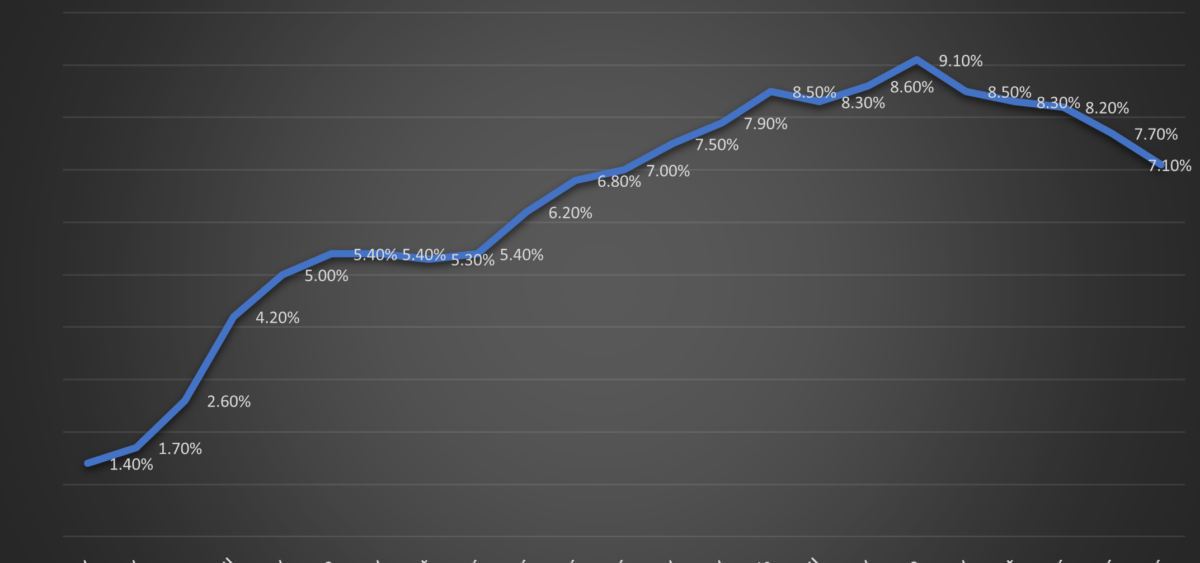
Inflation, which was 7.11% annualized as of 11-30-2022 remains elevated but has peaked after reaching a high of 9.11% in June. With the decrease in oil prices and the Federal Reserves’ steady rate hikes, inflation is finally on a solid downward track. At over 7%, it still has a long way to go, but progress has been made.
The question now is what will inflation’s long term effect be on the economy? Now that the peak has been reached, we will really start to feel its damage. The Fed wants inflation at an annual rate of 2% all the time, but what price will need to be paid to reach their goal? Only time will tell, but the economic impacts will most likely be negative for 2023. The Fed has already committed to at least 2 more rate hikes, we will see if they raise them even more.
Here is a chart of annualized inflation from January 2021 to November 2022.
Federal Reserve (A Bumpy Landing)
The biggest economic story of 2022 remained the Federal Reserve’s continued interest rate hike policy. I have elaborated on the Fed policy extensively in previous updates, so I will tell what has happened since September. Fed Chair Powell has since continued his Volcker like stance and raised interest in 2022 from a range of (0.00–0.25%) to (4.25-4.5%) a 1700% increase. The prediction of a 4.25% Fed funds rate at the end of 2022 ended up being spot on, and we will see if .75% in 2023 is the end result. The truth of the matter is that the Fed has now decided their course and the country now must wait and see what the result will be.
Let me know quote my last update:
“From the consumer’s perspective, this is very difficult, but for savers with low debt loads, the increased rates will mean higher bond and savings yields. This is the silver lining in the dark economic clouds overhead. So, what is the best way to take advantage of the Fed’s drastic policies? The answer is to carry very little debt and save more. The new rates will reward these efforts.”
Another Recession?
Since the end of the short recession that lasted from January to June of 2022, most of the economists and traders on Wall Street have been saying that the US will have another recession in 2023. Remember that a recession is 2 consecutive quarters of negative economic growth. The groundwork for another recession is certainly there, and it is the most likely scenario. The question that remains is will it be a mild recession or a serious one? The answer most likely lies somewhere in the middle. Whatever the result ends up being, it will definitely not be positive for 2023.
Midterm Election Results
Despite wide consensus, the November midterm elections did not pan out to be a sweep for Republicans. Instead of gaining 25-40 seats in the House and 1-2 seats in the Senate, the Republicans only ended up gaining 9 seats in the House and loosing 1 in the Senate. While many were disappointed with the result, it only amplifies the fact that the US is truly split down the middle, not just in whether to vote Democrat or Republican, but on what the future path of the country looks like. This is a lot more significant than the federal government being split for two more years, it is about whether our country will follow many others and give up private opportunity for the potential public good. If the twentieth century taught us anything, it is that collectivism leads to lack and want, but Americans must decide for themselves if they want to switch the American experiment for the collectivist experiment. The decision will be made soon. A people divided 50-50 will not stay in this balance for long before one side tips the scales. Abraham Lincoln said that a house divided will not stand, and that is still true today.
Housing Market Trouble
The housing market slowdown that picked up steam in Q3 has continued unabated. The volume of homes being sold is now back to April 2020 levels, almost pre pandemic. This slowdown is now starting to affect the price of real estate across the board, and price freezes are now turning into slight price decreases. This trend will continue into next year and most likely accelerate to the downside, as rising mortgage rates will thin the herd of buyers over the next year even further.
Real estate, just like the stock market and economy at large, has been a huge money maker over the last 10 years. How could it not? With interest rates commonly being found in the 2-3% range, mortgages were more layaway plans than loans. But now that rates are 6.5% and above, borrowers will actually have to think before buying. While this is not a bad thing, since “free money” always ends in inflation, this does mean that the housing market will have a hard time in 2023.
Looking forward, even past 2023, the real estate market will no longer be the cash cow it has been the last decade. The extremely high returns of the past are no longer on the table for the foreseeable future. This sounds negative, and it is in the short term. However, real estate is just another part of the US economy that needs fiscal discipline. It will be better in the long run for rates to be in the 5-7% range. The housing market is the most debt fueled portion of the economy, and high levels of debt are not good for any length of time. The real estate sector is another example of soberness coming back over the economy.
2022 in Review
No matter how you look at it, 2022 was a very difficult year. There were wins, but it was just difficult. With the stock market having its worst year since 2008, the bond market not holding up to help the traditional portfolio, the crypto investor getting his/her account obliterated, and the booming real estate market falling toward reality, the best thing that can be said about finances in 2022 is that it sets up 2023 to be a once in a decade buying opportunity. Over the last 5 years or so, every year the market gained, the attitude always had to be one of cautious optimism. Pure excitement had to be tempered since stocks have been overpriced for a while. However, 2023 brings a unique opportunity to finally buy when the markets are undervalued. We are not there yet, and have some room left to fall, but once the dust settles, the back half of 2023 can be a launching pad for the next decade of growth.
Looking Ahead to 2023
As I said above, 2023 should be a launching pad. That doesn’t mean that 2023 itself will be a great year for financial returns. Quality companies that go down too far simply because the rest of the market is being sold off creates enormously profitable opportunities for the long term. When the markets reach the most negative points is the time to jump all in and ride upward once again.
Caution is warranted; however, in investing for the next 10 years. The same high valuation, debt laden stocks, bonds, and real estate that soared in the last 5-10 years will most likely not be the investments that leads us into the future. Quality, soundness, cashflow, and common sense will be the traits looked for in the future.
The Markets Going Forward
So, taking all of these factors into account from 2022, what is the outlook for the stock market for 2023? Well, here are the factors to be watched:
- The Rate of Inflation’s Decline
- The Housing Market’s Fall
- The Federal Reserve’s Path Ahead
- Continued Rising Interest Rates
- A Probable Recession
- The Beginning of the Presidential Cycle
- A Potential Invasion of Taiwan by China
- The Speed and Timing of the Market’s Decline
All of these factors together paint a negative picture for the markets for the first half of 2023, but not the second. Finally for the first time in over a year there is light at the end of the economic tunnel. Holding treasuries, CDs, and cash has really paid off over the last year, but this year it will finally be time to put the money back in the markets. Remember that despite the huge possibilities this year has to offer, the very best rate of return of any investment is still found in paying off debt.
The overall picture for 2023 is negative from a short term view but amazingly bright with opportunities for investing. The economy, on the other hand, will not have as good a year, and it will most likely be 2024 before we will see a return of normal low inflation and medium economic growth. As I have said for the last year, companies with lower debt loads, great cash flow, high sales growth, and new opportunities all at once should do the best over the next few years. Time will tell, but 2023 should bring much more opportunity than 2022.
2 https://www.marketwatch.com/market-data
4 https://www.coindesk.com/price/bitcoin/
5 https://www.nytimes.com/interactive/2015/12/11/business/economy/fed-interest-rates-history.html
6 https://www.thebalance.com/components-of-gdp-explanation-formula-and-chart-3306015
7 https://www.reuters.com/markets/us/us-consumers-spurn-cars-couches-cruises-results-show-2022-09-30/
Securities and advisory services offered through Sunbelt Securities, Inc. Member FINRA/SIPC. CPA and related accounting services offered through Chamberlain Financial Services are not associated with the services of Sunbelt Securities, Chamberlain Financial Services and Sunbelt Securities, Inc. are unaffiliated companies. Sunbelt Securities, Inc. does not provide tax or legal advice. Tax advice and preparation services are strictly offered by Neil Chamberlain, CPA.