

Items of Interest
- Banking (Is the Trouble Over?)
- Inflation Is Falling (Is It Fast Enough?)
- Energy In Decline
- The Federal Reserve (On A Razor’s Edge)
- Election Cycle (Trouble with China)
- The Strange Real Estate Market
- The Markets Going Forward
Market Overview
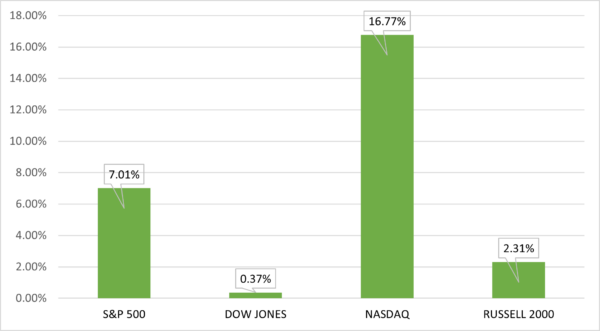
The first quarter of 2023 ended in mixed results, with the S&P 500 up 7.01%. Seven out of the eleven market sectors ended up. The technology sector was the biggest gainer (22.51%) while the energy sector performed the worst (-4.99%).[1] All of the four major indexes went up, with the NASDAQ far outpacing the rest due to its high concentration in technology. The market indexes (Dow Jones, S&P 500, NASDAQ, & Russell 2000) ended the first quarter as follows[2]:
Market Performance by Quarter
Banking (Is the Trouble Over?)
By far, the biggest economic story in the first quarter was the collapse of Silicon Valley Bank. This shocking collapse of a bank that had become a mainstay of the technology industry in Silicon Valley since its founding in 1983 rocked the financial world. But, as of the time of this article, the collapse has been written about and examined extensively. So, I will answer the two questions that all investors should be concerned about: What made it collapse? And, will it happen again?
On the first question, the answer is complicated, but it can be summarized as a compilation of overly aggressive loans with illiquid collateral, an over allocation in long term treasuries, the Federal Reserve’s fast paced rate hikes, and most importantly, a sudden lack of trust that caused its depositors to pull in excess of 40 billion dollars. These factors are how SVB went from fine to gone in less than one week.
For more details on the collapse, see this New York Times Article:
https://www.nytimes.com/2023/03/14/business/silicon-valley-bank-gregory-becker.html
As far as the second question goes, the answer is really up to the depositor. As of the time of this writing, Silicon Valley Bank, Signature Bank, and First Republic Bank, have been either sold or taken into receivership by the FDIC. The good news is that each of these cases have unique properties that will not necessarily be repeated. However, any bank will fall if the depositors pull their money: period. The FDIC only has approximately 2% of insured deposits in the reserve fund; so, the FDIC is not the most powerful entity in the banking system. It is the account holder. So, the fundamentals of the US banking system are not bad overall, but confidence in the banking system will decide whether or not the trouble is over. On the practical side, when choosing a bank, look for one that is managed conservatively and keeps reserves above the minimum requirements.
Inflation Is Falling (Is It Fast Enough?)
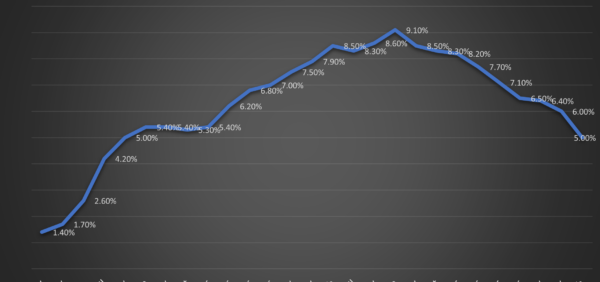
Inflation has significantly decreased on a running twelve month basis, down from 8.5% in March of 2022 to 5.0% in March of 2023. Inflation remains elevated still but has peaked after reaching a high of 9.11% in June. The issue for the Federal Reserve as they try to reduce inflation to a 2% annualized rate is that all of the inflation caused by stimulus and loose monetary/fiscal policy seems to have been drained from the economy. This means that unless there are changes in both monetary and fiscal policy, inflation will most likely remain in the 4-5% range for the foreseeable future without a recessionary deceleration. The Federal Reserve raised rates in May of 2023, but do they have any unused tools left to take inflation down below 4%? Only time will tell, but it is getting less and less likely.
Here is a chart of annualized inflation from January 2021 to March 2023.
Energy In Decline
It comes as no surprise that the energy finally gave up its crown as the top sector. In fact, going down only 4.99% is a relatively small correction compared to the enormous gains of 2022. The price of Brent crude was $79.17 as of March 31st. The odd thing is that while oil has decreased significantly, gas prices rose over the first quarter from $2.60 to $3.07[3]. It appears that gas and oil prices should remain relatively flat for the foreseeable future. Of course, any global tensions or recessions have the potential to raise or lower prices significantly.
The Federal Reserve (On a Razor’s Edge)
If you thought the Federal Reserve’s role in the economy couldn’t get any bigger, consider the banking troubles we currently face. The Fed’s problem went from juggling inflation and economic stability to now including banking troubles. Continuing to raise rates could now hurt both the economy and banks as their balance sheets include treasury portfolios with unrealized losses. I won’t rehash the Fed’s difficult position; however, let it suffice to say that continued interest rate increases have much more potential for harm than good. Hopefully they will pause and watch for the foreseeable future. This would be the best case scenario.
Election Cycle (Trouble with China)
With the 2024 election cycle beginning to heat up before the fall debates, candidates from both parties have begun touting their anti-China stances. Taking a nonpolitical stance clearly shows that an aggressive stance against China is bad for the economy in general and markets in particular. A cold war scenario would significantly harm any industries that have international exposure (which is most of the large US companies) and could cause a negative ripple effect all around the world. Let’s hope that any tensions with China are handled in an upfront manner with a lot of negotiations and talks to ease tensions. However, in the current political climate, this will be a challenge.
The Strange Real Estate Market
The housing market has flattened out since the end of 2022 due to a severe lack of inventory in the family housing sector. This is a good stabilizer for the economy in general; but first time homebuyers still have to deal with elevated prices and higher 5-7% interest rates for the near future. This should mean that the real estate market should be relatively stable.
The commercial side of the real estate market is not looking as stable, however. Commercial real estate loans are a major part of the real estate sector, and with the sharp increases in interest rates over the last year, companies and individuals that will need to refinance or renew their commercial notes in 2024 and 2025 (which is a significant amount), will be put in a hard position. This could cause a large downturn in the commercial space over the next two years. So, in summary, family housing seems to be ok, but commercial is what could cause problems.
The Markets Going Forward
So, taking all of these factors into account, what is the outlook for the stock market for the rest of 2023? Well, here are the factors to be watched:
- Banking System Issues
- The Stickiness of 4-5% Inflation
- Issues with Commercial Real Estate.
- The Federal Reserve’s Precarious Path Forward
- Potential Recession
- The Presidential Cycle Heating Up
- A Potential Invasion of Taiwan by China
All of these factors together paint a fuzzy picture for 2023? Will it end up? Down? Flat? Holding treasuries, CDs, and cash has really paid off and most likely will continue to for the rest of the year. For the long term investor, it will be time to put the money back in the markets soon.
The overall picture for 2023 is still negative from a short term view but will most likely be full of opportunities for investing. The best case scenario for the economy for 2023, on the other hand, is flat. A recession for the second half of the year is fairly likely but not set in stone. Once again, we will see. As I have said for the last year, companies with lower debt loads, great cash flow, high sales growth, and new opportunities all at once should do the best over the next few years. Time will tell, but the theme for 2023 remains to be: uncertainty. One thing is sure; the one strategy that will pay off in 2023 is discipline.
References:
[2] https://www.marketwatch.com/market-data[1]
[3] https://www.eia.gov/dnav/pet/hist/LeafHandler.ashx?n=PET&s=EMM_EPMRU_PTE_STX_DPG&f=W
Article written by Jonathan Chamberlin of Chamberlin Financial Services an Investment Advisor Representative, holding a Series 7 and Series 66 securities license.
Securities and advisory services offered through Sunbelt Securities, Inc. Member FINRA/SIPC. CPA and related accounting services offered through Chamberlain Financial Services are not associated with the services of Sunbelt Securities, Chamberlain Financial Services and Sunbelt Securities, Inc. are unaffiliated companies. Sunbelt Securities, Inc. does not provide tax or legal advice. Tax advice and preparation services are strictly offered by Neil Chamberlain, CPA.