
Items of Interest
- Giving Gains/Taking Gains
- Still Spending
- Inflation (American Made)
- Policy, Politics, & War
- Strikes, AI, and Lack of Labor
- The Federal Reserve (Finish the Job, then Some)
- Real Estate Woes
- The Maturing Economy
- The Markets Going Forward
Market Overview
The third quarter of 2023 ended in losses across the board, with the S&P 500 down 3.65%. Only two of the eleven market sectors ended up. Energy was the best performing sector (12.27%) while the utilities sector performed the worst once again (-1.92%).[1] All of the four major indexes went down, with the Russell 2000 taking the biggest hit. The market indexes (Dow Jones, S&P 500, NASDAQ, & Russell 2000) ended the third quarter as follows for the year[2]:

Giving Gains / Taking Gains
Coming into the third quarter, the markets had some good momentum, especially in the technology and energy sectors. The NASDAQ had its best first half in 40 years and it appeared a new bull market had begun. July was only an acceleration of this trend. However, as August wrapped up and September began, the traditional autumn decline began. September is historically the worst month for stocks. The optimism that began to take shape at the end of the second quarter has begun to slowly dissipate. Inflation stubbornly remained in the 3-4% range, job numbers came in lighter than expected, the Fed signaled yet more interest rate hikes are coming, and on and on the cookie kept crumbling. The stocks that led throughout the first half of the year began to either stall out or pullback. Apple’s disappointing iPhone 15 launch did not help matters. The trillions of dollars sitting in money markets I spoke of in Q2 have remained on the sidelines since the money market rates were in the 4-5% range. The higher treasury and money market rates are, the higher the threshold for investors to get into the market. 5% is nothing to sneeze at and these sideline funds won’t be invested until investors are confident that their equity/debt portfolios are worth the risk.
Still Spending
While consumer spending levels are still tremendously high, the numbers are beginning to soften in the lower income population. This does not necessarily spell trouble in the economy necessarily, but it is not a positive indicator. The average household income in the US for a family of four is approximately $70,000, which is up, but not as much as inflation. Personal savings as a percentage of disposable income is at its lowest point since 2007 and this trend is only accelerating.[3] In today’s culture, when prices increase, people simply increase their spending instead of pulling back or trading down to lesser versions of the same products. This is evidenced by the fact that credit card debt hit one trillion dollars for the first time this summer. Here is a piece by Forbes that goes into more detail about this issue:
American’s Credit Card Debt Tops $1 Trillion, Hitting All Income Levels
So, instead of being able to predict that the consumer will start to pull back in the near future, it appears that people aren’t going to stop spending until there is nothing left to spend. The key number to watch is Black Friday spending. If that number is as strong as 2022, then the consumer is still full steam ahead. In the short term this can be good for companies. This is a let’s watch and see issue.
Inflation (American Made)
Inflation has fallen from its elevated levels but has remained stuck in the 3-4% range for the last few months. This would not be a big deal except for the very high inflation of the last couple of years. Inflation of 3% would not be that much to handle, except that prices have risen significantly, and every American feels each new price increase no matter its size. However, instead of belaboring the current inflation situation, let’s spend a moment looking into a future inflation catalyst that many are not recognizing: onshoring. Onshoring, which is a fancy term for bringing manufacturing and industry into the United States from other countries, is what many Americans and politicians have talked about for years now. Made in America is its own mantra. Even on some websites you can filter the product selection by whether or not it was made in this country.
Bringing back these manufacturing jobs was a dream but is now becoming a reality after the Covid19 pandemic. Covid taught companies that they should try and make products in the countries in which they sell them. So, if a company sells in the US, it should make the product in the US. And, if a company sells product in China, it should make it in China. This theory suggests that not all production should be in one place. This theory is diversification in manufacturing. This sounds like a great boom for the US economy in the long run, and this is true; however, it will be a significant inflationary event over the next decade. The reason these companies moved their manufacturing outside the US to begin with is that other countries have cheaper currency, cheaper labor, and a looser regulatory environment. Bringing back these plant and jobs will cause inflation since it is more expensive to produce domestically. The price of labor alone is astronomically higher. No one likes to discuss it, but wagers are just as inflationary (if not more so) than any other input in prices.
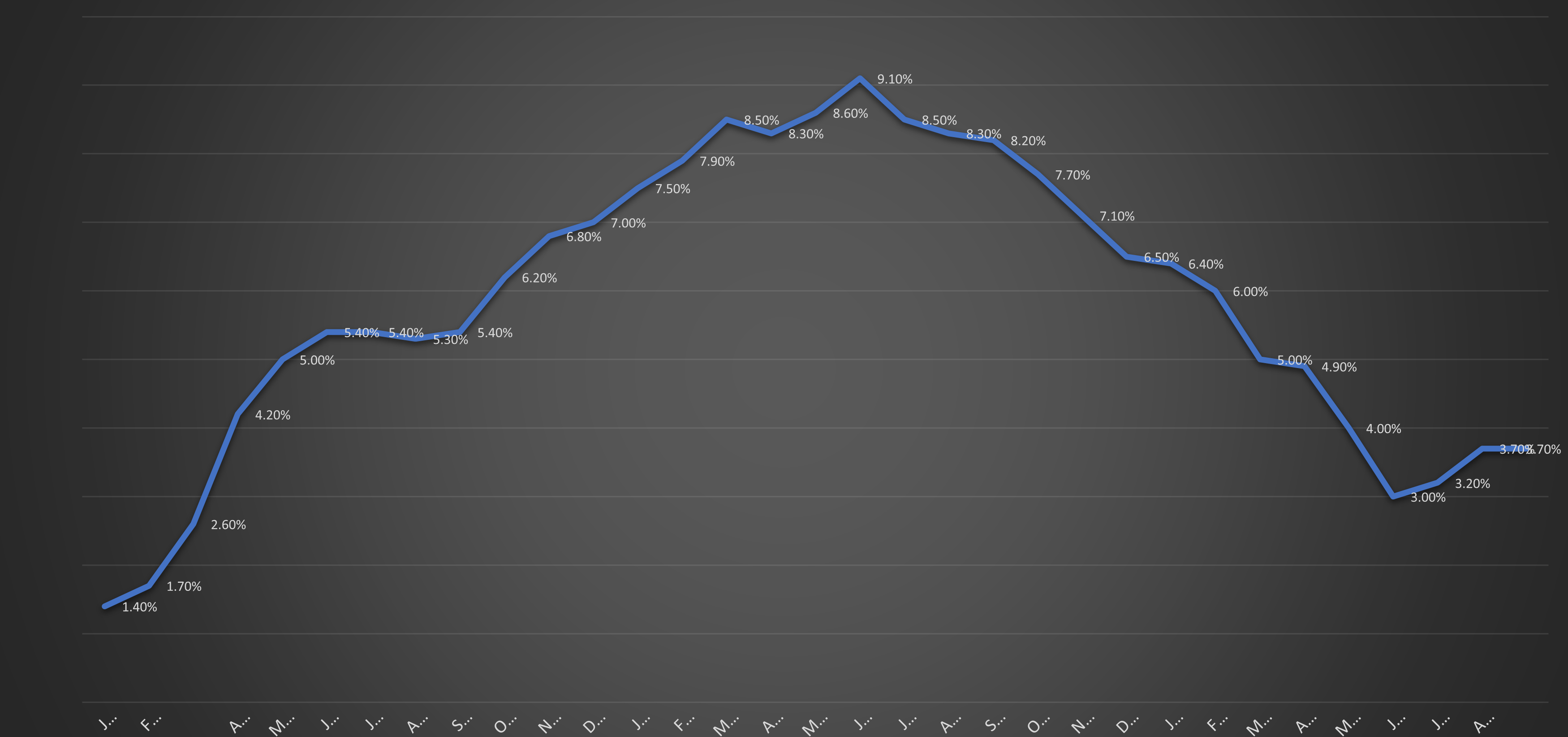
So, while inflation is taming from the 2022 soaring highs of 9.5%, there are headwinds that will keep inflation annoyingly higher for the rest of the decade at least. Even if the economy goes through another difficult period, bringing inflation down, this upward pressure will need to be watched and accounted for. “Made in America” could also be said as “Made More Expensively.”
Here is a chart of annualized inflation from January 2021 to September 2023.
Policy, Politics, & War
The third quarter of 2023 was filled with the typical news of presidential politics and seemed fairly straightforward until the ousting of Speaker of the House Kevin McCarthy. For the first time in American history, a Speaker of the House was removed from his position. What made this even stranger was that the coalition that ousted him was a fringe handful from the populist wing of the Republican party and the entire Democratic representation. The reason this moved shocked the country is that this type of interparty political brawling defines parliamentary style systems of government, like that utilized in Great Britain, Israel, Germany, India, and others. In the United States, the person to whom the gavel will be given is known and discussed before the House elections every two years. Everyone knew that Kevin McCarthy would be speaker, and this is indirectly voted on by the American people since they know who the speaker will be ahead of time.
However, the can of proverbial worms has been opened now. The term minority rule (since the fringe element that voted McCarthy out was 4% of the Republican Conference) was the only way to describe the proceedings; and now, the stability of leadership in the House of Representatives will forever be in question unless the internal House rules are changed. Let’s hope stability is restored in time to pass the necessary eight remaining spending bills and keep Israel’s Iron Dome defense system supplied with the necessary ammunition. Politics and policy are completely intertwined and knotted up at the moment. The only way to describe the situation is that it is a complete mess.
But the sudden ousting of the Speaker was not the most dramatic news of late. On October 6-7th, 2023, the terrorist organization Hamas brutally massacred Israeli civilians. We may not know the exact number for quite some time, but the initial estimates are around 1,000-1,200 Israeli casualties. Israel, in response declared war for the first time in exactly fifty years. I won’t go into the details of the attack, but it was a tragedy. There are many outlets covering the war, and I will leave you to them for up to date information. Hopefully the Republicans will be able to get their act together in time to help Israel with ammunition, verbal support, and additional resources since they are arguably the United States’ greatest ally.
As far as the economic ramifications go, the war seems to be contained and with the exception of a potential spike in oil and natural gas prices, the war does not seem to be making a dent into the US economy. However, this situation is still developing. If the war expands, (especially if Iran gets involved) economic and inflationary issues may develop.
Strikes, AI, and Lack or Labor
One of the most interesting domestic struggles in 2023 is the spike in striking by unions. Over 453,000 employees have gone on strike in 2023 thus far from unions like the United Auto Workers Union (UAW), the Screen Actors Guild (SAG), and the Writers Guild of America (WGA). The high inflation of the last couple of years has led to an emboldening of the union leaders to go on strike, asking for large increases in pay and a 4 day work week. The UAW and SAG unions have settled with the film studios, but the UAW is still striking, hurting General Motors and Ford significantly. The lack of labor in the United States has led to a scenario in which these union leaders can tell their members to strike, knowing that GM and Ford do not have the available manpower to pull from other places. This leaves work at a standstill and companies, whose margins have declined due to inflation, losing money due to these outsized demands. Everyone loves to tout the worker and complain that people’s incomes are not increasing with inflation, and this is true. However, every time these unions get pay increases for their workers (based on mass bargaining, not the value and potential of each employee) that cost is paid by the consumer when they purchase products. In a nonunion setting, workers gain wage increases through seniority, experience, or increased personal value through certification, etc. In a union setting, workers gain raises through the power of lawyers, not personal responsibility. In the 1800s, the need for unions was there since people (even children) were working 6-7 days per week over 12 hours per day. People in the United States today do not face these conditions. I wonder what founders of the original unions would think about union bosses using the power of collective bargaining to get a 4 day work week. The union system has been abused and will continue to be.
Artificial Intelligence will not be able to come up with enough efficiency to counteract these wage increases and lack of labor. The more code is written, and the more robots are made, the more people will be required to maintain them. AI is not a way around labor, it is simply a shift. So, every time you hear of a strike beginning or ongoing, remember that people are not getting raises based on merit and that you are paying for the increase in wages. It results in the wage inflation trap discussed above. Wages cause inflation just like other input costs.
The Federal Reserve (Finish the Job, then Some)
The Federal Reserve has signaled that it will continue to raise rates, although at a slower pace. The Fed currently has rates at 5.25-5.5% and they believe they will hit upwards of 5.6% by the end of 2023. They have also indicated that they plan on keeping rates at these higher levels for longer than expected (at least through 2024). It appears that rates will top out somewhere in the 6% range, but this is only an estimate. Mortgages are already 8.5%, so expect that number to possibly surpass 9% before the rate hiking is over.
Like I said last quarter, we are now far enough along in the rate cycle to begin to be able to start looking back and assessing the damage. The “inevitable” recession that many feared has yet to occur, other than the short recession last year. This information, as well as a low 3.7% unemployment rate will continue to embolden the Fed to do the work they need to do. The good news in all of this is that savings is now finally paying real interest for the first time in over 15 years. As long as the recession doesn’t happen, the Fed will feel free to move. As has been true for the last 2 years, this situation is still developing.
Real Estate Woes
The housing market, which has held up through the thick and thin of the economic and interest rate issues we have faced over the last couple of years, is now starting to crack. The single family housing market has slowed down to a crawl and multifamily housing, which typically doesn’t have many issues, has seen a fairly sizable drop in price over the last 45 days. The main issue is that the lack of supply and increased interest rates have left those with a 3% rate mortgage stuck in their current living situation. This means that although we have a housing shortage, we will have a frozen/down housing market in the near future. Back in the 80s, mortgage ratees were north of 12% and the economy thrived. That could not happen in today’s consumeristic economy.
The issues facing the real estate market at the end of 2023 going into 2024 revolve around commercial real estate for the most part. Many loans come due in 2024 needing to be refinanced; however, the same people and investors that could afford a 3-5% interest rate several years ago cannot afford the 8-11%+ commercial rates that are being charged at the moment. This will cause problems for banks and previous investors, but this opportunity will be a once in a decade opportunity at least. Be prepared to capitalize on this situation. What I said last quarter bears repeating:
The main point of concern isn’t the residential housing market but rather the commercial real estate market. With many loans coming due to be refinanced in 2024 and 2025, banks with high commercial loan exposure are at risk of defaults in their commercial portfolios. This is because commercial real estate loan rates are much higher than they were 5, 10, or 15 years ago. The banks seem to have enough capital to handle the problem, but highly levered businesses with commercial loans to refinance will have trouble. Some bankruptcies could result. However, this shouldn’t be an issue for companies with high quality balance sheets. This problem is more of an interest rate problem than a credit quality problem. This issue is concerning but not a crisis at the moment. We must continue to watch this going forward.
The Maturing Economy
While Q3 was filled with a lot of dramatic news, both in politics and economics, there is a slowly developing story that not many are reporting on. It is the maturing of the United States economy. A mature economy is simply defined as an economy with a stable population and slowing economic growth.[4] Mature economies also tend to have established industries, developed financial markets, and are consumption driven. This really describes the US. The United States economy has been the best in the history of the world, and that is truly no exaggeration. However, the law of large numbers is beginning to take effect. The Annual Gross Domestic Product (GDP) of the United States was $25.46 trillion in 2022.[5] For some perspective on that, there are only approximately 340 million people in the United States.[6] That means that there is roughly $74,880 of production per person annually in the United States. However, there are only 134.56 million workers in the United States.[7] This means that, in reality each of those workers is producing $189,209 per year of value. This is a gross averaging of course, but the point is made: worker’s cannot create much more value than they already do. AI will help, but so many tasks are already automated that the value growth potential of the United States is limited. Consider what has happened in Europe; their annual GDP growth rates are typically around 1%.[8] Countries with large, developing populations like China and India grow around 6%. Where is the United States? The US is, and has been, growing at around 2.5-3% growth for the last 10 years regardless of presidents, parties, or policies. We are slowly slowing in growth rates. This is inevitable since abortion, anti-immigration policies, and a culture that doesn’t value childbearing have pervaded over the last 50 years.
So, this sounds bleak, especially since this means that we are, over the next few decades, headed for a sub 1% annual growth rate. However, is this inevitable, or is there a way out of this stagnation? There is one way out, and it isn’t Artificial Intelligence. It is a significant and swift population increase. If the government stopped squabbling and focused on changing our current anti-immigration laws to allow for easy immigration of people with clean backgrounds that want better opportunities, this ship could be turned around in the direction of growth and innovation once again. How many people do we need? No one knows for sure, but the number seems to be at least 500,000,000. So, we need to accommodate at least 160,000,000 in immigration over the next couple of decades. The innovation alone will lower prices and create new job opportunities. Any short term pain of this influx would be an investment in the next generation, handing them an economy that is growing better than the one we were handed. That is a sacrifice worth making.
The Markets Going Forward
So, taking all of these factors into account, what is the outlook for the stock market for the rest of 2023 and the beginning of 2024? Well, there is negative information to be sure, and the S&P may not perform as well as could be hoped for, but there will be companies inside the index that will outperform handily. The time seems to be coming for us to look less at the markets overall and start looking for those companies that will outperform in the months ahead.
Here are the factors to watch in the months to come:
- The Israeli War against the Hamas Terrorists
- The Stickiness of 3-4% Inflation
- Looming Issues with Commercial Real Estate
- The Federal Reserve’s Continued Hikes
- A Tumultuous Presidential Election Cycle
- A Potential Invasion of Taiwan by China
- Economic Impact of Union Strikes
All of these factors paint a picture of both big issues and big opportunities. Will the markets end up? Are the October 2022 lows in the market the true bottom? I can’t say for sure, but the time to start buying is here. The attitude needed is “slowly but surely.”
The overall picture for 2023 has gone from negative to neutral in the short term view. The best case scenario for the economy for 2023 has now gone from flat to a stagflationary small gain. A recession for the first half of next year is less likely but still possible. Once again, we will see. As I have said for the last year, companies with lower debt loads, great cash flow, high sales growth, and new opportunities all at once should do the best over the next few years. Last quarter’s analysis still rings true; the theme for 2023 is still uncertainty. One thing is sure; the one strategy that will pay off for the rest of 2023 is discipline.
Article written by Jonathan Chamberlin of Chamberlin Financial Services an Investment Advisor Representative, holding a Series 7 and Series 66 securities license.
References:
2 https://www.marketwatch.com/market-data
3 https://fred.stlouisfed.org/series/A072RC1A156NBEA
4 https://www.nasdaq.com/glossary/m/mature-economy
6 https://www.worldometers.info/world-population/us-population/
Securities and advisory services offered through Sunbelt Securities, Inc. Member FINRA/SIPC. CPA and related accounting services offered through Chamberlain Financial Services are not associated with the services of Sunbelt Securities, Chamberlain Financial Services and Sunbelt Securities, Inc. are unaffiliated companies. Sunbelt Securities, Inc. does not provide tax or legal advice. Tax advice and preparation services are strictly offered by Neil Chamberlain, CPA.