

Items of Interest
- Economic Strength
- Energy Prices (The War Premium)
- Inflation (Where is it Headed?)
- The Federal Reserve (Holding Steady)
- The Strong Consumer
- The Markets Going Forward (The Envy of the World)
Market Overview
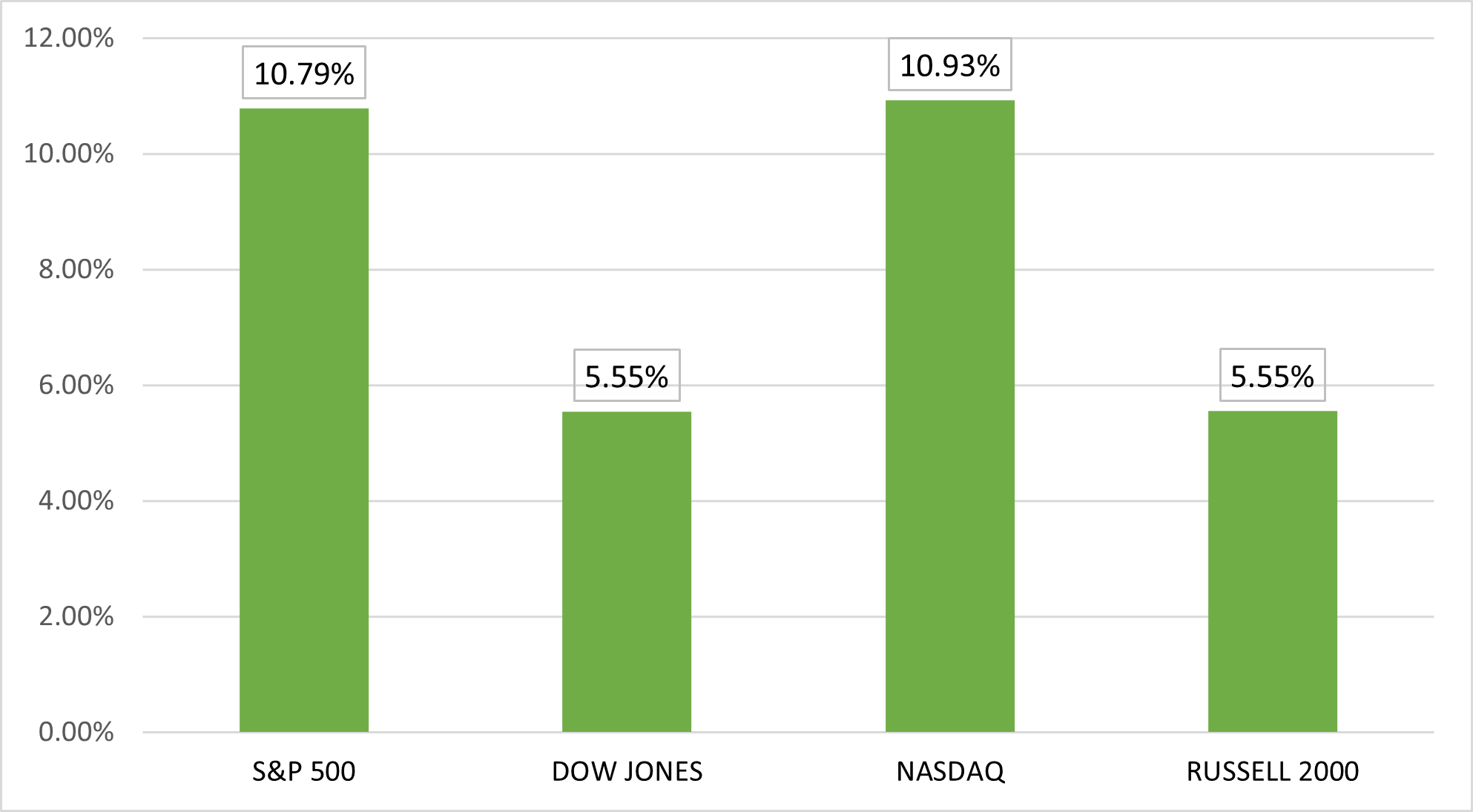
The first quarter of 2024 ended with a strong rally across the board, with the S&P 500 ending up 10.79% for the quarter. Out of the eleven market sectors, only one ended down. Communication Services was the best-performing sector (up 15.09%) while real estate performed the worst (-2.00%).[1] All of the four major indexes went up, with the NASDAQ barely beating the S&P 500. The market indexes (Dow Jones, S&P 500, NASDAQ, & Russell 2000) ended Q1 as follows[2]:
Market Performance
Economic Strength
2024 began with an unusually strong rally. This rally was not just limited to the stock market but was a larger depiction of the economy in general. Despite a series of formidable obstacles ranging from geopolitical tensions to interest rate uncertainties, the US economy has displayed a resilience that is noteworthy. This period has been marked by an assortment of defining moments and trends across various sectors, painting a picture of an economy at a pivotal juncture. Per usual, there are positive and negative forces at play on the economy and markets, but combined together, the stronger/positive forces are prevailing overall. The S&P 500 had its best first quarter performance since 2019. But the fact that the S&P 500 tied the NASDAQ (which is tech heavy) is very interesting and unusual. The magnificent seven (Apple, Amazon, Alphabet, Meta, Microsoft, Nvidia, & Tesla) were not broadly responsible for the returns like they have been. Instead, Amazon, Alphabet, Meta, Microsoft, & Nvidia did all the heavy lifting while Apple struggled, and Tesla has performed so poorly that many have taken it out of the “Magnificent Seven.” This change, especially the market going up while Apple went down, was a pivot in the right direction for the markets since the direction of Apple has been the direction of the market in general for the last several years.
As far as the economy in general is concerned, there are positive and negative forces, as there always are, but in general, here is a very brief synopsis:
- GDP is forecasted to have accelerated from Q4 2023’s growth rate of 2.3834% to 2.4663% for Q1 2024.[3] These numbers are annualized of course.
- Personal income rose by 0.3%, disposable personal income (DPI) increased by 0.2%, and consumer spending increased by 0.8%. The personal saving rate stood at 3.6%. (This shows that increasing in spending is more from discretionary spending than necessities and illustrates that inflation is not simply a systemic problem but a discretionary one.)[4]
- Inflation, as of March 31st, stood at 3.5% year over year.[5]
- The Industrial Production Index saw a marginal change of +0.1% in February 2024.[6]
- The Unemployment Rate remained at 3.8% as of March.[7]
- 829,000 full time equivalent jobs were created in Q1 2024.[8]
So, distilled down, this data collectively is positive. The outlier piece of data is inflation. More on that later. But suffice it to say, the economy is headed in the right direction.
Energy Prices (The War Premium)
While Oil prices are much lower than they were in May of 2022 (over $120 per barrel of Brent Crude), they remain in a trading range of approximately $75 – $90. This translates to a national average gas price of around $3.63 per gallon.[9] With oil and natural gas drilling at an all time high, anecdotal evidence would suggest that prices should be lower; however, there are a few factors keeping prices elevated. The first, and perhaps most important is what is known as the war premium. The ongoing wars in Ukraine and Israel have led to an actual price increase through volume reduction on the open market (from Russia in particular) but also from the Israel Hamas war. Anytime a middle eastern country goes to war the price of oil increases because of the risk to nearby oil producing nations.
The second reason is simple: the worldwide consumption of oil (despite the wishes of eco friendly influences) has gone up significantly. The daily consumption of oil has gone from 100,270,000 barrels per day (bpd) in 2019 to 101,890,000 bpd in 2023. While drilling has steadily increased over the last few years, the demand has outpaced the supply.
The third reason is OPEC (The Organization of the Petroleum Exporting Countries). Member nations include Algeria, Congo, Equatorial Guinea, Gabon, Iran, Iraq, Kuwait, Libya, Nigeria, Saudi Arabia, United Arab Emirates, and Venezuela. This organization has two objectives: to maximize profits for member countries and to stabilize the price of oil. OPEC has kept production cuts in place for a while, thus the trading range we find ourselves in now.
All of these factors are important and play their own roles in energy prices. So, any movement in any of these factors will determine the volatility of oil/gas going forward.
Inflation (Where is it Headed?)
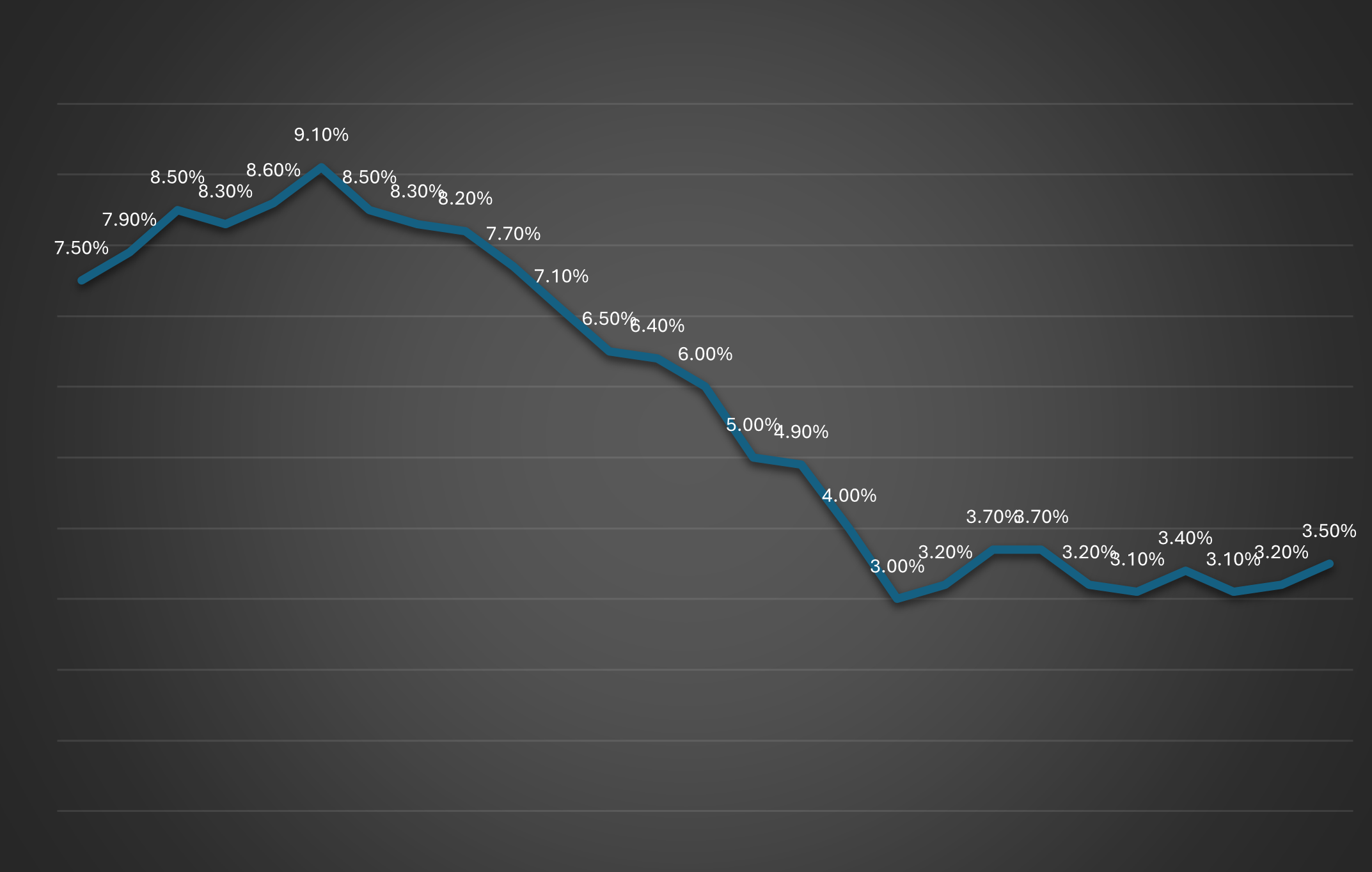
Inflation has come down significantly since its peak of over 9% and has had a fairly steady downward slide of the current 3.5% level. See the chart at the end of this section for the inflation from Jan 2022 – Mar 2024. However, with consumer discretionary spending, and spending across the board for that matter, continuing to rise, inflation remains in the 3-4% range. This bump from 3% to 3.5% is rattling the markets and analysts, but it shouldn’t. Any time in recent memory that there is high inflation, there is always a bump in the chart as inflation returns to normal levels. This is what is happening now. As long as the Fed retains a tighter policy (more on that later), this bump can work itself out. While 2% inflation (the Fed’s goal) is a ways out of reach, 3% is attainable in the near future. For context, 3% is the long term average annual inflation rate. So, in conclusion to the inflation discussion, inflation is following its normal path and the hype over reacceleration is much overdone. Here is the inflation chart mentioned above.
The Federal Reserve (Holding Steady)
The Federal Reserve has remained one of the most dominant stories through Q1. They have held the rates steady at 5.25-5.5%. But some slightly weakened numbers, that came out in January, got the hopes up of stock traders and home buyers alike. A swath of analysts, traders, and experts started calling for 3-6 rate cuts in 2024, but this was premature. Federal Reserve Chair Jerome Powell has indicated that the Fed is open to cuts, but more progress needs to be made on inflation before these cuts can occur. Continuing economic acceleration and inflation still above the 2% goal has the Fed content to wait and watch for the moment. In fact, a rate hike is more likely than three cuts. More than likely, rates will remain steady for the near future, perhaps into 2025. Remember that rates are not historically high. They are very close to the historical average. Perhaps the combination of steady rates and continued quantitative tightening will do the trick and bring inflation in line. Hopefully the Fed does not rush to cut rates and reintroduce the fabricated success of the last 10-15years. We will have to wait and see.
The Strong Consumer
Let’s take a realistic look at the consumer for a moment. With the political divide so strong in the current moment, it is impossible to get an accurate view of the economy simply by listening to politicians or the news. The numbers I mentioned earlier bear repeating. By March 31st, personal income was up 0.3%. Discretionary income was up 0.2%. This means that approximately 33% of that increase in income went to necessities. That means that 66% of the increases in wages is available for spending, giving, or saving. However, the next number is the key to the current economy. Discretionary spending (non-necessities) went up 0.8%. That means Americans spent 4x their wage increases on spending that was not necessary. That completely explains our current economy. For those in the lower brackets that haven’t received an increase in income, the 0.1% increased cost of their monthly necessities, combined with the high inflation of 2021-2022 means that they are struggling.
The issue of overspending has long term consequences, but not short ones. In fact, this is good for the short term economy and has kept growth at a rate higher than the 40-50 year average. So, in the near term, things are quite well. The person who invests for the long term does well, but the person who is afraid of the future will stay stagnant.
In conclusion, things are great… for now. How long is now? 5 years? 10 years? 20 years? 40 years? We don’t know. The name of the game is flexibility and discipline.
The Markets Going Forward (The Envy of the World)
With all of the good factors and bad factors I mentioned above, the next question I usually ask is: what does this look like for the markets going forward? But first, let’s take a moment to be grateful for the position we are in. The current economy in the US has been described by many economists lately as the envy of the world. What does this mean? Well, almost every other developed country has much lower wage growth and much higher inflation than we do in the United States. This is due to a myriad of factors. But let’s be grateful to still be best in class.
Now, looking at all the factors mentioned above plus others like the escalation of the Israel-Iran conflict, the war in Ukraine, and political turmoil surrounding the 2024 elections, opportunity seems to be the word to describe the totality of where we are. 2023 did hand 2024 a good economy, with some issues to be sure, and the country took advantage of this in Q1. We have the same mix of good wage growth, GDP growth, low unemployment, and lowering inflation that we had in Q4. Inflation may not be optimal, but it is within a reasonable range, since the long term average is around 3%.
All these items considered, here are the factors to watch in the year to come:
- Continued War in Ukraine
- The Expanding Israel-Iran Conflict
- Inflation in the 3%-4% Range
- The Federal Reserve Holding Interest Rates Steady
- A Tumultuous Presidential Election Cycle
- A Potential Invasion of Taiwan by China
- Higher than Average Wage Inflation
All of these factors paint a picture of both issues and big opportunities. Once again, no one knows what the future holds. However, the theme of uncertainty from 2023 has turned to a theme of both hold steady and opportunity in 2024. Let’s not be the ones that look back with regret at opportunities we could have taken. Those who don’t try will never succeed. There will always be issues in the economy and market. There always have been. The key for the rest of 2024 is: hold steady and out the political noise. I will continue to reiterate what I have said for the last year, companies with lower debt loads, great cash flow, high sales growth, and new opportunities all at once should do the best over the next few years. The best strategy for 2024 continues to be discipline.
1 https://eresearch.fidelity.com/eresearch/markets_sectors/sectors/si_performance.jhtml?tab=siperformance
2 https://www.marketwatch.com/market-data
3 https://fred.stlouisfed.org/
4 https://www.bea.gov/news
5 https://fred.stlouisfed.org/
6 https://fred.stlouisfed.org/
7 https://fred.stlouisfed.org/
8 https://www.bls.gov/ces/publications/highlights/2024/current-employment-statistics-highlights-03-2024.pdf
9 https://fred.stlouisfed.org/series/GASREGCOVW
Securities and advisory services offered through Sunbelt Securities, Inc. Member FINRA/SIPC. CPA and related accounting services offered through Chamberlain Financial Services are not associated with the services of Sunbelt Securities, Chamberlain Financial Services and Sunbelt Securities, Inc. are unaffiliated companies. Sunbelt Securities, Inc. does not provide tax or legal advice. Tax advice and preparation services are strictly offered by Neil Chamberlain, CPA.