

Items of Interest
- Economic Overview
- Energy Prices (The War Premium)
- Inflation (Holding Steady)
- The Federal Reserve (Any Rate Cuts Coming?)
- Weakness & Strength (Unusual Consumer Behavior)
- Nvidia (Story of the Decade)
- The 2024 Elections (Is Europe an Indicator?)
- The Markets Going Forward
Market Overview
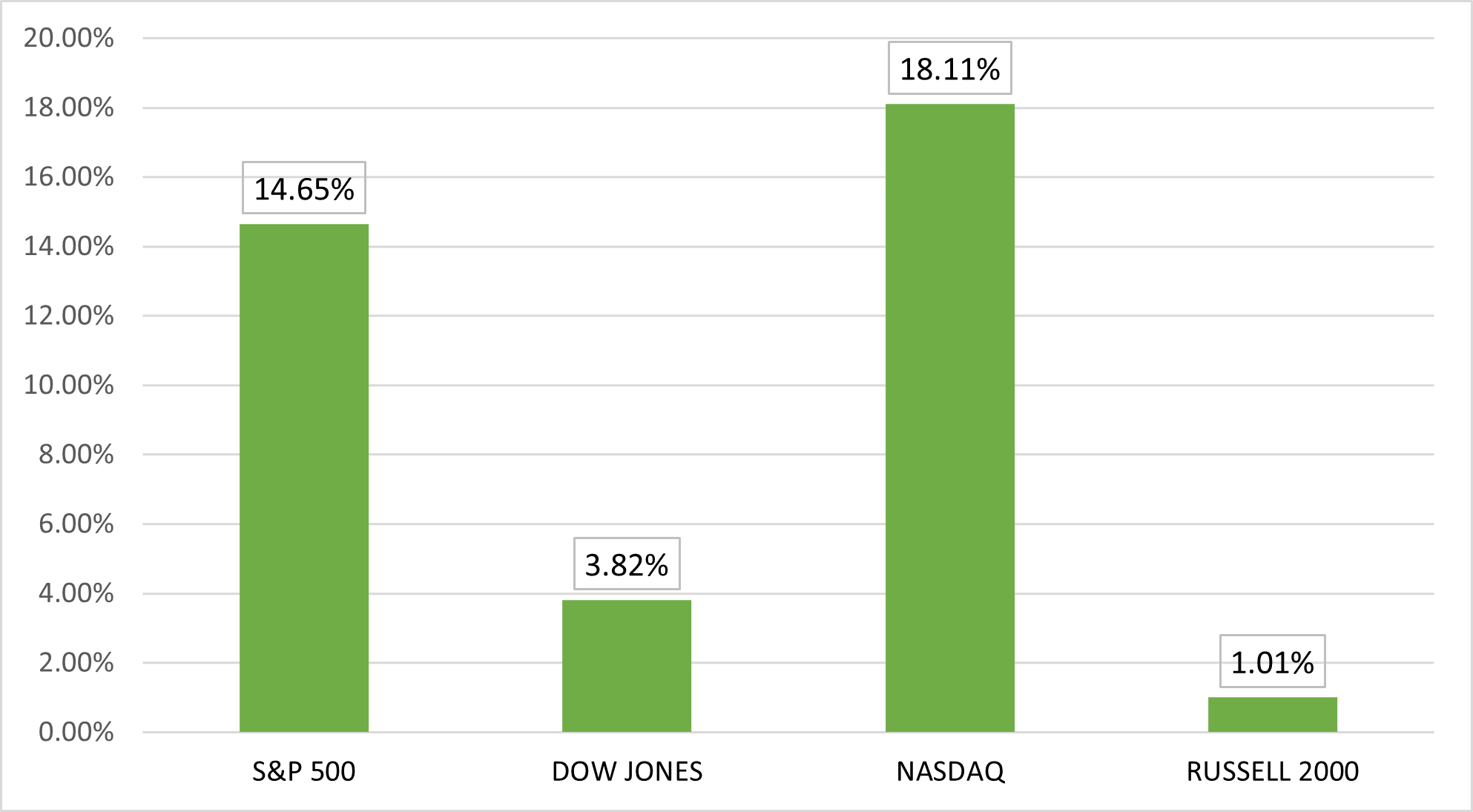
The first half of 2024 ended mixed, with the S&P 500 & Nasdaq advancing while the Dow Jones & Russel declined. The S&P 500 ended up 14.65% for the year and 4.31% for the second quarter specifically. Out of the eleven market sectors, six ended down. Technology was by far the best-performing sector (+13.48%) while materials performed the worst (-4.65%).[1] Of the four major indexes, the NASDAQ advanced the most. The market indexes (Dow Jones, S&P 500, NASDAQ, & Russell 2000) ended The first half of 2024 as follows[2]:
Economic Overview
The unusually strong rally that started 2024 began to lose some of its steam in Q2. This was not primarily due to economic issues but because the markets had an unusually strong beginning to the year. While the US is still the strongest economy in the world this year, the spending machine that keeps the US economy growing has begun to show a slowing down. The positive forces in the economy are still prevailing, but not as much as in Q1. The market broadening that we saw in Q1 didn’t really continue as much as one would have hoped. When you see the S&P 500 and Nasdaq far outpacing the Dow Jones and Russell, it indicates more consolidation is underway. However, this consolidation (led primarily by Nvidia) may not be undeserved. I will go into the Nvidia phenomenon a little bit later.
Here is the January through May economic synopsis:
- GDP is forecasted to decelerate from Q1 growth of 2.47% to 2.2% for Q2 2024.[3] These numbers are annualized of course.
- Personal income rose by 0.48%, disposable personal income (DPI) increased by 0.45%, and consumer spending increased by 0.25%. The personal saving rate stood at 3.9%. (This shows a change since Q1 where a decrease in the percentage spending rate is directly correlated to an increase in the personal savings rate.)[4]
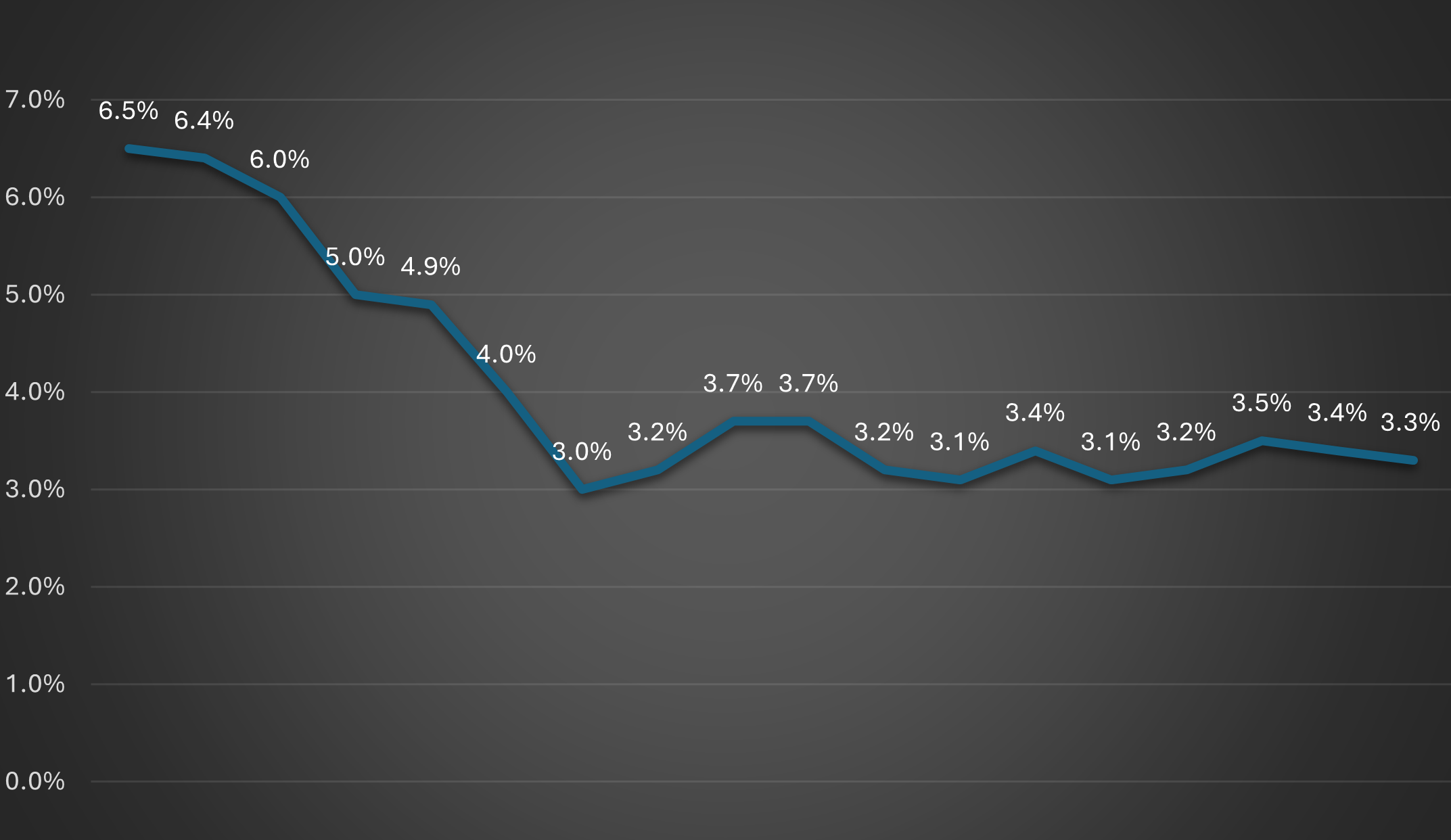
- Inflation, as of May 31st, stood at 3.3% year over year.[5]
- The Industrial Production Index saw an increase of +0.37% as of May 2024.[6]
- The Unemployment Rate remained steady with a slight uptick to 4% as of May.[7]
- 1,239,000 full time equivalent jobs were created from January – May 2024.[8]
So, distilled down, this data is actually positive. Inflation is down slightly, spending is down slightly, and savings is up slightly. In all, the consumer is starting to save more and spend less overall. This is a positive for the consumer but a negative for the overall economy.
Energy Prices (The War Premium)
Energy has been one of the main segments of these articles for years now. So, I won’t belabor the details again. The status of energy can be summarized simply: no real changes in Q2. The average price of a gallon of gas is down from $3.63 in Q1 to $3.50 in Q2, but that change is negligible.[9] The war premium from the Ukraine and Israeli wars are still in effect. All things considered, oil and gas prices should remain stable into Q3.
Inflation (Holding Steady)
Inflation has now solidly fallen into the 3.0% to 3.7% range over the last year, averaging a little over 3.3%. This is significant progress since the 9% peak but is still above the Fed’s 2% target. Anecdotal evidence suggests that the small decrease in spending in Q2 may have directly caused inflation to fall from 3.5% to 3.3% during the same timeframe. Inflation continues to remain at long term averages and is still being upheld by consumer spending. At this point, decreased consumer spending is the only thing that can rapidly bring inflation under 3%. Even more Fed rate hikes couldn’t affect inflation as much as the consumer. So, expect 3-4% inflation to continue. Here is the chart of inflation over the last 18 months:
Energy has been one of the main segments of these articles for years now. So, I won’t belabor the details again. The status of energy can be summarized simply: no real changes in Q2. The average price of a gallon of gas is down from $3.63 in Q1 to $3.50 in Q2, but that change is negligible.[9] The war premium from the Ukraine and Israeli wars are still in effect. All things considered, oil and gas prices should remain stable into Q3.
The Federal Reserve (Any Rate Cuts Coming?)
The Federal Reserve continued to hold rates steady at 5.25-5.5%. They have been signaling a potential cut in December, but the end result will probably be no change in rates for 2024. Those that had been calling for multiple rate cuts have been quiet for some time, and the most aggressive ones left are calling for two cuts. So, rates should remain stable for at least the rest of this year. Just as in Q1, Federal Reserve Chair Jerome Powell has indicated that the Fed is open to cuts, but more progress needs to be made on inflation before these cuts can occur. The Fed is still content to wait and watch. We will see what Q3 has in store.
Weakness & Strength (Unusual Consumer Behavior)
For the first quarter, the story was the unusual strength of the consumer (especially for a first quarter). The story has changed since then. Strong spending has been exchanged for a split approach. The average American has begun to succumb to the higher than average energy and food prices and has started cutting back on the essentials. Fast food has taken quite a significant hit so far in 2024; cheaper prepared meals in Walmart specifically have taken share. It is a strange atmosphere when people are shopping more at Walmart and also buying more Lululemon apparel in the same breath.
See this article by for a more in-depth analysis:
https://www.foxbusiness.com/features/penny-pinching-consumers-pose-challenge-for-retailers
This is interesting behavior. People are spending less on everyday essentials, but more on luxury goods, vacations, and experiences. What does this mean for the consumer overall? It illustrates a consumer that has been on a historic shopping spree that is beginning to cause problems. After the Covid stimulus, discretionary income skyrocketed, and debt reduced. But a few short years later, savings are running low, but the spending continues. If the consumer adjusts and reduce their luxury spending, it will cause an economic slowdown, but will ensure the long term health of the American family. If not, the next few months will see tremendous growth, followed by a sharper downturn. In all honesty, inflation may remain in the 3-4% range because the consumer has not reduced spending commensurate with the recent increase in savings and discretionary income. A lot now rests in the consumer’s hands. Regardless, the current spending habits are an interesting trend that are worth keeping a close eye on.
Nvidia (Story of the Decade)
The stock market this year has been about one factor primarily. The Fed, inflation, elections, and wars have been top of mind to be sure, but the semiconductor company Nvidia has eclipsed all of them. To put this in context, Nvidia was founded in 1993 by three men (one of whom is the CEO) with only $40,000. Fast forward 31 years later and it is the leading graphics processing unit (GPU) developer, and is the leader in gaming, visualization, data center, automotive, and AI sectors. Even before AI becoming such a hot economic and market story, Nvidia reported revenues of almost $27 billion in 2023.
This has led to an increase in Nvidia’s stock of over 153% in 2024 alone. This makes sense, however, since Nvidia is responsible for over 30% of the all the S&P 500’s earnings. Nvidia at one point in Q2 became the world’s most valuable company, at one point garnering a $3.34 trillion valuation in mid-June. This may not simply be a fad, though. Nvidia has been raising and beating their revenue and profit estimates for several quarters now. If this continues, Nvidia may be the new leader of the market like Apple used to be. The Nvidia story is one of the most positive forces on the stock market and will be critical going forward.
The 2024 Elections (Is Europe an Indicator?)
Usually this far out from an election, speculations are unproductive, especially where the markets are concerned. However, two interesting developments have occurred that are worthy of mention. First is the first US presidential debate. Without getting into the politics too much, it is fair to say that the unfortunate debate performance of President Biden has begun a broader discussion by market traders as to what investments will be best under a second term of President Trump. Obviously these speculations are just that, but the rise in these discussions in the secular market environment is worth noting.
Second, are the recent elections in Europe. The fact that the French elections handed a decisive victory to France’s right wing and the earlier EU elections swinging dramatically to the right as well, would not be that important to the US stock markets. However, in the 2016 election, Brexit was voted on just months before President Trump won the presidential elections. This has not occurred enough times to form a true pattern, but another sudden swing in Europe to the right wing before a US presidential election is simply interesting. This is not actionable information, but an interesting lens to look through as we enter the second half of 2024. Is Europe an indicator? We shall see. In the mean time, there is a lot of time between now and November.
The Markets Going Forward
With all of the good factors and bad factors mentioned above, the next question is always: what does this look like for the markets going forward? Looking at all the factors mentioned above plus the continued Israel-Hamas conflict, the war in Ukraine, and political turmoil surrounding the 2024 elections, opportunity is still the best word to describe where we are. Q1 was a great start but some issues began to develop in Q2.
All these items considered, here are the factors to watch for this year:
- Continued War in Ukraine & Israel
- Energy Prices Remaining Elevated
- Inflation in the 3%-4% Range
- The Federal Reserve Holding Interest Rates Steady
- A Tumultuous Presidential Election Cycle
- Decreasing Consumer Spending
- The Emergence of Artificial Intelligence
All of these factors paint a picture of both issues and big opportunities. Once again, no one knows what the future holds. However, the theme of uncertainty from 2023 has remained through to 2024. To be honest, this theme remains most of the time, but the number of negatives have increased since Q1. They are still not in the majority, but definitely worthy of note. Discipline is still the name of the game. Our moto moving forward should be: steadfast and unmovable.
2 https://www.marketwatch.com/market-data
3 https://fred.stlouisfed.org/
5 https://fred.stlouisfed.org/
6 https://fred.stlouisfed.org/
Article written by Jonathan Chamberlain of Chamberlain Financial Services an Investment Advisor Representative, holding a Series 7 and Series 66 securities license.
Securities and advisory services offered through Sunbelt Securities, Inc. Member FINRA/SIPC. CPA and related accounting services offered through Chamberlain Financial Services are not associated with the services of Sunbelt Securities, Chamberlain Financial Services and Sunbelt Securities, Inc. are unaffiliated companies. Sunbelt Securities, Inc. does not provide tax or legal advice. Tax advice and preparation services are strictly offered by Neil Chamberlain, CPA.