
Items of Interest
- Economic Overview
- Stubborn Inflation/The Fed’s Path Forward
- Immigration (HB1 Visa Debate)
- Policy Potential
- Energy Revolution
- Artificial Intelligence
- The Markets Going Forward
Market Overview
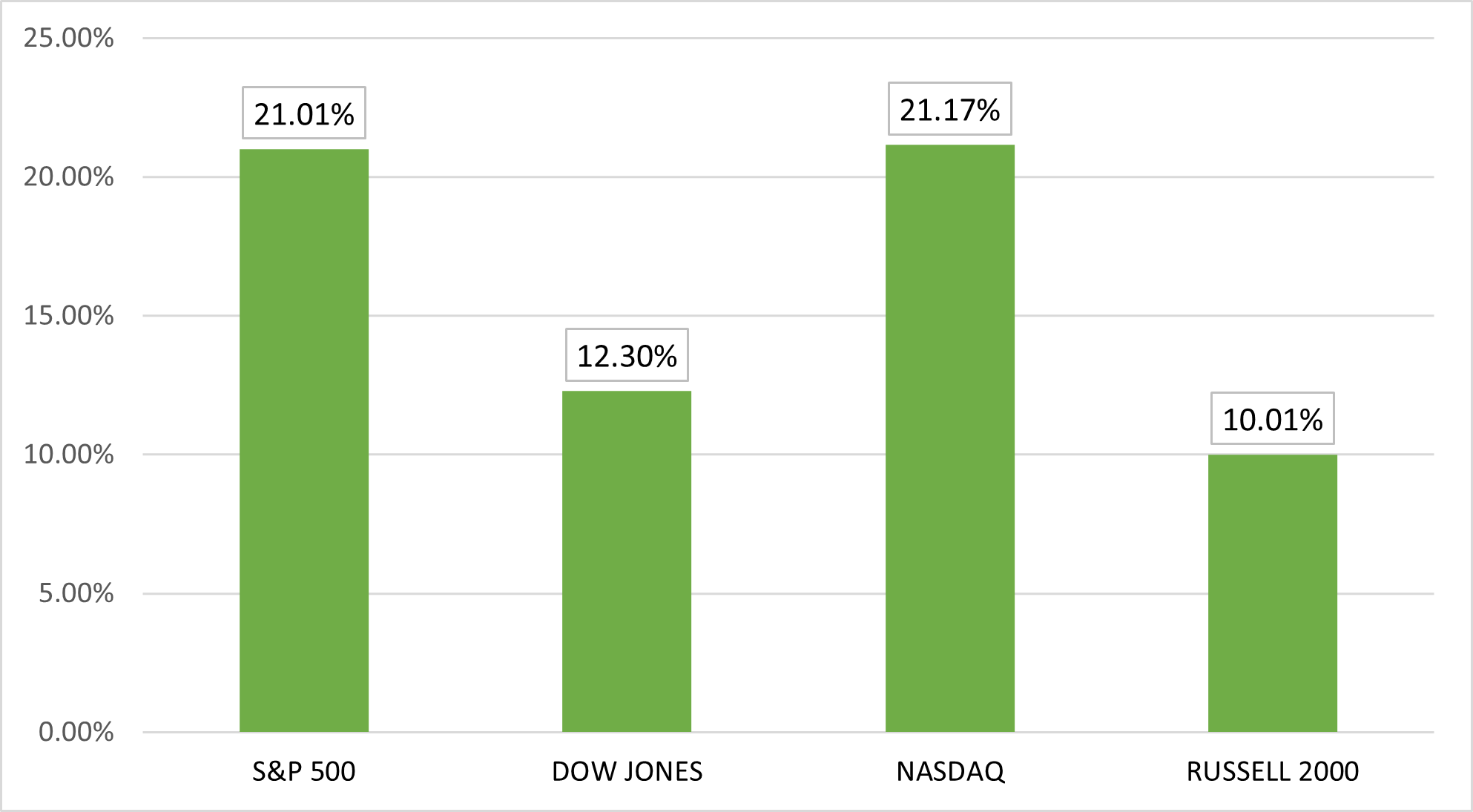
The fourth quarter of 2024 ended up strongly, with all four market indices advancing. The S&P 500 ended up 21% for 2024. Out of the twelve market sectors, ten ended up once again. Materials was the worst-performing sector (-0.87%) while the Communication Services sector performed the best (+45%).[1] The market indexes (Dow Jones, S&P 500, NASDAQ, & Russell 2000) ended as follows:[2]
Economic Overview
The 2024 economy was shaped by multiple factors, including post-pandemic recovery, inflationary pressures, geopolitical tensions, and rapid advancements in technology. This year was incredibly unique in many ways.
Q3’s strong market rally was dwarfed by the post-election rally in Q4. President Trump’s win on November 5th set the stock market on a rocket like trajectory. This overshadowed the Federal Reserve ambiguity, continuing geopolitical tensions, and economic slowing. The economy more broadly did not reflect this rally, but the rally is worth noting due to its massive nature.
The US was still by far the strongest economy in the world in 2024, and its lead is still growing. As I said in the Q3 update, the spending machine that keeps the US economy growing has continued to stunt an economic slowdown. Positive forces in the economy prevailed, but a gradual deceleration continued all year. Unemployment ticked up slightly and remains in a healthy range but is nearing “a little too high” levels. This is partly due to the chronic and continuing lack of population to keep competition in the US workforce. Overall, the economy is still in good shape, but there are some issues. The word that comes to mind for the economy in 2024 is stable. It wasn’t great and it wasn’t bad.
Here is the 2024 economic synopsis:
- GDP is forecasted to come in at 2.7% for 2024.[3] These numbers are annualized of course. Q1 GDP of 2024 was 2.9%, so the economy slowed slightly throughout 2024.
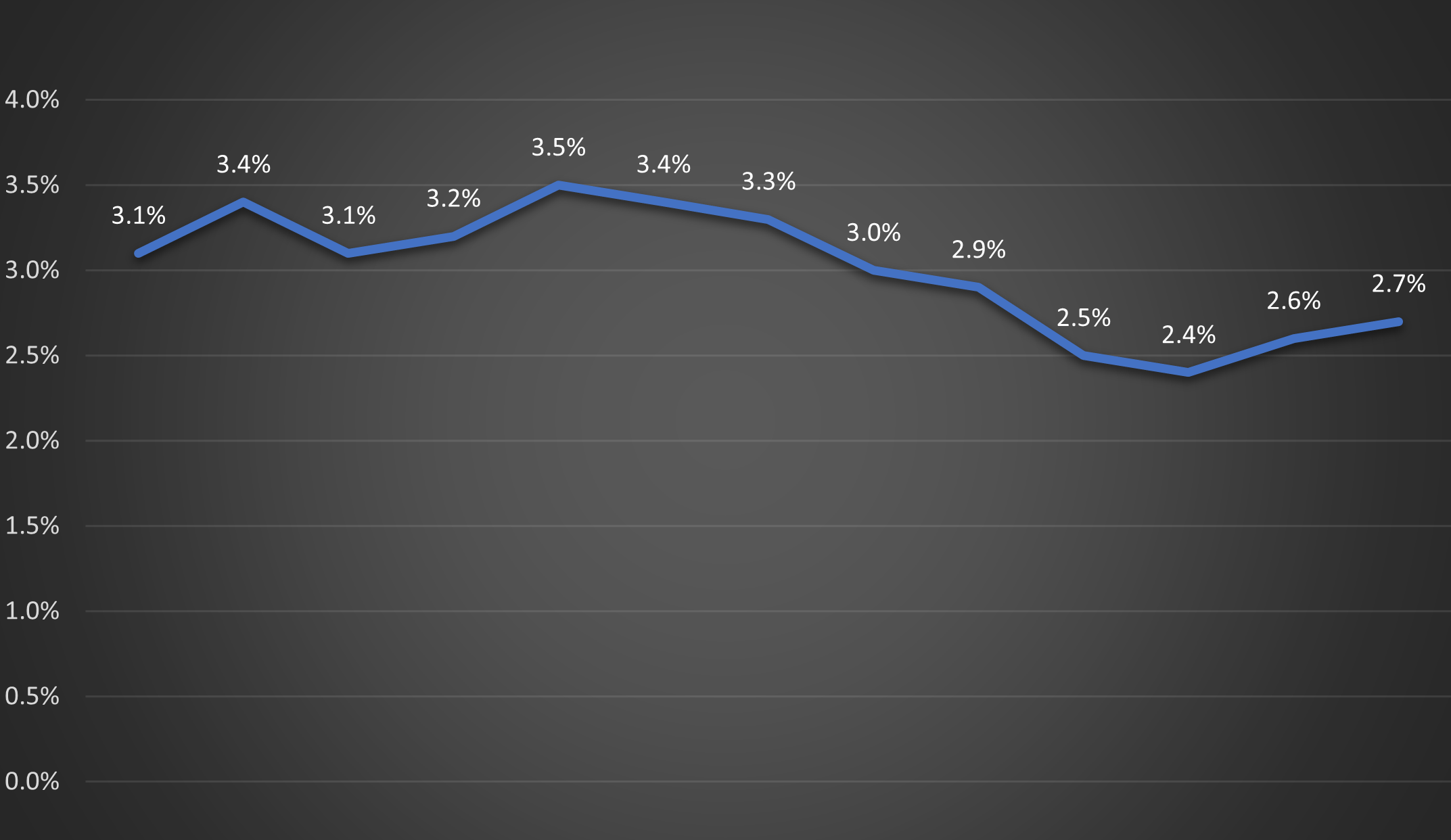
- Inflation, as of November 30th, stood at 2.7% year over year.[4]
- The Industrial Production Index increased slightly from 101.483 in January to 101.9621 in November.[5]
- The Unemployment Rate saw a slight uptick to 4.2% as of November.[6]
- 1,984,000 full time equivalent jobs were created from January – November 2024 according to projections.[7]
So, distilled down, this data is still positive, but all these data points started to slowly degrade throughout the year. Inflation is up slightly, unemployment is up slightly, and production is relatively flat.
Stubborn Inflation/The Fed’s Path Forward
Inflation has decreased from its major highs a couple years ago, but it still stands at 2.7%. This is above the Fed’s 2% target and problematically grew in 2024 instead of continuing to decrease toward that 2%. This is one of the reasons that economists believe that the Fed will not cut rates as many times in 2025 as initially excepted. As of 12/31/2024 the Federal Reserve Rate is 4.25% – 4.5%. The Fed will most likely cut twice in 2025 and then wait. Those that still are concerned with inflation above 2% are concerned that inflation will accelerate because of these cuts, but the Fed is in a very difficult position.
Let me reiterate the battle the Fed faces. Their mandate is to maximize employment and bring stability to pricing in the United States. The Federal Reserve cuts rates for two primary reasons under its Congressional mandate: either they anticipate a slowing economy or rising unemployment. Both of these things are happening, but there is an issue: inflation is rising.
While the markets celebrate the prospect of cheaper debt, it’s worth asking—why celebrate a move that signals an underlying issue? Even if the problem isn’t severe or widespread, it still exists. We will see if the cuts do more good than harm, but that is unlikely unfortunately. We will see what 2025 holds on this front.
Here is a chart of inflation over the last 12 months:
Immigration (H-1B Visa Debate)
One of the hot topics in the country remains immigration, even after the election. I have discussed these issues at length in the past, but one new development has occurred, a discussion of the merits of the H-1B visa program. The program, designed to attract skilled foreign workers to the United States, remains a hotly debated topic. Recent online discussions have focused on whether the program is achieving its goal of addressing labor shortages in specialized fields or if it inadvertently harms domestic workers by creating competition for jobs.
Supporters of the program argue that it fills critical gaps in the workforce, particularly in technology, healthcare, and engineering, where demand for highly skilled labor outpaces supply. The H-1B visa enables U.S. companies to recruit global talent, bolstering innovation and maintaining competitiveness on the world stage. Advocates also point to studies showing that these workers contribute to economic growth by helping businesses expand and invest in new technologies.
On the other hand, critics question whether the program is being misused by companies seeking to lower labor costs. They argue that some employers rely on H-1B visas to replace American workers with less expensive foreign labor, a practice that undermines the program’s original intent. Calls for increased oversight and reform to prevent abuse are gaining traction among those wary of its impact on the domestic job market.
As the debate intensifies, it’s worth considering that skilled immigration has historically been a driver of innovation and economic expansion in the United States. Rather than dismantling the H-1B program, addressing its shortcomings could balance the needs of American workers and businesses while preserving the country’s global leadership in critical industries. We already have too few workers; cutting off new workers could be a significant hinderance to future economic growth.
Policy Potential
After President Trump’s sizeable win in the November Presidential election, we need to look at the potential consequences (positive and negative) that could occur with the implementation of his economic and geopolitical agenda going forward. First, let’s look at the potential positives.
On the positive side, corporate and individual tax reductions could stimulate economic activity, encouraging investment and even more consumer spending. Businesses will experience growth due to reduced regulatory burdens, potentially boosting job creation and profitability. President Trump’s focus on reshoring manufacturing and securing favorable trade deals could help revitalize industries, reduce reliance on foreign supply chains, and support domestic production.
On the negative side, Large-scale tax cuts could increase the federal deficit, leading to long-term fiscal concerns. Protectionist trade policies, like tariffs, could lead to retaliatory measures from trading partners, potentially increasing costs for U.S. exporters and consumers. Remember that a tariff is simply another word for tax. Another challenge may arise in balancing short-term economic gains with sustainable growth. Such policies might prioritize immediate boosts to GDP at the expense of addressing structural issues.
Ultimately, the consequences of Trump’s economic agenda will depend on its implementation. President Trump is a pragmatist if nothing else, his first term demonstrated his ability to pivot when new data comes in. The consequences of the new policies are unknown, but they do have a good chance of succeeding. Let’s be patient and see what unfolds.
Energy Revolution
The discussion of energy typically follows along a political path, but for a moment, let us look at energy from a historical and technical perspective without any political involvement.
For thousands of years, mankind’s understanding of energy was limited to organic mechanisms, energy derived from the labor of people and livestock. That is why we still look at the power of an engine in terms of “horsepower.” This lasted all the way until the 1800s, when the machine came into vogue. This was when people found a way to channel a substance (i.e. running water, chemicals, even electricity) that was useless on its own into a source of energy outside of a living thing. Whether it be water running dams, coal power plants, electric cars, or diesel generators, people have been figuring out a way to transform matter into energy. This is what has run the world for over 150 years.
But, with new technology, mankind is entering the next stage of energy. This new energy will not come from expending a material (like a gasoline run engine) but in understanding and harvesting matter’s innate energy. The relatively new understanding that everything in the universe is made up of energy as well as matter has opened a new world of possibilities. Nuclear Fusion is the ultimate example, but don’t worry, I won’t get into the details of nuclear fusion in an economic update. Just know that nuclear fusion can generate approximately 4 million times more energy than burning oil or coal.
The third era of energy technology has arrived, this will lead to cheaper, more available energy for people all over the globe. With oil, coal, solar, wind, kinetic, geothermal, nuclear fission, and nuclear fusion energies all available to create power, the future of energy is brighter than ever.
If you would like to learn more about nuclear fusion, read this article:
https://www.iaea.org/newscenter/news/what-is-nuclear-fusion?utm
Artificial Intelligence
In 2024, one of the biggest societal and economic developments was the widespread adoption of artificial intelligence (AI). This marked a major change for both individuals and businesses, transforming how tasks are done, and problems are solved.
For businesses, AI brought new ways to improve efficiency and innovation. By automating repetitive tasks, employees can focus on more strategic and creative work, increasing productivity. AI-powered tools provided greater insights, helping companies make better decisions in areas like marketing, manufacturing, and supply chain management. Small businesses also benefited by using AI to streamline operations and compete with larger companies.
For individuals, AI makes daily life easier. Virtual assistants helped manage schedules, while AI-based tools improve learning, healthcare, and even personal finance. Creators gain access to advanced design and content tools, making technology more accessible to everyone. Just look at the adoption of ChatGPT as an example.
Although concerns remain about job loss and ethical issues, these challenges can be addressed with upskilling workers and a focus on AI creation in an ethical manner. Instead of replacing human work, AI can enhance it, creating opportunities for growth. The mainstream adoption of AI in 2024 is not just a technological shift but a benefit overall, especially in a country like the US where our workforce is not large enough to accommodate future economic growth.
The Markets Going Forward
With all the dynamics mentioned above, the next question, as always, is: what does it look like for the markets and economy going forward? Looking at all the elements above plus the continued wars and economic troubles abroad, opportunity is still the best word to describe where we are. The year was great for investors, and alright for the economy in general. Despite many issues, the economy is still in good shape overall.
All these items considered, here are the factors to watch for in 2025:
- Continued War in Ukraine & War in Israel
- Inflation Higher Than Expected
- The Trump Administration’s Agenda Being Enacted
- The Battle Between Unions and Artificial Intelligence
- Rising Tensions Between China and the United States
- Tax Policy Up in the Air
- Geopolitical Shakeups
All these factors still paint a picture of both issues and opportunities as I have said for years. Once again, no one knows what the future holds. The theme of uncertainty from 2023 remained through 2024, but that uncertainty should be looked at through the lens of hope and optimism. Remember that with a potential economic increase over the next few years, discipline and sticking to core investing principles is still the best strategy. We will see what is in store for 2025.
2 https://www.marketwatch.com/market-data
3 https://fred.stlouisfed.org/
4 https://data.bls.gov/pdq/SurveyOutputServlet
5 https://fred.stlouisfed.org/
6 https://fred.stlouisfed.org/
7 https://data.bls.gov/timeseries/CES0000000001&output_view=net_1mth
Article written by Jonathan Chamberlain of Chamberlain Financial Services, an Investment Advisor Representative, holding a Series 7 and Series 66 securities license.
Securities and advisory services offered through Sunbelt Securities, Inc. Member FINRA/SIPC. CPA and related accounting services offered through Chamberlain Financial Services are not associated with the services of Sunbelt Securities, Chamberlain Financial Services and Sunbelt Securities, Inc. are unaffiliated companies. Sunbelt Securities, Inc. does not provide tax or legal advice. Tax advice and preparation services are strictly offered by Neil Chamberlain, CPA.