
Items of Interest
- Taking the Bull by the Horns
- Banking Consolidation (A Temporary Solution)
- The Strength of Corporate America
- Spending It All
- Inflation / Stagflation
- Policy at Work
- The Federal Reserve (For Better or Worse)
- The Commercial Real Estate Market
- The Markets Going Forward
Market Overview
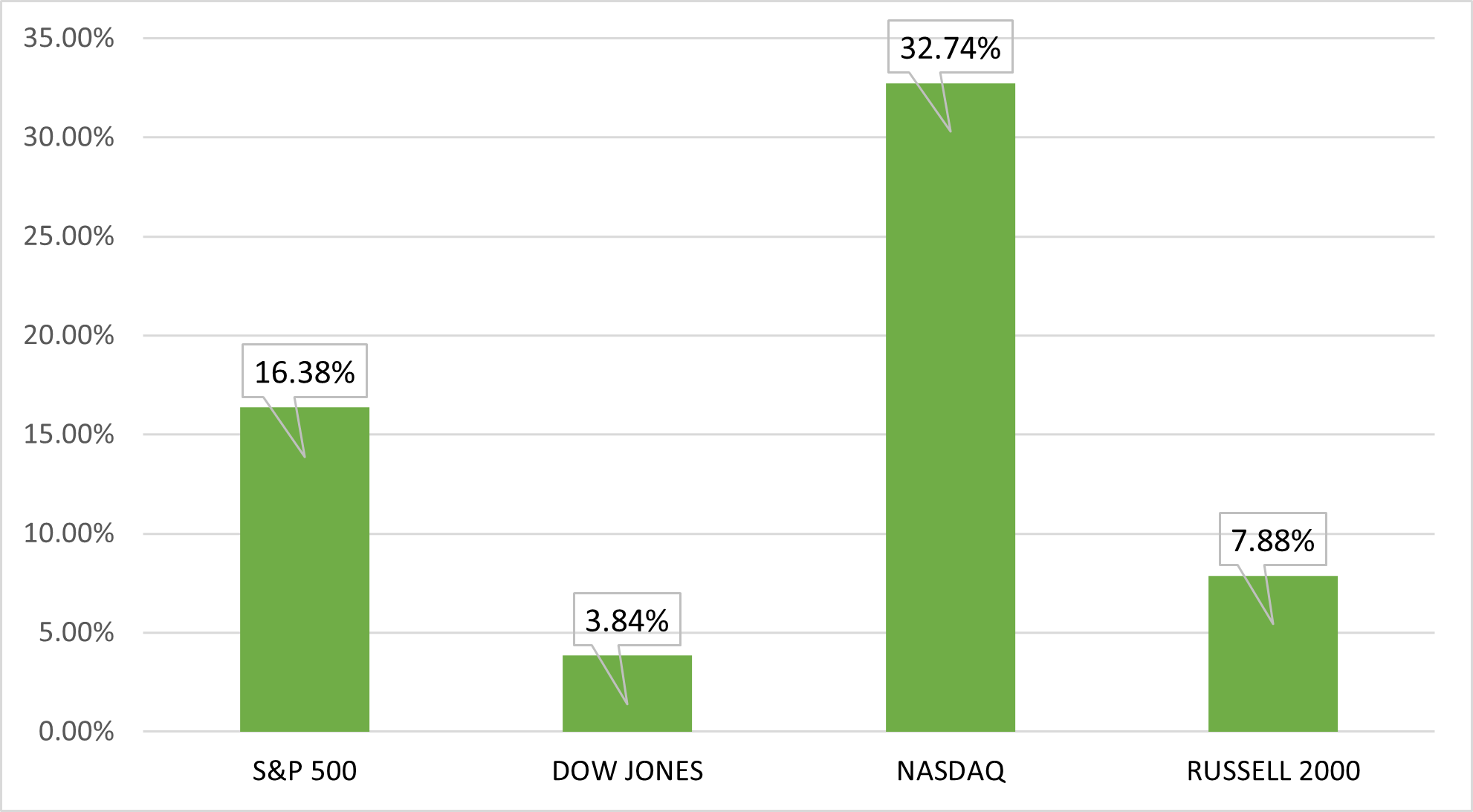
The second quarter of 2023 ended in gains across the board, with the S&P 500 up 7.66%. Nine out of the eleven market sectors ended up. The technology sector was once again the biggest gainer (20.33%) while the utilities sector performed the worst (-1.92%).[1] All of the four major indexes went up, with the NASDAQ far outpacing the rest once again due to its high concentration in technology. The market indexes (Dow Jones, S&P 500, NASDAQ, & Russell 2000) ended the second quarter as follows for the year[2]:
Market Performance Through the Second Quarter
Taking the Bull by the Horns
For the first time in 18 months, the market has begun to exhibit the signs that a bull market is returning. The NASDAQ had its best first half of the year in 40 years. As 2023 was taking shape in the first half, a lot of different economic and political information was finally digested by market traders. The number one thing that the market relies on is certainty. Even if the news is bad, the markets would rather know than not. So, as inflation continues its steady downward trajectory and employment remains high and earnings remain strong, some of the trillions of dollars that have been waiting in money markets are being invested. Simply put, now that most of the bad news is understood, if not resolved, people are comfortable putting their money back into the markets (or at least stocks they are comfortable with). This is why Apple, Microsoft, Nvidia, and other consistently performing tech stocks once again took the lead, just as they have for years. The old expression “dance with the one who brought you” seems to be the adage traders are using, at least for the first half of the year.
Banking Consolidation (A Temporary Solution)
As of the end of June, the banking issues in the United States are still mainly contained in the collapse or sale of Silicon Valley Bank, Signature Bank, and First Republic Bank. The immense strength of the big banks (especially JP Morgan) seems to be enough to absorb the blows the banking sector has experienced in 2023. Other regional banks will most likely have issues as the Federal Reserve continues to raise rates, but the prevailing sentiment is that a broad scale collapse will not occur. While we can’t be 100% sure, it seems the worst of the storm has passed. This assumption is one of the cornerstones of the tremendous market rally of the first half of this year. Also, the Federal Reserve has conducted their annual stress tests of the big banks, and all passed. This test is not comprehensive and has its issues, but it is a good overall picture. All the banks passing this test also increase optimism for the second half of 2023.
While it is long, I recommend reading the Federal Reserve Stress Test Results for a better understanding of the state of the United States Banking System. Here is a link[3]:
https://www.federalreserve.gov/publications/files/2023-dfast-results-20230628.pdf
The Strength of Corporate America
Besides the fact that the banking system remains stronger than expected, the other factor buoying up the US stock market is the surprising strength of Corporate America. Earnings have remained more elevated than expected, partially due to the stronger than expected middle class, the stabilization of energy costs, and the consolidation of business.
The term “Big Business” is commonly used in political circles, but it simply refers to large corporations that are big enough to have leverage or even pricing power. Due to the inflationary environment over the last couple of years, big business has only consolidated more. The larger a corporation, the lower its costs per unit of product sold. So, mergers and acquisitions have only gotten larger and more frequent recently. This leads to higher profits, making Wall Street stocks smaller in number, but more profitable. While it might not be the best thing for the economy in the long run, it is great for short term earnings. This trend will most likely continue, especially in the technology and healthcare sectors. This will help offset the economic stagflation (more on that in a bit) that we find ourselves in now. But, regardless of opinion, the profits of Corporate America are simply better and higher than anticipated. Without unforeseen shocks, this will most likely continue into the near future.
Spending It All
While Corporate America is trekking along doing better than expected, the average American has pretty much the same story to tell. While the political environment we are in tries to force us to believe that the economy is either the best in history or completely falling apart, both are simply not true. There are issues to be sure, but Americans saved trillions of dollars during the pandemic shutdowns and those savings still aren’t depleted. This, once again, is good for the short term economy. Here is some more positive data points:
- Credit card payment delinquencies are at the lowest they’ve been in 6 years.
- Mortgage delinquencies are the lowest they’ve been in 17 years and are still falling. This is partially due to the fact that around 37% of homes in the USA are paid for.
- Delinquency rates on loans overall are the lowest they’ve been in over 50 years.[4]
- Except for the pandemic peak, disposable income is the highest on record and still climbing.
These are just some of the reasons that the economy has remained resilient. However, when looking out toward the future a looming problem exists: American’s are going to spend their pandemic savings. People don’t learn lessons easily, and before we know it, the current spending spree with covid savings will be over. This will no doubt lead to decreased earnings if the government or Federal Reserve do not restart stimulus policies. This is an issue to keep an eye on, but in the short term, companies can benefit.
Inflation / Stagflation
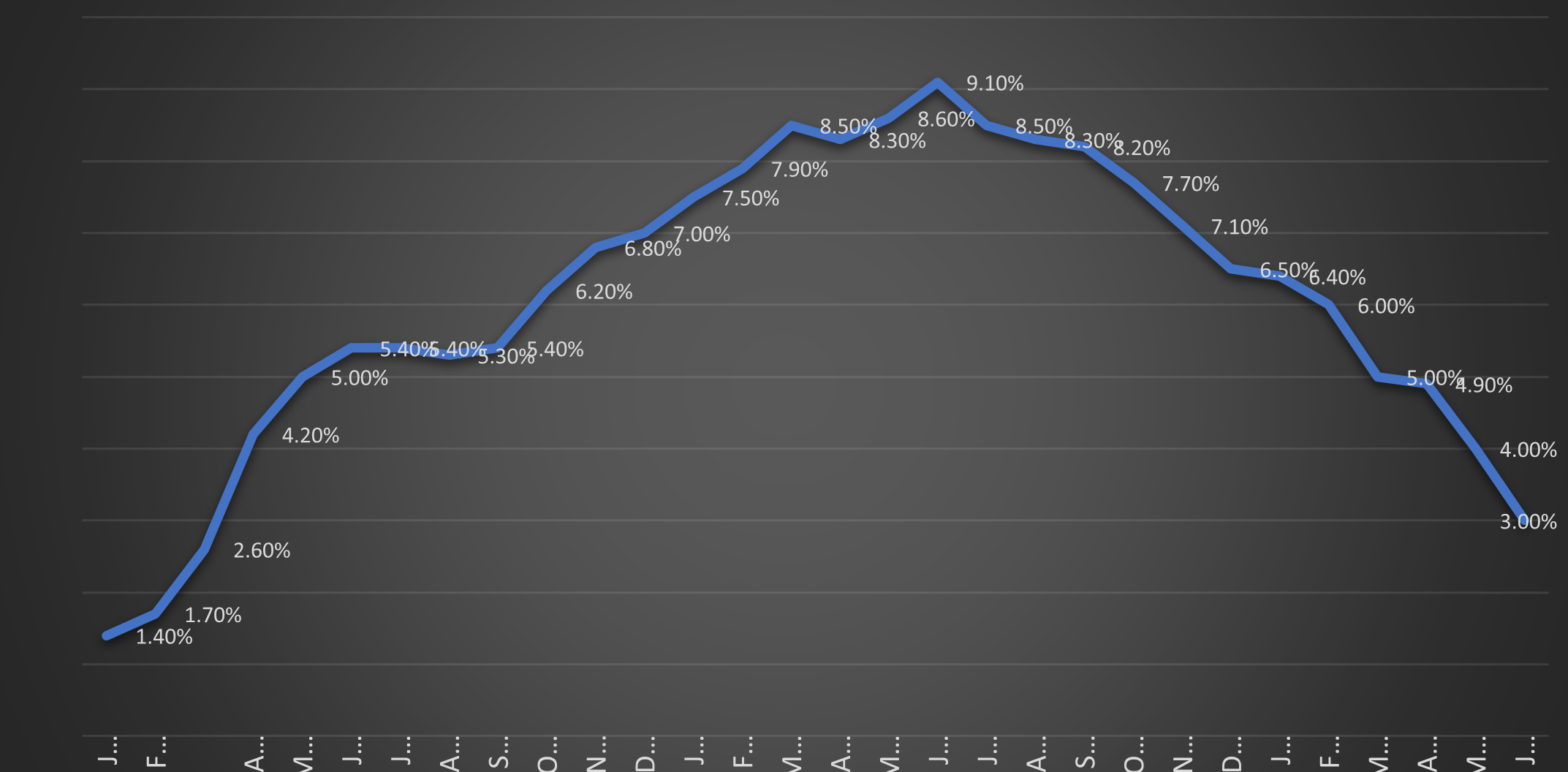
Inflation continued its decrease, and as of June, is now below the critical 4% level, coming in at 3%. If inflation continues to go down and can stay below 4%, then the hard work on inflation will have been done. 3-4% is still high, but with 2% being the long term goal of the Federal Reserve, they may feel the need to tighten the economy further. The current rates the Fed has set are more in line with historical averages than the extremely low rates of the last 15 years, but that doesn’t mean they won’t cause some problems.
So, if inflation remains around 3%, this will most likely cause very slight economic growth. I would call this stagflation; however, the traditional definition of stagflation requires high unemployment. But, if you count lower levels in the workforce artificially keeping unemployment down, then stagflation is an appropriate term for the conditions we face. Less than 2% growth and 3-4% plus inflation will lead to a prolonged period of stagnation. Stagflation is basically a timeout period for the economy. If this continues, then people and businesses will have to get creative when trying to grow. Stagflation seems to be becoming more likely than a recession at this point.
Here is a chart of annualized inflation from January 2021 to June 2023:
Policy at Work
There have been very few updates on the political front since Q1. A few more presidential candidates have gotten into the race, President Trump and President Biden both are in deep legal trouble, and the House is in turmoil over Republican infighting, but none of this is really new. Instead of going into detail on the political front this quarter, Let’s take a moment to set politics aside and review the economic policies the US has implemented over the last 15 years.
Regardless of party, the last three Presidents have all held fairly similar economic (not social) policy. This is due to the fact that all three are populists. This may be a strange idea at first, but populism is not a left or right ideology. Populism is an adjective that can be placed alongside many others (i.e. populist conservative, populist democrat). Populism, when boiled down to its core, is a political approach that emphasizes the interests and opinions of the common people. It presents itself as a response to the concerns of ordinary citizens who feel excluded or neglected by established political elites or institutions. Populist leaders are described as champions of their people and are characterized by an us versus them attitude. It has a strong emotional appeal.
Populist policies are affected by the underlying politicians political views, but it always ends in an increase in spending because the politicians simply want to help “The People.” Obamacare, covid stimulus checks, lower interest rates, etc. While the beneficiary of populism changes every presidential cycle (especially in the energy sector), it continues to grow government spending and increase the economy as a result. One example of this is the debt growth of the US government since 2007.
Here is a chart of US government debt growth:[5]
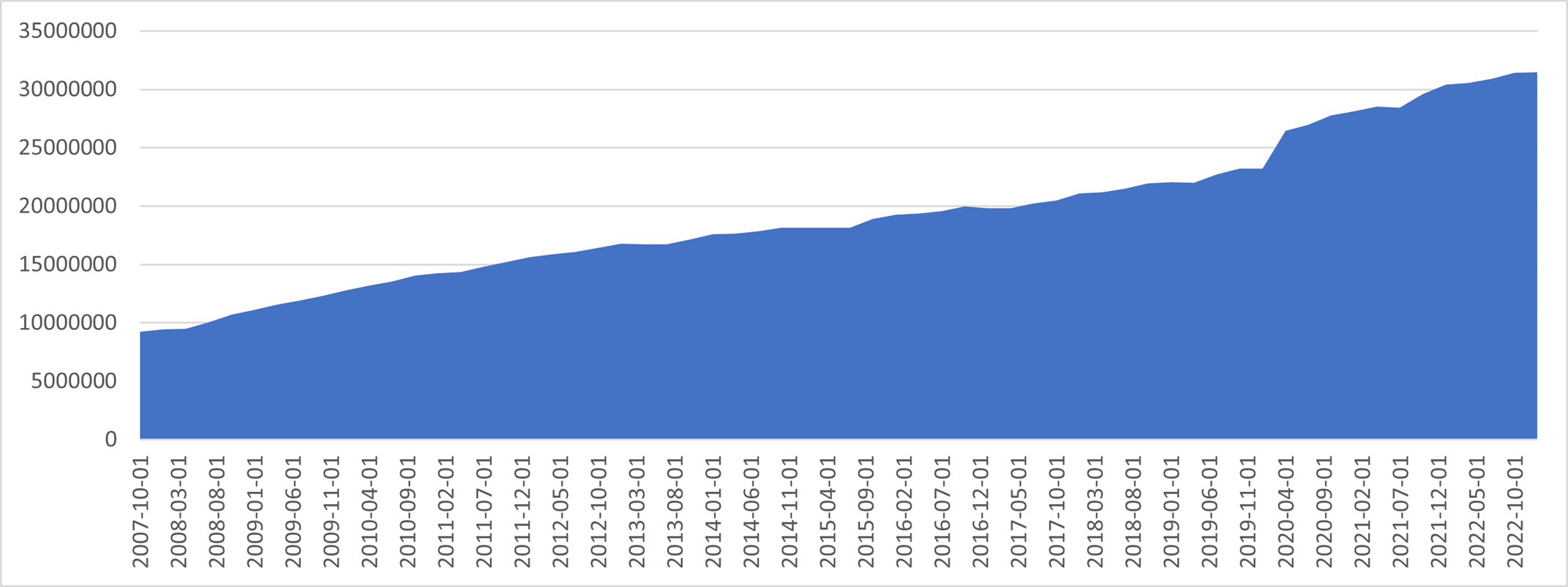
Note that debt and spending increases almost never slow down in this populist period. Combine this period with extremely low debt rates, and economic growth is almost inevitable because the cost of money is so low, especially for the wealthy.
So, without going on and on, let it suffice to say that the interesting, mixed economy we are in is not the result of any one president or congress’ policies or politics. This storm has been brewing since 2007. None of where we are is by accident and all of it can be accounted for by policy. So, who got us in this situation? Look at both sides of the isle. The path out of debt and back to fiscal policy leads away from populism, not to it. But in the current political environment, populism still rules both parties. It will be interesting if the next two years brings change or continuity.
The Federal Reserve (For Better or Worse)
The Federal Reserve has signaled that they are nearing the end of their rate hiking cycle. Some think they have .5% to go. Others think it might be up to 1%. But in any event, the end appears to be near. With employment remaining strong, unemployment at lows, and inflation still elevated, 1% seems more probable, but this is simply an educated guess. We are now far enough along in the rate cycle to begin to be able to start looking back and assessing the damage. The “inevitable” recession that many feared has yet to occur, other than the short recession last year.
We now look forward to the future. Over the next couple of years, many believe the Fed will cut rates back down to historically low levels like in 2020, but the Fed has signaled something far different. The Federal Reserve typically leaves rates alone when they are satisfied, and don’t move them until an economic event causes them to raise or lower. This means that the Fed will most likely leave rates frozen at whatever level they peak at until the economy changes for better or worse. So, unless something goes wrong, mortgages and other various loans will still remain more expensive.
The Commercial Real Estate Market
The housing market has held up through the thick and thin of the economic and interest rate issues we have faced over the last couple of years. The housing market has slowed, but that is positive for the long term health of the economy. The lack of housing has basically kept its thumb on the demand side of the housing market, and this does not seem like it will change anytime soon.
The main point of concern isn’t the residential housing market but rather the commercial real estate market. With many loans coming due to be refinanced in 2024 and 2025, banks with high commercial loan exposure are at risk of defaults in their commercial portfolios. This is because commercial real estate loan rates are much higher than they were 5, 10, or 15 years ago. The banks seem to have enough capital to handle the problem, but highly levered businesses with commercial loans to refinance will have trouble. Some bankruptcies could result. However, this shouldn’t be an issue for companies with high quality balance sheets. This problem is more of an interest rate problem than a credit quality problem. This issue is concerning but not a crisis at the moment. We must continue to watch this going forward.
The Markets Going Forward
So, taking all of these factors into account, what is the outlook for the stock market for the rest of 2023? Well, the factors to watch are pretty much the same as in Q1. However, many of these factors are getting better not worse. The invasion of Taiwan by China does seem to be off the table for the foreseeable future, so I have taken that factor off for now. Here are the factors to watch:
- Banking System Issues
- The Stickiness of 4-5% Inflation
- Issues with Commercial Real Estate.
- The Federal Reserve’s Precarious Path Forward
- Potential Recession
- Populist Policy Consequences
All of these factors still paint a fuzzy picture, but the situation is brightening. Will the markets end in gains? Are the October 2022 lows in the market the true bottom? I can’t say for sure, but the tide is turning and the time to start putting money back to work in the markets is finally here.
The overall picture for 2023 has gone from negative to neutral with a hint of positivity in the short term view. The best case scenario for the economy for 2023 has now gone from flat to a stagflationary small gain. A recession for the second half of the year is less likely but still possible. Once again, we will see. As I have said for the last year, companies with lower debt loads, great cash flow, high sales growth, and new opportunities all at once should do the best over the next few years. Last quarter’s analysis still rings true; the theme for 2023 is still uncertainty. One thing is sure; the one strategy that will pay off for the rest of 2023 is discipline.
2 https://www.marketwatch.com/market-data
3 https://www.federalreserve.gov/publications/files/2023-dfast-results-20230628.pdf
Article written by Jonathan Chamberlain of Chamberlain Financial Services an Investment Advisor Representative, holding a Series 7 and Series 66 securities license.
Securities and advisory services offered through Sunbelt Securities, Inc. Member FINRA/SIPC. CPA and related accounting services offered through Chamberlain Financial Services are not associated with the services of Sunbelt Securities, Chamberlain Financial Services and Sunbelt Securities, Inc. are unaffiliated companies. Sunbelt Securities, Inc. does not provide tax or legal advice. Tax advice and preparation services are strictly offered by Neil Chamberlain, CPA.