
Items of Interest
- Tech Soared
- No Recession
- Falling Energy Prices
- Christmas Spending Cheer
- Rates at Their Peak?
- The Federal Reserve (A New Approach)
- New Year Real Estate Rates
- The Markets Going Forward
Market Overview
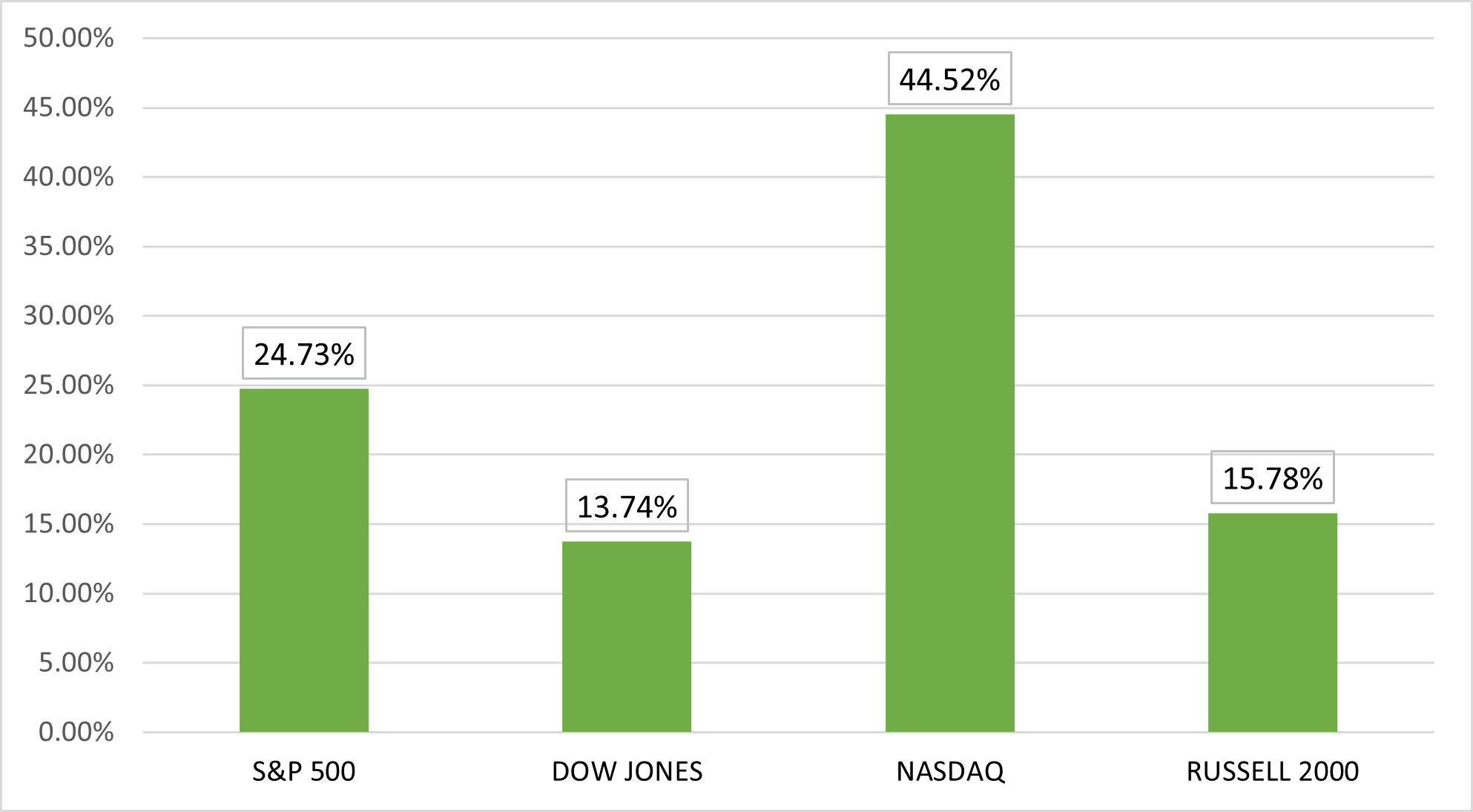
The fourth quarter of 2023 ended with a strong rally across the board, with the S&P 500 ending up 24.23% for the year. Out of the eleven market sectors, eight ended up, while the three that declined for the year were down by only single digits. Technology was the best-performing sector by far (up 52%) while the utilities sector performed the worst once again (-8.96%).[1] All of the four major indexes went up, with the NASDAQ ending by far the highest. The market indexes (Dow Jones, S&P 500, NASDAQ, & Russell 2000) ended 2023 as follows[2]:
Market Performance
Tech Soared
The year ended well as far as the broader market is concerned. The switch to dividends, a concentration in quality, and a broad disregard for growth was somewhat exchanged for a return to the sentiments held over the last decade. The magnificent seven (Apple, Amazon, Alphabet, Meta, Microsoft, Nvidia, & Tesla) were responsible for most of the market gains as they have been for the past few years. This is evidenced by the relative outperformance of the NASDAQ (which is tech centric) compared to the other indexes. While tech returning atop the leaderboard is not especially surprising, there was and still is an emphasis on the quality of the tech companies. This is the reason the high quality tech companies of the past continued to dominate in 2023.
Also, with the high interest rates that continued through 2023, the larger and more cash rich companies benefited, which is another reason that large cap tech soared. Leveled out inflation, the seeming end of interest rate hikes, and better than expected economic growth, set the stage for the year we just had. All the market bears and those preaching a coming recession were not correct after all. The traditional autumn decline that took place in Q3 was no match for the extensive Santa Clause rally that ended the year with a bang. Even with treasury rates remaining the highest in a decade, and a short banking crisis in Q1, 2023 was a great year for financial markets and the economy overall.
No Recession
The much-hyped recession of 2023 did not occur. In fact, the economy continued to accelerate. What I said last quarter about people now spending until there is nothing left to spend continued to be true, with Q3 GDP clocking in at just shy of 5%.[3] Black Friday alone indicates Q4 GDP shouldn’t be bad either. The economy, jobs market, stock market, and overall financial system exhibited surprising resilience, bolstered by the prior stimulus. The rate hikes of the last 2 years still were not enough to take down the economy as many feared. Part of the reason for this is that wage growth has remained higher than normal for the last couple of years. This has mitigated the effects of inflation for the average consumer.
Falling Energy Prices
The high-energy prices that defined 2022 significantly fell throughout 2023. For example, the average price of a gallon of gasoline in the United States was $4.8 in June of 2022, $3.15 in December 2022, $3.45 in June 2023, and had fallen to $2.97[4] By the end of 2023. Once the effects of the Russia Ukraine war began to wane and US oil production rose to all-time highs, prices began to moderate as supply and demand came into balance once again. This price reduction is one of the main reasons that inflation has fallen below 4% and real wage growth (wages growing faster than inflation) is the highest in over 25 years.[5] Aside from a new global political crisis occurring, the relative energy stability should follow us into 2024.
Christmas Spending Cheer
As I said in Q3’s update, one of the most important pieces of data that would tell the strength of the consumer going forward was the spending data from Black Friday through Cyber Monday. These numbers came through at all-time highs, with over $221,800,000,000 expected in holiday season sales.[6] These numbers were tremendous, even though the number of buy now pay later sales were high. These numbers confirm the point, once again, that the K shaped economic growth continues, with the middle class and up doing quite well, while the lower class continues to struggle. Remember that a K-shaped recovery occurs when different parts of the economy recover at different rates, times, or degrees.
As predicted, the high spending numbers propelled a sharp market rally in Q4. Q4 consumer numbers (illustrated by Christmas shopping) showed that the consumer fared much better in 2023 than initial estimates suggested. This bodes well for 2024.
Rates at Their Peak?
One of the most dominant stories in the markets was the role of the Federal Reserve. This is nothing new since 2022 was also defined by the Federal Reserve’s rate hikes. The rates stayed steady through Q4 at 5.25-5.5%. Federal Reserve Chair Jerome Powell has indicated that the Fed is open to cuts in 2024, but nothing is guaranteed. These rate cuts may not happen at all if the current economic acceleration continues and inflation doesn’t fall below the Fed’s 2% target. After ten years of historically low interest rates, the Fed raising rates to their current levels may have seemed dramatic (especially to home buyers), but rates are closer to their longer term historical averages. So, when will the Fed start to cut? That is the question on the minds of every investor and home buyer alike. The answer may end up being more nuanced than we originally thought.
As I have mentioned in previous updates, the Federal Reserve has been both raising rates and engaging in quantitative tightening. With quantitative tightening having an even greater effect than rate hikes/cuts, it is possible that toward the back half of the year, the Fed may ease in to loosening conditions by both continuing quantitative tightening and lowering rates. This would have an effect closer to neutral while giving home buyers lower rates. This would allow the Fed to chew gum and walk at the same time by reducing their expanded balance sheet and lower rates for the consumer and small businesses. I’m not saying this is what they will do, it is simply a possibility due to the hesitancy of Chair Powell to lower rates for fear of another spike in inflation. In any case, unless a sudden spike in inflation occurs, the Federal Reserve is indicating that rates are peaking for this rate cycle.
The Federal Reserve (A New Approach)
Let’s back up for a moment from the details of the rate hikes and cuts to the 30,000 foot perspective. What is the Fed doing when it is moving the interest rates? It is changing the cost of borrowing money. At its core, borrowing money is a way to possess something that you do not own. So, as we look back at the last 10-15 years, the low interest rate environment caused something that I believe can be called fabricated success. If a business or an individual cannot afford the same item simply due to an interest rate change (not a principal change), then that item is too expensive. For example, if a home with a 3% interest rate is 25% of household income (a typical measure of housing affordability) and is suddenly over 30% of income with a rate increase, then the home was too expensive to begin with. This is not a popular opinion, with the rise of channels like HGTV and the swell of real estate investors flooding TikTok; however, what a person or business can afford should not ride the line of disaster. The key word is margin.
It took 11 hikes over 2 years to reach the average rates we have now. The result is more expensive debt, but more money in savers pockets. I am not suggesting that high rates are always a good thing, but rates at their current level are only preventative for those wishing to borrow too much. If the Fed leaves rates where they are or lowers slightly, a long-term trend in rates will be restored, and growth will not be propped up by relatively free debt. Debt carries risk, and higher interest rates help reflect that reality and bring soberness to an economy overheated by debt. Hopefully this new normal will restore that key word to the economy: soberness.
The New Year Real Estate Rates
The time is fast approaching when we will find out whether the commercial interest rate issues predicted in 2023 come to fruition in 2024. The residential real estate market has been upheld due to a lack of supply, but the commercial real estate market is seeing some issues. The good news here is that these issues are regional and do not affect the whole country equally. For example, multifamily and retail real estate does not show as many signs of cracking as commercial (especially office spaces). This means that any increase in defaults will hopefully be contained to this sector and hopefully the excess profits the banks made in 2023 will result in an even bigger decrease in defaults and repossessions. Things are looking better than expected at this point, but commercial real estate remains a significant risk for the first half of 2024.
The Markets Going Forward
Well, in all honesty, the economy and stock market turned out to be much stronger in 2023 than most anticipated. The market’s resilience and adaptability stood out as the year progressed. 2023 hands 2024 a good economy, with some issues to be sure. But good wage growth, GDP growth, low unemployment, and lowering inflation is a good mix of economic conditions. There is certainly negative information, but companies with good balance sheets and growth have a tremendous opportunity in 2024 to capitalize on the growth from 2023.
Here are the factors to watch in the year to come:
- Continued Wars in Ukraine and Israel
- Inflation in the 2%-4% Range
- Potential Issues with Commercial Real Estate
- The Federal Reserve’s Path Forward
- A Tumultuous Presidential Election Cycle
- A Potential Invasion of Taiwan by China
All of these factors paint a picture of both issues and big opportunities. But it appears that, while no one knows for sure, the markets have a great opportunity for growth in 2024. The overall picture for 2024 has gone from neutral to positive in the short to medium term view. As I have said for the last year, companies with lower debt loads, great cash flow, high sales growth, and new opportunities all at once should do the best over the next few years. The theme for 2023 was uncertainty, but the theme for 2024 seems to be opportunity. One thing is sure; the one strategy that will pay off for 2024 is the same one that worked in 2023: discipline.
Article written by Jonathan Chamberlin of Chamberlin Financial Services an Investment Advisor Representative, holding a Series 7 and Series 66 securities license.
1 https://eresearch.fidelity.com/eresearch/markets_sectors/sectors/si_performance.jhtml?tab=siperformance
2 https://www.marketwatch.com/market-data
3 https://www.bea.gov/news/2023/gross-domestic-product-third-estimate-corporate-profits-revised-estimate-and-gdp#:~:text=Real%20gross%20domestic%20product%20(GDP,real%20GDP%20increased%202.1%20percent.
4 https://fred.stlouisfed.org/series/GASREGCOVW
5 Fred.stlouisfed.org/series/FRBATLWGTUMHWGO
6 https://www.forbes.com/sites/shelleykohan/2023/11/30/black-friday-and-cyber-monday-record-sales-by-the-numbers/?sh=75904eedaba2
Securities and advisory services offered through Sunbelt Securities, Inc. Member FINRA/SIPC. CPA and related accounting services offered through Chamberlain Financial Services are not associated with the services of Sunbelt Securities, Chamberlain Financial Services and Sunbelt Securities, Inc. are unaffiliated companies. Sunbelt Securities, Inc. does not provide tax or legal advice. Tax advice and preparation services are strictly offered by Neil Chamberlain, CPA.